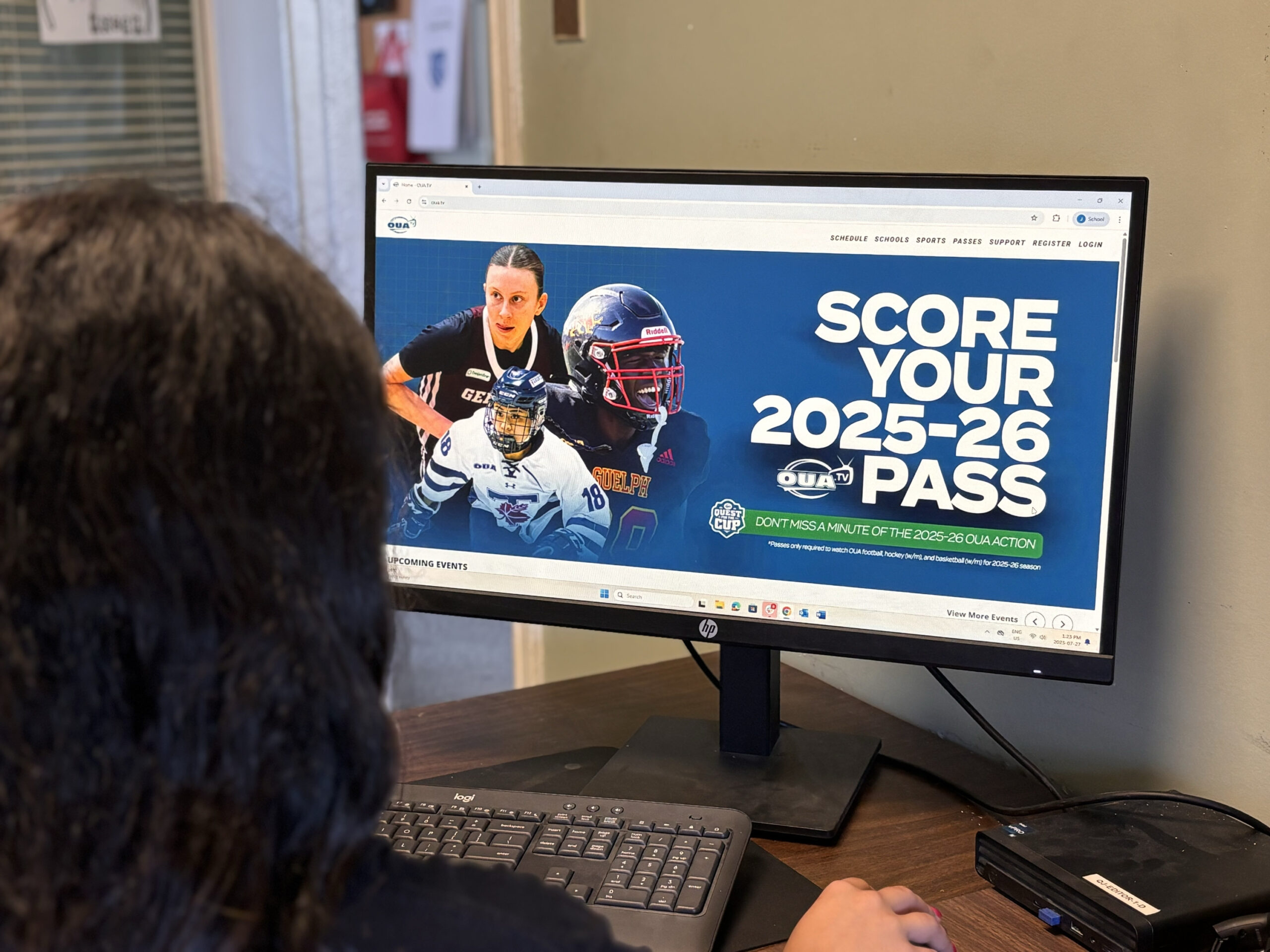
A new paywall to watch select Ontario University sports is drawing backlash across the province from fans, families, and broadcasters.
Starting this fall, OUA.tv will no longer be free for fans of football, hockey, and basketball with the introduction of subscription fees for live and on-demand broadcasts of its top sports.
Since launching in 2014, OUA.tv has served as the primary streaming platform for Ontario University Athletics (OUA) sports, offering free access that kept fans, families, and alumni connected with their teams. This season, that accessibility comes to an end, marking a major pivot and significant shift toward a revenue-driven model as the platform introduces its first-ever paywall.
The new revenue-driven model for the streaming service includes a full-season all-access pass for $89.99, sport-specific passes for $39.99, and single-game options for $8.99. Other sports will remain free with a registered account.
In a press release, OUA officials stated that the shift towards a revenue-driven model is meant to “make streaming sustainable” and to “improve production quality”. With over 1,400 events streamed each season, the added revenue is expected to strengthen the overall experience for athletes and fans, according to OUA officials.
While the OUA’s rationale in adding a paywall emphasizes long-term benefits and a fair investment in coverage—but for the university sports community, the addition of a subscription feels counterproductive, with some fans soliciting negative reactions.
Concerns mainly revolve around the potential decline in casual viewership, making it harder for fans, families, student-athletes, and aspiring sports media professionals to stay connected and support Ontario’s collegiate sporting landscape.
Among those concerned is Radio Laurier 2024 Broadcaster of the Year, and Wilfred Laurier University’s (WLU) Marketing and Promotions Award of Excellence in 2025 as an In-Game Host, WLU student broadcaster, Matteo Beckles—who has been open about concerns about the added barriers for student broadcasters.
“A lot of student broadcasters always want to go back and hear what their calls are like and see what they can improve upon,” Beckles said in an interview with The Journal. “Now, they have a significant paywall just to watch the product. Under the old model, you could watch games for free for 24 hours [but] now, student broadcasters have to pay just to review their own work.”
Beckles also raised concerns about how the subscription fee adversely affects families and supporters. “Most of the people watching OUA games are families of the athletes,” he said. “Adding a paywall reduces the number of families who can tune in. It’s not growing the sport.”
Similar sentiments regarding concern over the paywall’s decrease in accessibility are shared by York University women’s hockey commentator, Kyle Cushman. “Canadian university sports should be more accessible, not less,” Cushman said in an interview with The Journal.
He feels that the subscription fee is just another strain on families, and questions whether many non-family members would splurge on the subscription—something Cushman isn’t alone in stating.
“U SPORTS is supposed to be about growing Canadian sports and removing barriers so people can watch and support Canadian athletes,” Beckles said.
Both Beckles and Cushman agree that the paywall must be accompanied by significant improvements in production quality, but a lack of clarity in the OUA’s press release regarding revenue allocations is keeping viewers in the dark.
“The quality of most broadcasts has to improve significantly to be worth a subscription,” said Cushman. “I wonder how [funding will] actually manifest itself, when it often feels like it’s up to the school to decide how much they want to invest in broadcasts in the first place,” Beckles said.
The OUA’s decision to target hockey, basketball, and football, leaves Beckles also wondering if the OUA would keep the paywalls restricted to those sports, or if they will be used as test runs to install the paywall model on other sports—especially as other conferences in Canada have already adopted broader subscription models.
Subscription-based streaming models aren’t unprecedented. In recent years, Canada West and Atlantic University Sport (AUS) have switched to similar paywall models. Canada West offers all-access passes for as low as $94.99, while individual sports options cost $34.99. AUS offers their all-access passes for $99.99, while sport-specific passes cost $39.99. Canada West has used the model for over a decade, but the AUS only made the switch last year.
While other conferences charge similar prices, their paywalls also cover sports like soccer, rugby, and volleyball, raising concerns that paywalls could soon extend beyond just football, hockey, and basketball.
In addition to the paywall, a new OUA.tv mobile app is expected to launch this fall, with a subscription pass required to watch select sports on the app. The OUA claimed in a press release that the app will improve the viewing experience for fans across devices.
Subscription passes for the 2025-26 season are now available on the OUA.tv webpage, as the league prepares to roll out its new digital experience this fall.
All final editorial decisions are made by the Editor(s) in Chief and/or the Managing Editor. Authors should not be contacted, targeted, or harassed under any circumstances. If you have any grievances with this article, please direct your comments to eic@queensjournal.ca.