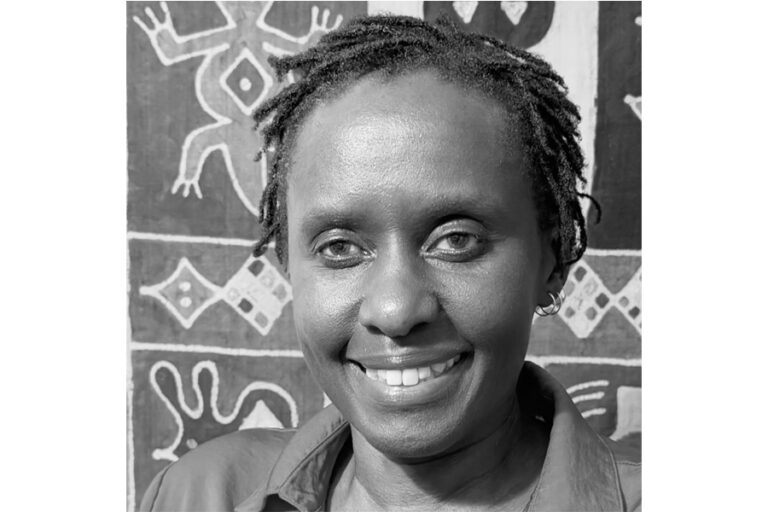
A prominent Queen’s storyteller is in the spotlight on this year’s Giller Prize longlist.
On Sept. 15, the 2025 Giller Prize jury named 14 Canadian fiction authors to its $100,000 longlist, including Otoniya Juliane Okot Bitek for We, the Kindling. A Black Studies professor at Queen’s, Okot Bitek will speak about the novel at the 2025 Kingston WritersFest on Sept. 19. In an interview with The Journal, she reflected on the honour and the dedication to storytelling behind the book.
Stories can be tricky to tell if they “can’t be proven,” Okot Bitek said. This was a central question she had when approaching transcripts, recordings, and life stories of survivors of the Lord’s Resistance Army in Northern Uganda. We, the Kindling is a fictional account based on the lived experiences of women who survived capture during the war between the Lord’s Resistance Army and the Ugandan government.
Originally submitted the book for publication in 2011 as a work of creative nonfiction, Okot Bitek explains how crucial details missing from source materials made telling the story in this way a challenge. “I quickly realized the limitations of creating nonfiction,” she said.
Okot Bitek turned to tradition for storytelling tools. “I come from a rich storytelling tradition.” Her people, the Acholi, are an ethnolinguistic group primarily residing in Northern Africa, for whom myths and folklore are a large part of culture. Okot Bitek’s father, Okot p’Bitek, published a book of Acholi folklore titled Hare and Hornbill.
For Okot Bitek, including folklore in We, The Kindling was part of the novel’s larger tapestry of written devices used to capture the story’s full scope.
“It seemed to me that fiction was a much easier place from which [to] tell a more complete truth,” Okot Bitek said. She used poetic devices, like myths, lists, and vignettes, to complete this truth. “I’ve been writing poetry for a long time, and I think of myself as a poet a lot,” Okot Bitek said. “I used everything I could to try and tell the story.”
Okot Bitek stresses the reflective nature of poetry, making prose fiction the better choice for writing We, The Kindling. In her poetry collection 100 Days about the ’94 Rwandan genocide, “I wasn’t telling other people’s stories—I was doing a reflection,” Otok Bitek said.
We, The Kindling were different. “The goal of telling [the story] was to say it was a terrible thing. People suffered. People still suffer,” Okot Bitek said. “I needed to use the tools of fiction to invite the reader in and keep them there.”
Writing stories about other human beings requires writers to “care for the reader,” Otok Bitek said. “I can’t just be caring for the women’s stories; I have to care for the reader who I want to stay with me through the whole book.”
Finishing the novel became about honouring the past and the future. Okot Bitek chose to begin We, The Kindling in the present day, so readers know the protagonists survived capture.
“You think about the agency of the women who are telling the story so that they are more than what happened to them,” Okot Bitek said. Grounding the story in the present day means survivors “have a future beyond what happened to them,” she said. “I wanted to write a story they could stand next to and say, ‘This is a fair representation.’”
When asked if she anticipated literary recognition of We, The Kindling, such as the Giller Prize longlist, Okot Bitek laughed. “If you’re writing for a prize, you’ll be writing a long time,” she said.
Tags
Fiction, Giller Prize, Literature, We The Kindling, WritersFest, writing
All final editorial decisions are made by the Editor(s) in Chief and/or the Managing Editor. Authors should not be contacted, targeted, or harassed under any circumstances. If you have any grievances with this article, please direct your comments to eic@queensjournal.ca.