
Some questions are meant to be answered, though not everyone is ready to take the call. Perhaps, however, one student leader was.
While applying for the Laurier Scholars Award in Grade 12, Ruth Osunde, ArtSci ’26, didn’t know that one question on the application would stay with her for years. Although she was waitlisted, the question stood out: it asked applicants to imagine a project rooted in the United Nations Sustainable Development Goals (SDGs).
The Laurier Scholars Award provides recipients with $40,000 toward their education, including $10,000 dedicated to experiential learning, supporting opportunities such as a summer research assistantship, an international exchange, or other hands-on learning experiences beyond the classroom. For Osunde, that question sparked an idea that would later become much more than a theoretical exercise.
Now, four years later, Osunde, former AMS vice-president (university affairs), turned the idea she first envisioned on paper into action. She founded ‘AmeIyoba,’ an official nonprofit grounded in “advocacy, healing, and the radical empowerment of women and children across borders.” Its name, drawn from the Benin language, means “the well a queen drinks from,” symbolizing a source of strength and opportunity.
Growing up in Nigeria, Osunde witnessed firsthand how women often must fight for respect or a space to make impactful work. “Even with strides toward gender equality, we’re so far behind,” she said, pointing to recent setbacks in reproductive rights in the United States as an example. These experiences shaped her vision for ‘AmeIyoba’, which is built on three guiding principles aligned with the United Nations’ SDGs: SDG 3 Good Health and Well-Being ,SDG 4, Quality Education, and SDG 5 Gender Equality.
To put these goals into action, the foundation launched the ‘Rising Series’, a back-to-school pilot program aimed at increasing access to early childhood education in Lagos, Nigeria and focused on SD4. “It’s a Small, community-led effort focused on supporting children with basic school supplies and light snacks as they return to school, while also learning directly from families what meaningful education support actually looks like,” the Instagram caption explained.
“For us, this is about starting carefully, listening closely, documenting what we learn, and building future child-focused programs that are shaped by the people they’re meant to serve.”
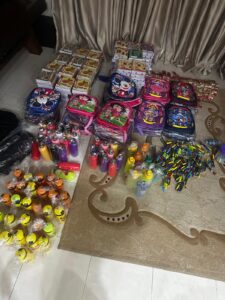
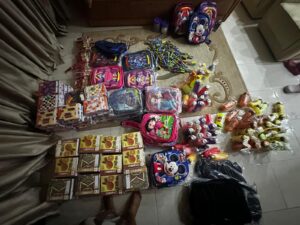
Her determination to bring the project to life was solidified during a church service, when two moments hit her deeply: first, witnessing a young girl sobbing because she couldn’t afford her school fees, and later, seeing people lying on the ground outside the church in front of wealthy houses and expensive cars. The stark contrast in wealth and opportunities drove her to act on her idea.
“That was the push that I needed,” she recalled in an interview with The Journal. In April, she officially incorporated ‘AmeIyoba’ in Canada, dedicating herself to laying the foundation for the organization.
Osunde also emphasized the importance of involving communities in decision-making, aiming to avoid the pitfalls of foreign aid that often disempower local communities. “One thing that we want to do differently with AmeIyoba is to prioritize voices of the community. Very often, when it comes to foreign aid, what happens is that the aid destabilizes the way of life for the people who exist there,” Osunde said.
“What we see is a white saviour complex that exists in Western society or Western entities coming into a space. And obviously, the original intent is good. I’m not going to say that it’s always bad. But what they do is they make them [the communities they are trying to help] dependent on their way of life, which destabilizes how these people have always worked,” she added.
Funding the initiative was challenging. Osunde relied on a mix of personal savings and donations from friends and family, some of whom gave their last dollars to support the cause. Reflecting on this, she said, “People think that when they want to do something, they need to do it big. But what this showed me was that even the smallest thing goes a long way.”
Yet for Osunde, success isn’t just about numbers; it’s about lasting impact.
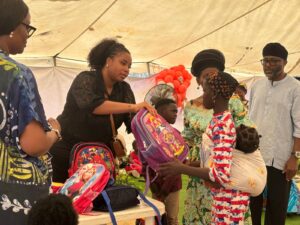
She ties her philosophy to her grandmother’s saying: “You can bring a horse to the river, but you can’t force it to drink.” Beyond immediate support like backpacks or school supplies, she’s focused on sustainable outcomes: ensuring children stay in school and women gain access to resources to start businesses.
Osunde shared an early access story from the Rising Series: one girl, two years ahead of her class, whose intelligence and enthusiasm inspired Osunde’s father to fund her tuition and track her progress through school records. For Osunde, being able to ensure she will continue her education is the truest measure of success.
“AmeIyoba is that dream made tangible—a nonprofit grounded in advocacy, healing, and the radical empowerment of women and children across borders.”
Tags
All final editorial decisions are made by the Editor(s) in Chief and/or the Managing Editor. Authors should not be contacted, targeted, or harassed under any circumstances. If you have any grievances with this article, please direct your comments to eic@queensjournal.ca.