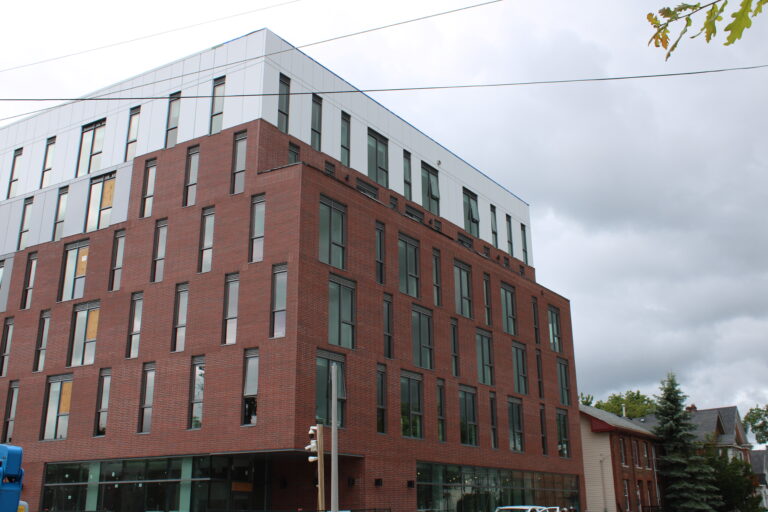
Student housing around Queen’s is going vertical.
Off-campus student housing has traditionally consisted of multi-unit detached homes and low-rise apartment buildings in the University District. Yet, a wave of new purpose-built student accommodation (PBSA) could change that.
The Hive, a six-storey, 120-bed building at 390 Johnson St., built by Canadian developer Amber Peak is among several PBSA projects opening in September. Municipal planning and zoning changes in 2024 have allowed greater density near campus, while broader financing programs and tax incentives have made rental development more attractive.
Even larger projects are in the pipeline.
Cedar Podium’s 283 Queen, a 15-storey residence with 389 bedrooms, is scheduled to open in September 2027. The Canadian PBSA investment firm has invested $1.5 billion across 19,000 beds, including more than 39 completed buildings and seven under development.
Campus Suites has proposed a 16-storey, 612-bedroom residence on Clergy St. between Princess and Queen streets. Fitzrovia is seeking to build another 800 bedrooms in two 10-storey buildings at 525 and 555 Princess St.
The activity reflects a broader provincewide trend. In its Spring 2026 PBSA report, real estate research firm Urbanation Inc. recorded eight Ontario PBSA transactions worth $475 million between May 2024 and May 2026. The province is expected to add a record 6,313 new student-housing beds this year.
Nick Revington, a professor at Montreal’s Institut national de la recherche scientifique who studies housing and young adults, spoke in an interview with The Journal about how Canada’s PBSA market has expanded over the past decade.
“The simplest definition [of PBSA] is that it’s development oriented toward students,” Revington said, which includes university residences. What distinguishes PBSA from other rentals is the population it is designed and marketed towards.
Buildings often feature amenities that developers believe students want, including furnished bedrooms, en-suite bathrooms, event spaces, gyms, and on the higher end, swimming pools.
For students, much of the appeal lies in the condition of the building.
“I think one of the key things is the newness of the building, and to some extent the amenities,” he said. Older houses adapted for multiple tenants may have awkwardly sized or oddly shaped rooms, poor-quality renovations, and “general degradation over time.”
Parents are also more involved in students’ housing decisions, he said. Their role can extend beyond paying rent to helping choose a building, and amenities like security and front-desk staff are designed to appeal to parents as well as students.
For investors, PBSA’s appeal lies in higher rents and lower-risk through bedroom-by-bedroom leasing.
“When you combine two or three or four students paying [for a bedroom each], it is usually more than what a family might be willing to pay for an entire apartment,” Revington said.
Smaller bedrooms allow developers to fit more rent-producing rooms into the same space, while individual leases mitigate the risk of vacancies. If one tenant leaves a four-bedroom unit, the operator can continue collecting rent from the other three. Operators can also sign students to 12-month leases, unlike university residences.
The result is considerably higher revenue per square foot of housing.
According to Urbanation, PBSA rents in Ontario were more than 70 per cent higher per square foot than conventional purpose-built rentals in Guelph, Kingston, and London. Students living away from home paid an average of $1,146 a month in rent across 22 Canadian post-secondary schools in 2026.
However, Revington cautioned that private PBSA and university residences are not an “apples-to-apples” comparison. Residence fees typically include meal plans, on-site staff, social programming and other supports.
Although PBSA remains an emerging asset class in Canada, the modern sector was established in the United Kingdom and United States from the mid-1990s to early 2000s.
Revington traced its rise in Canada to Waterloo around 2011, when the city adopted a “nodes and corridors” strategy to direct higher-density development into selected areas to ease student housing shortages and protect established residential neighbourhoods.
Most of the local developers are Canadian firms headquartered in Toronto, Revington said. Canadian pension funds have invested heavily in student housing abroad while maintaining a more limited presence in the domestic market.
“The reason they’re less interested within Canada is that there just isn’t the scale yet,” Revington said. “They’re looking to do big deals with a big portfolio that’s already assembled.”
That doesn’t mean they aren’t here. OPTrust on behalf of Ontario Public Service Employees Union (OPSEU) has partnered with Podium Developments and other firms on Kingston projects including GEOCentral, GEOPark, and Unity Point.
Despite the recent buildout, Ontario still faces a student housing shortage. University residences and private PBSA combined account for just 20.6 per cent of post-secondary students.
While Ontario needs more student housing, Revington warned that increasing supply alone will not solve the affordability crisis.
New construction is expected to ease rents, but enrolment growth has historically outpaced supply in many communities, he said. Today’s new buildings will likely become less expensive as they age, but only to a certain degree.
“Will they become more affordable over time in the sense of being actually affordable to the lowest-income students? Probably not,” he said.
Tags
affordability, Geography and Planning, Investments, Off campus housing, Real Estate
All final editorial decisions are made by the Editor(s) in Chief and/or the Managing Editor. Authors should not be contacted, targeted, or harassed under any circumstances. If you have any grievances with this article, please direct your comments to eic@queensjournal.ca.