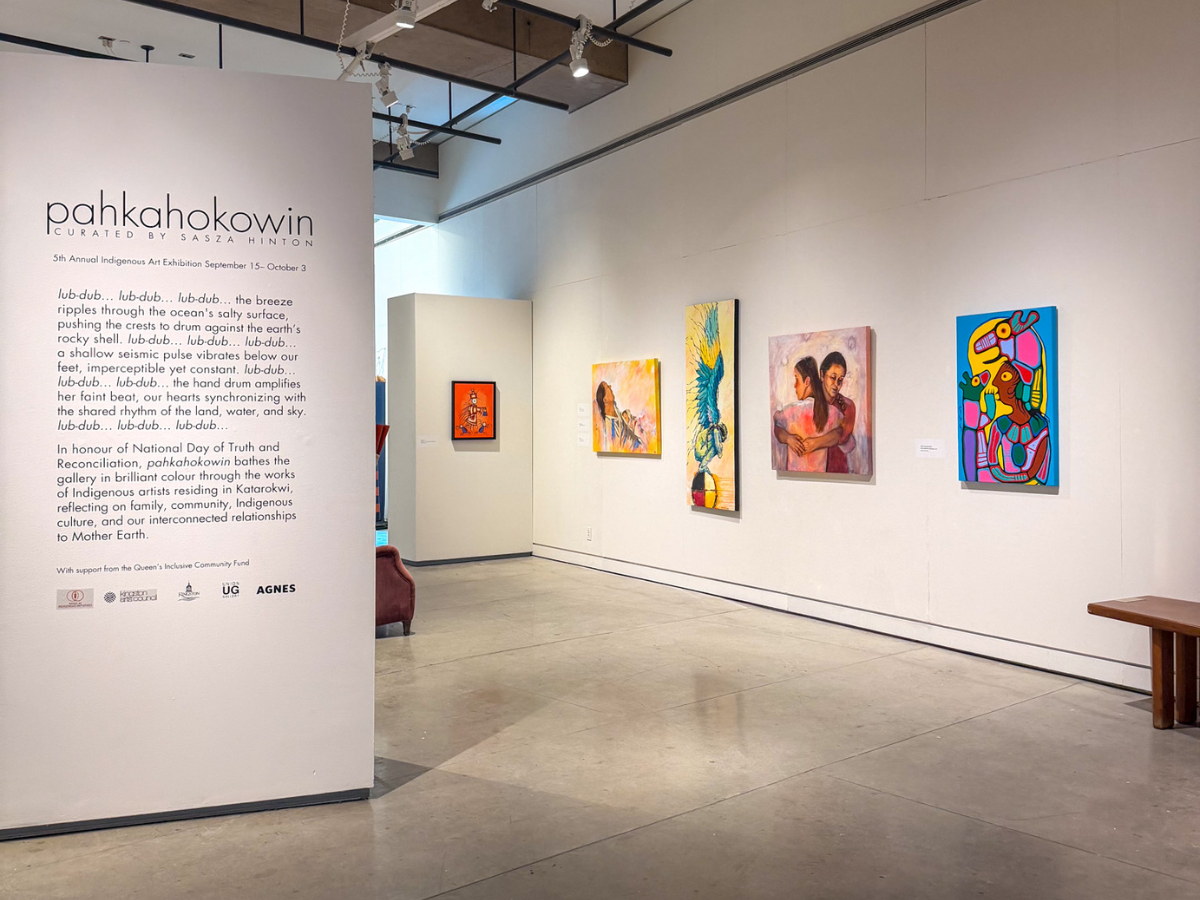
From Haudenosaunee beadwork to Anishinaabe woodland style paintings, Pahkahokowin‘s vivid artworks adorn the Union Gallery’s white walls full of colour to celebrate the survival of vibrant Indigenous history, communities, and culture.
In partnership with the Office of Indigenous Initiatives and the Agnes Etherington Art Centre, the Union Gallery‘s fifth annual art exhibition is on display from Sept. 15 to Oct. 3, featuring multidisciplinary works of 11 Indigenous artists residing in the Katarokwi area in honour of National Day of Truth and Reconciliation, which takes place Sept. 30.
This exhibit is curated by Afro-Indigenous researcher and scholar Sasza Hinton, who is pursuing her PhD in Screen Cultures and Curatorial Studies at Queen’s. She developed the theme after reconnecting with her culture’s roots.
“[My mom and I] have these huge dictionaries that have been written by some scholars in our area. I was cycling through them, and I wanted to connect this [exhibit] all back to my culture, to my landscape, to my language,” Hinton explained in an interview with The Journal.
Pahkahokowin, a specific Plains Cree word, translates to “heartbeat or pulse” depending on the context.
“I really liked ‘heartbeat,’ especially in context to the stories that I know of Turtle Island, and the way that our drum circles are meant to replicate the heartbeat of the world,” Hinton said.
As a curator, Hinton advocated for the exhibition’s vibrant colour palette to draw connections to memories.
“With the National Day of Truth and Reconciliation, it absolutely is a heavy day, but those orange shirts are all so bright and it’s immediate that you recognize them. It’s this unrelenting kind of colour that you cannot forget that this happened,” Hinton said.
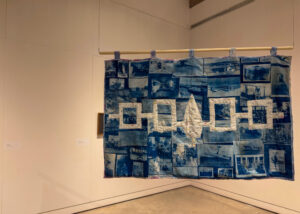
Tsi tke:teron, 2026, cyanotype and cotton. PHOTO BY EVE LINDEN
In Pahkahokowin, Brittany Dale, a Two-Spirit Queer Disabled Mohawk artist pursuing a PhD in Cultural Studies at Queen’s, blends beadwork with quilting to examine colonial legacies.
Tsi tke:teron, a cyanotype cotton textile piece on display, features printed photographs from Camp Mohawk, a Canadian military training camp in Tyendinaga that did not compensate the band council over its land acquisition. Now, it is the home of the Indigenous run and led First Nations Technical Institute.
“That’s why I wanted to put the Iroquois confederacy symbol on the front of it, and the translation to the text on the back says, from my understanding, ‘where we live,’ to talk about how this was our home,” Dale said in an interview with The Journal.
While Dale learned how to quilt from their aunt, Elenor, Aamjiwnaang artist Nico Williams taught Dale how to weave beadwork into their quilting practice with their displayed flexible piece, Family of Things, at a workshop hosted by Union Gallery in 2025.
Next to Dale’s Quilted Glass, Mohawk beadwork artist Niiostoseraah Thompson reflected on Indigenous womanhood through What would sky woman wear?, a raised beadwork collection of strawberry designs. While Michif beadworker Hugo Lussier-Meek’s Mākaskāc-Mostōs is colourful beaded medallion composed of over seven thousand glass seed beads to reflect on Métis diaspora.
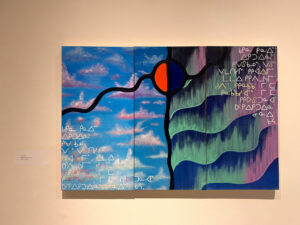
Bezhig Anishinaabe, 2024, acrylic on canvas. PHOTO BY EVE LINDEN
The exhibition’s poster features Bezhig Anishinaabe by Anishinaabe artist Helen Baillie, ConEd ’28, who tells the story of the Ojibwe and Algonquin sister languages through painted symbolic writings on canvas. Although both writings begin with the same story, the writings diverge to represent different divided Anishinaabe settlements across the Great Lakes region.
“It’s such an amazing way to look at community; We are constantly shaping each other, we are constantly around each other, our landscapes change a little bit about us, but in the end, we are so all connected,” Hinton said in an interview with The Journal.
Another artist Sasha Hill’s bright oil portraits, When Dad is Home and When I come home, continue these reflections on community, with subtle words like “silent” and “love” hiding beneath the brushstrokes.
When these artworks are embraced by the same gallery space, it’s as if their heartbeats match up, and “they have all fallen within the same pattern, the same beats,” Hinton said.
Pahkahokowin pulses with vibrant Indigenous artworks with distinct stories.
Tags
Indigenous Art, Truth and Reconciliation, Union Gallery, Visual art
All final editorial decisions are made by the Editor(s) in Chief and/or the Managing Editor. Authors should not be contacted, targeted, or harassed under any circumstances. If you have any grievances with this article, please direct your comments to eic@queensjournal.ca.