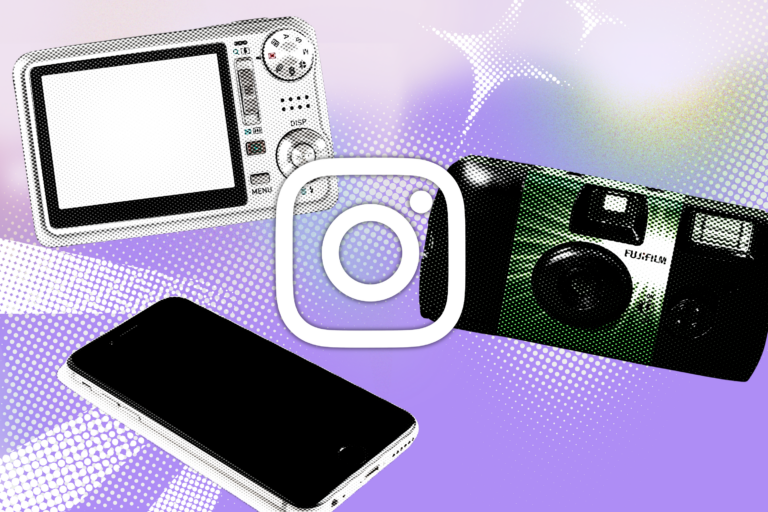
As more memories are captured with disposable film and digital cameras, it’s becoming clear that we still aren’t “living in the moment.”
Although we swapped cellphones for physical cameras, our intentions remain the same. After a night out, friends ask the designated digicam taker for the Google drive link before asking if they got home safely. If the digicam taker prefers film, then friends constantly interrogate them over developing the camera roll.
Once these physical images are digitally scanned, it contradicts the reason why we ditched our phones in the first place. We live in these moments only for our memories to be uploaded to Instagram stories and curated photo dumps, constructing our online personas as off the grid while remaining chronically online.
Instagram profiles are designed to present idealized versions of ourselves. If we desire to be perceived as disconnected by other social media users, then candids taken on physical cameras communicate that desire to be seen as both offline and online. Digicams and disposables perfectly blend reality and fantasy when their images are uploaded.
As a Film and Media student, studying media has always felt too personal. When I analyze media as a subject, I’m an active character that contributes to its narrative each day when I go online. Now, I can’t pull out my camera without overthinking.
In full transparency, my Instagram profile is a case study on how physical media shapes online personas. My main posts are shot on film. My highlights consist of digicam pics. My profile picture is literally a scanned Polaroid of me reading a book by a river.
These images have that unedited, candid look that everyone online is desperate to achieve because physical cameras feel like a proof of life in our digital era. Point-and-shoot, crappy cameras are a piece of evidence to prove that you experienced living “authentically.”
For instance, my shot-on-film Iceland dump depicts me with wind blowing through my hair as I hike on glaciers and tread on black sand beaches. One image even has a thumb peaking over the lens. No selfies, no phones, just me and my Kodak FunSaver camera against the world. Here, my point-and-shoot camera functions to communicate that I lived in the moment.
I wonder if, subconsciously, I always meant to publicly share this camera on the ‘gram.
When I took physical photos with the intention of living authentically, only for these pics to be online uploaded and shared on digital public profiles, I took myself out of these real experiences.
I guess it doesn’t matter because physical media on my digital profile works to convey that I am “offline,” even if my camera ruins a genuine moment to communicate that message. Strangers who follow me may believe I am down-to-earth, when I am just as chronically online as them.
The “father of media studies” Marshall McLuhan theorizes the medium is the message.
When offline devices act as extensions of ourselves, a candid taken on a point-and-shoot, crappy camera communicates disconnection with the digital world. After these images are uploaded to social media as online content, it raises the question of whether we are truly unplugged simply because we’re using physical cameras instead of our phones.
If we insist that phones interrupt real experiences, then shoving physical cameras in our friends faces isn’t any different. When we live experiences through viewfinders, it’s no different than living them through phone screens. All cameras are intrusive technologies that seek to reconstruct our lived experiences.
The gaps between media and reality are collapsing, and it’s why our perceptions of reality are easily manipulated by technology.
As more choose physical cameras to document authentic experiences in lieu of controversially pulling out cellphones, we must rethink how we approach sharing these images on social media. If it all amounts to the same Instagram-worthy goal, then physical cameras communicate the same message as phones, just with a few more performative steps.
Tags
digital photography, film photography, instagram
All final editorial decisions are made by the Editor(s) in Chief and/or the Managing Editor. Authors should not be contacted, targeted, or harassed under any circumstances. If you have any grievances with this article, please direct your comments to eic@queensjournal.ca.