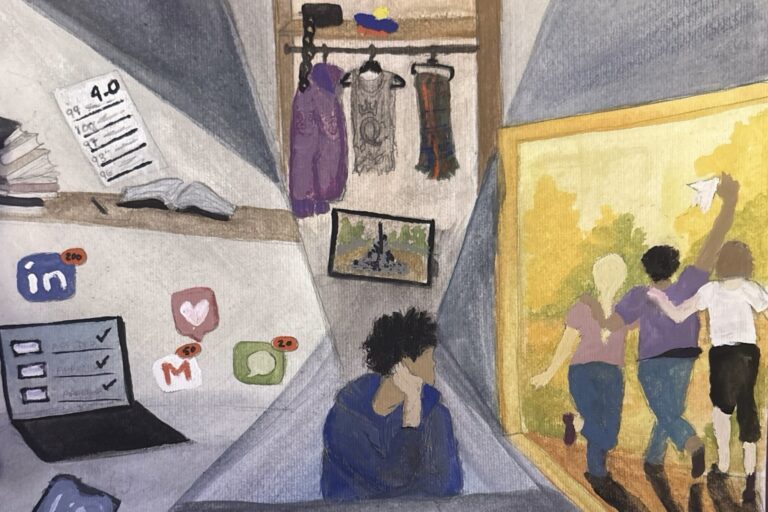
Imagine being told that university would be the most formative years of your life. The most impactful, eye-opening years, filled with learning and excitement. Then imagine you’ve finished your first year feeling like an embarrassment and wondering what was wrong with you.
That was me. I came to Queen’s from Kitchener as a Computer Engineering student, ready to put my high school experiences behind me and rewrite my story on a blank slate. University was a chance to find belonging on my own terms and finally land somewhere I fit. Instead, the exact opposite happened.
I was ambitious. I was told to throw myself at every opportunity the Engineering Society (EngSoc) had to offer, and I did exactly that: application after application for the positions I really wanted.
What I got back was a series of “we cannot offer you the position at this time,” while I watched others land the internships, the research spots, and the leadership roles I’d been reaching for.
Each denial landed a little heavier than the last. I’d refresh my inbox hoping this one would be different, and when it wasn’t, I’d quietly run through everything I may have done wrong. So many questions flooded my brain. “Did I not know the right people? Was I too gullible? Were my interviews really that bad?”
I did what a lot of first-years do, and I turned the bitterness on myself.
University was starting to feel absolutely awful, but I realized it didn’t have to be.
My relationship with EngSoc was a one-way street. I kept bending over backwards just to get walked over. The failures started piling up.
First, the person assigned to mentor me from EngSoc completely stopped showing up. The initiative was designed to help integrate first-year students into EngSoc, but meetings were scheduled and then abandoned. When I raised my concerns, I got a dismissive “we’ll deal with it”, but nothing changed.
Then, there was the pattern I couldn’t stop noticing. When I saw my application to be a FREC (an engineering orientation leader) was rejected, I looked into who did get chosen. I noticed it was overwhelmingly white and white-passing students. Of the few people of colour selected, most had European-sounding names. I stopped assuming that was a coincidence.
Smaller things added up too. For months, I was addressed by my last name only, no first name, by more than one person in EngSoc leadership. While a small thing itself, it made me feel like a file number rather than a person they actually knew.
None of it was dramatic on its own. There was a mentor who vanished, a name that never got learned, another “no”; little things, but they accumulated.
Each small dismissal told me the same thing: that I was on the outside of something everyone else seemed to be a part of, and that I would never be accepted nor respected by them. I started to feel like I was auditioning for a role that I was never going to get. The worst part was how much I let it confirm my belief that I was the problem all along.
I wish someone had told me to stand up for myself. If a faculty society has continuously belittled you, denied you, made you feel unheard, and given you the bottom end of the stick for positions, then you are more than entitled to reconsider your relationship with that community.
Eventually, that’s exactly what I did. I reduced my involvement with EngSoc before stepping away entirely.
I abandoned the traditions too, such as slamming and “purpling” my engineering jacket. I paid $500 for that jacket, but I’d rather grow into it than damage it to prove I belong. Call it stubborn, but I’ll wear mine plain, and I’m fine standing out for it. I don’t need to prove my worth to a community who never had a place for me regardless.
I learned what happens when you keep putting other people ahead of yourself. I spent too much of first year pouring into relationships that only felt reciprocated in one direction. I was bending over backwards for people I thought were my ride-or-dies and slowly realized the effort was never mutual. I kept giving second chances that were never returned and mistook being needed for being valued.
Eventually, I stopped. I built a wall, not to shut everyone out, but because my overall well-being wasn’t in check that year, and I couldn’t keep pouring from an empty cup.
Looking back now, I can see what I couldn’t see then. I learned the society’s rejection was never a verdict on my own worth. It was information about their process and their blind spots, not mine. It took stepping away to see that clearly.
Stepping back from what drained me made room for what didn’t, and that turned out to be the difference.
Pulling away from EngSoc freed up room for the things that gave me something back. I found belonging in the people who met me halfway instead of making me prove I deserved a seat. I found it volunteering at orientation, running around keeping first years hydrated and spray-painting their hair, being a vital part of the energy without having to audition for it. I found it on a team where I was valued for what I could build, not screened out before I started.
For a while, the bitterness convinced me everyone at Queen’s was fake, hypocritical, two-faced, and stuck-up. Clearly, that’s not true. I would’ve missed out on so much goodness if I’d let my worst experiences become the whole picture.
My most cherished moments in my first year were all the shenanigans. From swarming Waldron Tower to losing our minds after Davis Schneider and Vladdy Jr.’s back-to-back home runs during the 2025 World Series, to celebrating the end of exams at Kinton Ramen, these are the moments permanently etched in my brain. They remind me that joy matters just as much as learning.
What I’ll hold onto after are the moments I threw myself into; the feelings of chaos and calamity, the student roles that built my grit, or the experiences that shattered my old worldview. Those are the things that change you.
If you’re a first-year reading this after your own string of rejections, here’s what I wish someone had told me: not getting in doesn’t mean you don’t belong. The society that keeps turning you away is not the measure of your worth, nor is a title from a club or a faculty society that never wanted you. The version of you who walks out in four years is built by the experiences you throw yourself into, not by how many titles you collect.
Don’t spend your first year like I almost did: begging for a seat at a table you were never going to enjoy sitting at anyway, let alone be invited to.
Tags
clubs, EngSoc, first year, rejection
All final editorial decisions are made by the Editor(s) in Chief and/or the Managing Editor. Authors should not be contacted, targeted, or harassed under any circumstances. If you have any grievances with this article, please direct your comments to eic@queensjournal.ca.
Tia
Well said. This message should be shared broadly. Living the life of a first year minority student can be lonely and isolating. It makes you question your worth and constantly asking “Am I good enough?”
Jonathan Rose
What a beautifully written, poignant and thoughtful reflection. I’m sorry that the first year experience was so bad but happy that you shared it. You clearly have a future in writing if that engineering thing doesn’t work out!