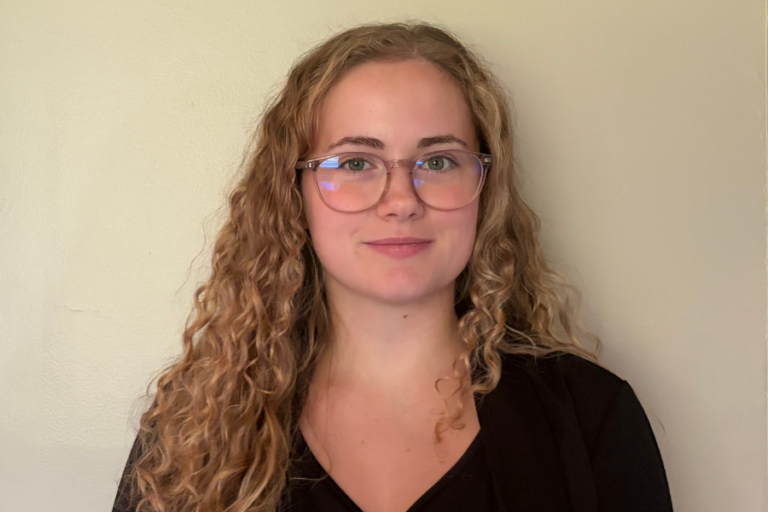
With International Week of Deaf People underway, Canadian Hearing Services (CHS) recognized a deaf Queen’s student in her pursuit to help deaf newcomers navigate Canada’s immigration process.
International Week of Deaf People is taking place from Sept. 21 to 27, with the International Day of Sign Languages on Sept. 23 to mark the date the World Federation of the Deaf was established in 1951. On Sept. 15, Brittany Gillies-Hamilton, who is pursuing a graduate diploma in immigration and citizen law, became a returning recipient of the CHS National Scholarship. She was the only Queen’s recipient this year.
The National Scholarship Program awards $3,000 to full-time students and $1,000 to part-time students, with recipients eligible for the same level of funding for up to four consecutive years. The funding can be used for tuition, residence, and educational resources.
Launched in 2017, the program supports deaf and hard of hearing students pursuing post-secondary education. It is the largest Canadian scholarship program exclusively supporting deaf and hard of hearing students, according to the CHS website.
Born to deaf parents, Gillies-Hamilton’s first language is American Sign Language (ASL). In a written statement to The Journal, she said her background has shaped her commitment to deaf advocacy.
“I didn’t just learn about Deaf culture, I lived it from day one, and I’ve seen firsthand what access, and the lack of it, can mean for an individual and a family,” she said.
Gillies-Hamilton has been working towards her diploma since September 2024. She is a part-time student who lives outside Kingston and studies through Queen’s online program.
Previously, Gillies-Hamilton studied Human Rights & Equity Studies at York University. While living in Toronto, she said she began noticing how many people in the city’s deaf community were immigrants, refugees, or on study or work permits.
She is now working toward becoming a Regulated Canadian Immigration Consultant to help deaf newcomers navigate the Canadian immigration system.
Gillies-Hamilton said one barrier that deaf newcomers face is the assumption that deaf people share one language. She said many newcomers communicate using a “home sign system,” which is often very different from ASL.
“That gap alone can leave someone lost at every stage of the process,” she said.
She said that while interpreting services may technically be offered, it does not necessarily mean effective communication is taking place.
Gillies-Hamilton called receiving the CHS scholarship “an honour,” saying it has eased concerns about funding her education. She said the scholarship was more than recognition, describing it as “tangible support” that allows her to focus more on her studies.
“The scholarship is what made it possible for me to eventually be in a position to give back to that same community,” she said.
In addition to receiving the scholarship, Gillies-Hamilton has also recently become a mother, describing her daughter as “one of [her] biggest motivations to keep pushing forward.”
She said she wants her daughter to see her mother, a deaf woman, build a career in immigration consulting.
“Becoming a mother hasn’t changed my direction, if anything, it’s sharpened it,” she said.
Ahead of International Day of Sign Languages, Gillies-Hamilton emphasized the importance of access to sign language, which she described as a human right.
She said more than 70 million deaf people globally use one of roughly 300 distinct sign languages, and that access to sign language can determine whether people can access education, understand their legal rights, participate in their communities, and be understood by others.
“It’s a good moment to remember that the fight for linguistic access isn’t new, and it isn’t finished,” she said.
Gillies-Hamilton said she would like to see more initiatives at Queen’s recognizing International Week of Deaf People and International Day of Sign Languages.
“Even something small would go a long way for Deaf students and the broader community,” she said.
Gillies-Hamilton said she wants to show that deaf women can pursue higher education, build careers, and become mothers while advocating for more accessible systems.
Tags
Canadian Hearing Services, International Week of Deaf People, scholarship, World Federation of the Deaf
All final editorial decisions are made by the Editor(s) in Chief and/or the Managing Editor. Authors should not be contacted, targeted, or harassed under any circumstances. If you have any grievances with this article, please direct your comments to eic@queensjournal.ca.