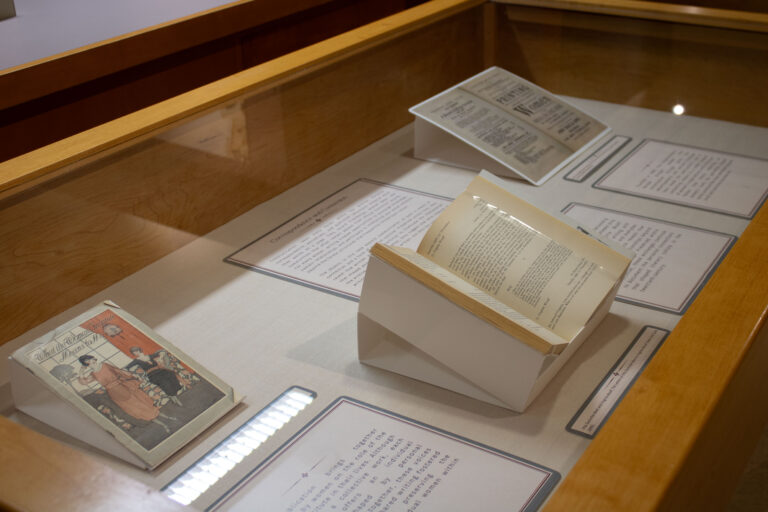
As we near closer to the world of Ray Bradbury’s Fahrenheit 451, it’s important to remember the value of physical books.
Since 2024, AI company Anthropic has been systematically scanning and destroying rare books to help “train” its large language model Claude with high-quality literature written before the “corrupting influence of generative AI on contemporary text.” This process is called “destructive scanning,” where AI companies are buying millions of books to digitally scan, only to destroy and discard the originals.
In light of this unsettling news, The Journal spoke with Professor Leslie Ritchie from the Department of English Literature and Creative Writing about the importance of books as physical, cultural, and historical artifacts with value that exists outside of solely the contents inside.
Ritchie teaches the upper-year English seminar, ENGL 436: A Material History of Book and Print Culture. She has spent her research career working with a “number of rare books, newspapers and prints from the eighteenth century in various archives and libraries in North America, the United Kingdom, and Ireland,” she told The Journal in an email statement.
“Each [physical] book is a small archive in itself,” Ritchie stated. She explained that by studying the history of a physical book as a material artifact, you can ask different kinds of questions than when you’re solely considering a book’s contents.
Last year, in London, Ritchie viewed copies of newspapers from 1789. Though she acknowledges she could have read the content online in a digital archive, it was important to study the annotations in the margins. Through her research, she found the annotations and scratchings of someone sympathetic to the abolitionist cause, which was clear from how their notes responded and interacted with the news.
“From this contemporary reader’s perspective, each newspaper issue was a battleground where one could trace advancing and retreating frontiers of opinion. The reader’s notes show how closely the London Committee for the Abolition of the Slave Trade monitored public opinion during Parliamentary debates on the slave trade—and I needed to see this copy of this newspaper to understand this,” Ritchie stated.
She isn’t alone in studying margins and annotations of physical books to learn more about the cultural climate of the time.
Historian Miriam Borden studied children’s primers from Canadian Yiddish schools to figure out how the new generation was engaging with Yiddish and Jewish identity post-Holocaust as first-generation immigrants from Eastern Europe.
In her research, Borden analyzes children’s doodles and jokes, written in both Yiddish and English, to try to understand the Canadian youth’s attitudes towards their Jewish identities and study of Yiddish language at the time.
In her research, she quotes folklorist David Allen Ensminger who proposed a theory of the ‘intimate graffiti of doodles,’ writing “within the margins of the page, a brief suspension of boundaries and borders, authority and power, occurs. The reader hides in anonymity, free to reroute the meaning of the book.”
By preserving physical books, we can learn from the authors and the ideas inside the pages, but we can also learn about who the readers of the time were, and what the literary mood was like.
Even the typeface in which a book is printed has a story. As the book historian Robert Darnton put it, “typography as well as style and syntax determine the ways in which texts convey meaning.”
Everything about a physical book can tell us something: watermarks, the printer’s name, the publisher, and more. As Ritchie explains, “examining watermarks shows that more paper was being produced in England later in the century, which brought down the price of paper for printers and made print materials more accessible for readers.”
Even font tells its own story.
“Each typeface has its own history of uses, associations, and connotations: we associate Times New Roman with news (Stanley Morison’s typeface was designed in 1931 for the Times of London), for instance; it would be difficult to take the news seriously if it appeared in Comic Sans or Papyrus,” Ritchie wrote.
Each physical book is a time capsule full of little mysteries that scholars and readers alike can crack open to learn more about the time it was produced.
When these AI companies destroy books, they are erasing our intellectual history, handing our critical thinking and imagination to be eaten by machines only to leave us hungry.
Tags
artificial intelligence, book, Literature
All final editorial decisions are made by the Editor(s) in Chief and/or the Managing Editor. Authors should not be contacted, targeted, or harassed under any circumstances. If you have any grievances with this article, please direct your comments to eic@queensjournal.ca.