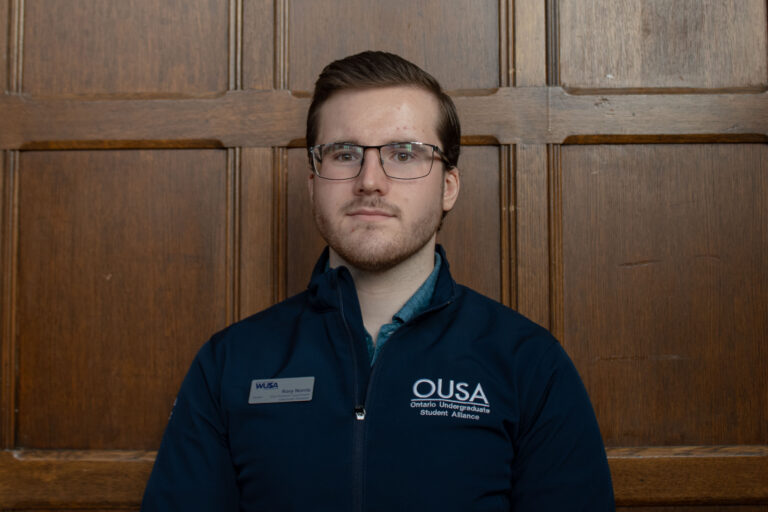
The Ontario Undergraduate Student Alliance (OUSA) visited Queen’s campus on Sept. 29 to connect with students and University administration as it continues its advocacy for the academic year.
OUSA is a non-partisan coalition consisting of nine university student associations around Ontario, including the AMS, and represents more than 160,000 professional, undergraduate, full-time, and part-time university students to the provincial government. OUSA executives typically plan an Ontario-wide tour each year.
READ MORE: OUSA stops on campus to speak with Queen’s leadership
During its visit, OUSA representatives met with university and student leaders and hosted a booth in the ARC.
Rory Norris, president of OUSA, sat down with The Journal to discuss the organization’s priorities and goals for this academic year.
Changes to OSAP
OSAP changes that came into effect Aug. 1, 2026, made it so Ontario students could only receive a maximum of 25 per cent of funding in grants, meaning a minimum of 75 per cent would be provided as a loan. Comparatively, grants could comprise upwards of 85 per cent of OSAP funding before the changes.
The Ontario government said the adjustment is intended to improve the program’s long-term financial sustainability, while OUSA has raised concerns about the increased debts students may face.
READ MORE: Students raise concerns as new OSAP framework takes effect
Norris said early survey responses and feedback suggest students are beginning to feel the effects of the recent OSAP changes.
“Students are taking more time off of school, they’re taking less classes, they’re trying to work either more hours at their part time job or trying to find other ways to cut costs to be able afford their tuition,” Norris said.
OUSA is currently advocating for an extension of the loan repayment grace period from six months to at least two years and the elimination of interest on provincial student loans.
The organization has also called for greater clarity around the Student Access Guarantee, which provides additional funding to students in financial need, under the new OSAP framework.
“Additional support through the Student Access Guarantee is a welcomed complementary policy; however, uncertainty regarding eligibility and its implementation continues to raise apprehension among Ontario students and their families,” OUSA wrote in a press release on Aug. 1.
Affordability
OUSA’s Affordability advocacy extends beyond student aid.
The organization wants the province to provide more direct funding to universities as students begin to feel the effects of budget pressures through fewer programs and course options.
Norris said that universities need more funding, but increasing tuition should not be the primary solution. In OUSA’s January Presidential Update, the organization called for any tuition increases to be “gradual” and accompanied by “proportional” increases to OSAP grants and loans.
“In the future, we would want the increases to come from grants and not necessarily tuition increases,” Norris said.
He said that direct government grants could have the greatest impact on students and universities.
Transition into the work force after graduation
Employment after graduation is another issue OUSA plans to continue addressing.
Norris said the uncertainty in the labour market has contributed to student concerns about how technologies, such as AI, may impact entry-level jobs after graduation.
OUSA has advocated for universities to provide more work-integrated learning opportunities across all fields of study.
Indigenous students
In August 2026, OUSA released its Indigenous Students policy paper, which was developed, researched, and written by Indigenous undergraduate students. The paper addresses barriers including Indigenous self-determination and representation, financial aid, campus culture, student supports, and health and wellness.
Norris said OUSA is working to strengthen its connections with Indigenous communities and better incorporate their perspectives into its advocacy.
While Norris said many Queen’s students might not regularly see OUSA’s work directly, he said much of the work happens behind the scenes.
“We’ve been working behind the scenes on your behalf to advocate on many different things,” he said.
OUSA will return to campus from Nov. 5-8 for its General Assembly, which Queen’s will host.
Tags
2026 OSAP Changes, OUSA, Provincial politics
All final editorial decisions are made by the Editor(s) in Chief and/or the Managing Editor. Authors should not be contacted, targeted, or harassed under any circumstances. If you have any grievances with this article, please direct your comments to eic@queensjournal.ca.