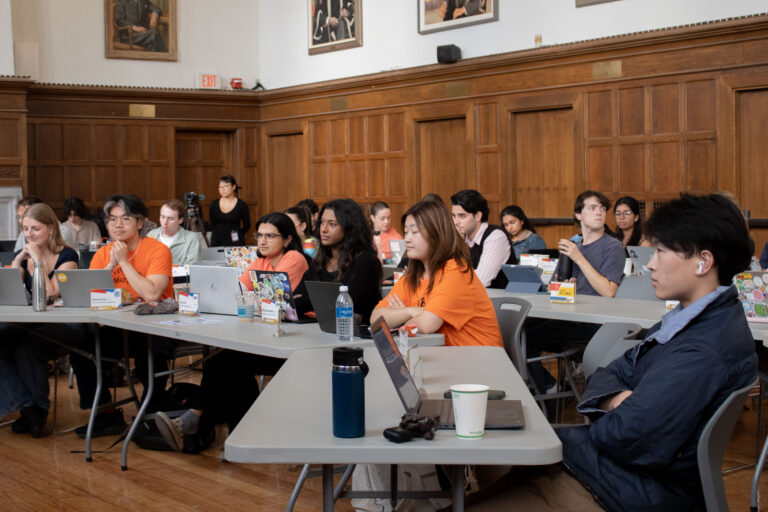
The second AMS Assembly of the month — just after Assembly’s first meeting of the school year took place last week — kicked off on Sept. 29 at 5:11 p.m. with a presentation from the Ontario Undergraduate Student Alliance (OUSA).
OUSA is a student advocacy organization representing undergraduate students at universities across Ontario. It advocates to the provincial government on post-secondary issues.
READ MORE: OUSA visits campus, bringing provincial advocacy to Kingston
OUSA’s President Rory Norris and Executive Director Octave Andrade-Dixon opened Assembly by presenting the organizations provincial advocacy priorities for the year. They discussed the Ontario Student Assistance Program (OSAP), housing and affordability, employment after graduation, work-integrated learning opportunities, and AI.
OUSA also confirmed that Queen’s will host its General Assembly from Nov. 5-8.
Following OUSA’s presentation, Assembly heard reports from AMS executives and observers. Motion two delayed the approval of September 20th meeting minutes.
In motion three, Assembly unanimously ratified Shanal De Silva, LifeSci ’27, as Judicial Case Manager. The Judicial Case Manager investigates category one non-academic misconduct cases referred by the University and provides educational and peer support to students navigating the system.
Motion four elected former Health Science Society president Arani Hiritharan, HealthSci ’27, as Chief Returning Officer (CRO). The CRO co-chairs the AMS Elections Team and administers all undergraduate elections and referenda.
Under motion six, Assembly unanimously elected Saanuja Mayooran, HealthSci ’28, the only candidate for the postion, as speaker for the 2026-27 term. The speaker chairs Assembly meetings and manages debate.
During the President’s report, AMS President Dreyden George spoke about how the Queen’s Senate is developing principles surrounding large language models and encouraged students to raise concerns about the use of AI in academics.
AMS Vice-President (Operations) Avery Papoulidis reported high use of AMS services, including Walkhome, the Peer Support Centre, and the Food Bank. According to Papoulidis’s September report, the Food Bank saw an “overwhelming” number of new patrons over the summer and first weeks of the fall semester, causing it to exceed its budgeted spending on purchased food.
“We’ve seen a crazy increase in foot traffic this year and it’s been very challenging [..] to meet student demands,” Papoulidis said. The AMS is looking to increase donations and improve Food Bank operations.
Papoulidis said the AMS is exploring reduced spending and additional grant funding to address the demand. The Food Bank has also sought donations through orientation events, a partnership with FryWay, and a campaign for monetary and non-perishable food donations.
Assembly also discussed the recently announced $25 million donation for student financial aid and potential new University District Safety Initiative (UDSI) dates for October.
READ MORE: Queen’s receives record $25-million endowed gift
Rector Niki Boytchuk-Hale told Assembly the proposed UDSI period would run from Oct. 15 to Nov. 1, but said the dates had yet to be approved by Kingston City Council.
Commission budgets and priorities
AMS Commissioner of External Affairs Racheal Reddy presented her commission’s goals and budget for the year.
Reddy said the commission wants students to be more involved in shaping its advocacy, saying past lobbying efforts have relied heavily on survey data.
“We built really strong relationships with the councillors and the community district associations, but there is a gap in the student visibility and contributions,” Reddy said.
The commission budgeted approximately $100,577 in expenses for 2026-27, up from $96,162 budgeted the previous year. Assembly’s allocation to the commission increased from $66,000 to $67,049.
Personnel represents the commission’s largest expense at $77,501, including $38,231 in salaries and $30,039 in assistant manager wages. The commission also budgeted $10,525 for the Academic Grievance Centre, $2,400 for the AMS Community Development Summit, and $2,280 for the Housing Resource Centre.
She also said the commission has $1,000 available each month through its academic accessibility bursary to help students cover course-related expenses such as textbooks and lab materials.
Assembly unanimously approved Reddy’s goal plan and budget.
Under motion eight, the AMS’s spending on OUSA was unanimously approved. The 2026-27 budget totals approximately $98,953, funded primarily through $77,168 in student activity fees and a $21,785 allocations from Assembly.
Membership fees to be a part of OUSA make up the largest expense, totalling $77,168, followed by $6,930 for conference fees, $6,272 for accommodations and meals, $4,033 for travel, and $3,250 in UCRU expenses.
This year, Queen’s is also responsible for hosting OUSA’s Fall General Assembly, with Reddy’s report listing venue and room bookings, plenary planning, delegate hiring, campus programming, and stakeholder invitations among the preparations.
Speaking to Assembly, Social Issues Commissioner Eshal Ali presented the Social Issues Commission’s (SIC) 2026-27 goal plan and budget.
The SIC budget projects $191,960 in revenue and expenses for 2026-27, up from the $154,995 budgeted last year. The commission is set to receive $91,900 from Assembly and $71,760 through student activity fees.
Personnel accounts for $97,384 of the commission’s expenses, while $39,000 is budgeted for grants and bursaries. The commission also budgeted $12,249 for its Menstrual Equity Project and $9,000 for special projects.
Around $6,800 in surplus funding from the commission’s budget will be redirected to equity grants. Assembly unanimously approved the SIC’s goal plan and budget.
Under Motion 10, the Internal Affairs Office (IAO) presented its 2026-27 goal plan and budget, with priorities focused on governance accessibility, policy modernization, record keeping, and increasing students’ understanding of AMS processes.
The IAO projects $113,000 in revenue for the year, including a $105,550 allocation from Assembly and $7,450 in miscellaneous revenue. The Assembly allocation decreased from $115,603 the previous year, with the office looking to alternative revenue sources to offset some of the difference.
Personnel expenses include $39,852 in salaries, $46,859 in assistant manager wages, and $3,900 in honoraria. The office also budgeted $22,889 in operating expenses.
Policy changes and broader discussions
Assembly approved revisions to the AMS Awards Policy, preventing AMS senior managers and executives from receiving awards for work done through their AMS roles.
The meeting then discussed the AMS 2026-27 Executive Roadmap, which focuses on affordability, engagement, accountability, finances and workplace culture.
Assembly ended with discussion of the newly established 3P Summit, an AMS initiative focused on policy development and improving how Assembly members engage with the Society’s legislative process. The summit is scheduled for Nov. 14, 15 and 21. Assembly formally received the executive roadmap and information.
The meeting adjourned at 7:04 p.m.
Tags
AMS Assembly, AMS Commissioners, Ontario Undergraduate Student Alliance
All final editorial decisions are made by the Editor(s) in Chief and/or the Managing Editor. Authors should not be contacted, targeted, or harassed under any circumstances. If you have any grievances with this article, please direct your comments to eic@queensjournal.ca.