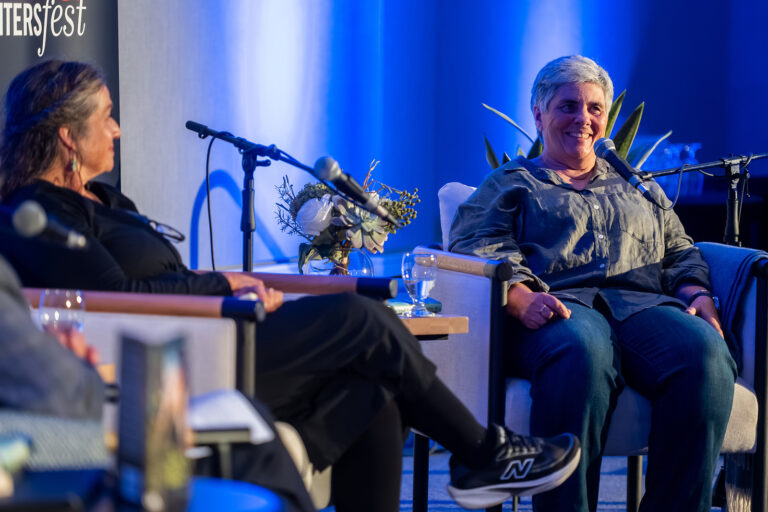
On Oct. 2 at 7:00 p.m., broadcaster Eric Friesen led the festival’s sold-out panel, Our Reconstructions, which featured two admired Canadian authors.
Playwright Judith Thompson, ArtSci ’77, debuted her first novel, In Crow’s Field, earlier this year. Writer and Acting Director of the Queen’s Creative Writing Department Helen Humphreys launched her memoir, Summerland, in September.
For the panel, Friesen chose to interview Thompson and Humphreys individually then brought them together at the end.
Frisen first asked Thompson why she wrote a novel after decades in theatre. Known for her Governor General award-wining plays White Biting Dog and The Other Side of the Dark, Thompson explained that In Crow’s Field could take no other literary form. Set primarily in Kingston and embedded with biographical elements, the novel follows Ana, a young girl finding her voice after trauma.
“I’d say [it’s] about two thirds autofiction,” Thompson said. “When you draw on something that’s rich and full of blood, then you can create more easily because those details feed the richness. They feed the creative process.”
When Thompson read an excerpt describing the traumatic event, her striking recitation and brilliant dialogue made the crowd audibly gasp.
During the talk, Thompson explained that due to her background as a playwright, her first draft was too dialogue heavy. However, Thompson leaned into this quality to give the novel’s first-person perspective more depth.
“I like dialogue to be the character, because I still think character comes through brilliantly in dialogue in a way it just can’t in description,” Thompson said.
When Friesen asked why Thompson wanted to write about Ana, she explained that “the word Anastasia means resurrection.”
“I really wanted to write about the resurrection of a young girl becoming a woman, […] and the risks that it takes because you have to risk everything in order to speak out, and that’s why so many of us have not spoken out in the past. But we are now,” Thompson said.
Then, Friesen shifted the conversation to Helen Humphreys and her memoir, Summerland. Through a reconstruction of her grandfather’s unpublished short stories, Humphreys investigates the inheritance of dreams and desires.
Humphreys began reading an excerpt from the memoir, which explains how her grandfather, Dudley, disappeared during World War II. Although seemingly this loss ended his aspirations of becoming a writer living on an orchard in Summerland, British Columbia, Humphreys demonstrates that Dudley’s dreams live on through their family.
During the talk, Humphreys discussed her approach to writing within and continuing her grandfather’s short stories, which were based on his experiences fighting in war.
“The thing with being a writer is that when you encounter another writer, you can enter into conversation on those terms, so even though he was my grandfather and I never met him, […] when I’m reading his story, I’m relating to it as another writer,” Humphreys explained.
After talking to epigeneticists in preparation for the book, Humphreys explained to the crowd that while you can inherit trauma through DNA, dreams and desires don’t mark DNA, making their inheritance harder to prove. However, she has a lot of faith in its potential after an epigeneticist said it’s “plausible” to “inherit good things as much as you would inherit the trauma.”
“Maybe it’s fantasy, but it’s a good fantasy, and I like belonging to my grandfather’s dream,” Humphreys said.
When writing the memoir, Humphreys visited Summerland with her cousin, Phil, who physically resembles her grandfather. Although Friesen assumed that this visit was disappointing, similar to her trip to Walden Pond after writing Followed by the Lark, Humphreys pushed back and shared that she did not expect anything for the trip. Part of the beauty was “not having something that’s predetermined” and “just being receptive to whatever happens.”
“I thought maybe it’s like I’m going into the future and the past simultaneously, and maybe I’ll just find my grandfather still there,” Humphreys said.
After a short question and answer period, the panel concluded ten minutes early at 8:20 p.m.
Tags
Canadian literature, Helen Humphreys, Kingston WritersFest, Memoir
All final editorial decisions are made by the Editor(s) in Chief and/or the Managing Editor. Authors should not be contacted, targeted, or harassed under any circumstances. If you have any grievances with this article, please direct your comments to eic@queensjournal.ca.