As the workshop and interview were conducted in Arabic, all quotes and learned material have been translated.
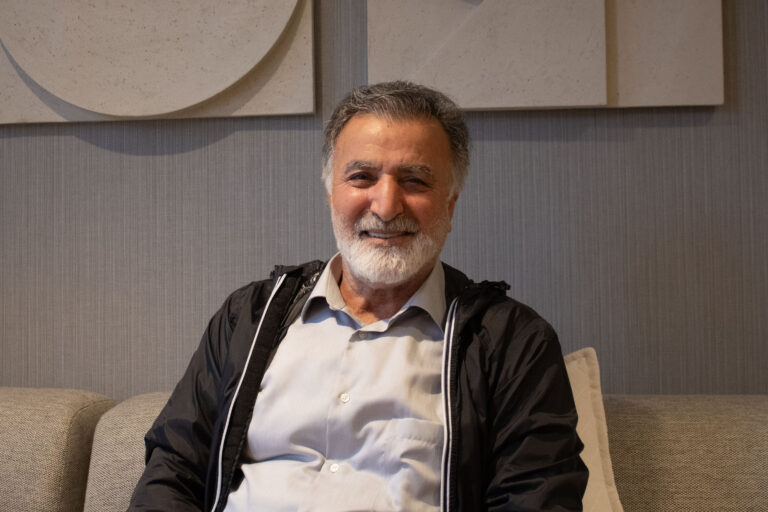
Activist and writer Jamal Saeed argues that poets are born from lived experiences that are kept inside until one day an event unleashes those buried feelings and memories.
On Oct. 1 at 10:30 a.m. at the Kingston WritersFest, Saeed explored his philosophy that every lived experience is a poem itself at his Arabic “Writing Workshop.” A small workshop, there was only one attendee. The low turnout didn’t stop Saeed from hosting a thorough and moving workshop built around different questions such as, ‘How do we understand the relationship between art and poetry?’ and ‘Do we live poetry before we write it?’ Each question was designed to guide participants, step by step, through the process of discovering how to write their own poem.
“Inside every person, there is a poet,” Saeed said as he introduced the workshop’s purpose.
During the workshop, Saeed explained that as we go through experiences in life, our inner poets formulate different poems. These are not just words rearranged to create sentences but lived experiences, thoughts that occur to us that turn into words to eventually become a poem.
Saeed’s first workshop question asked whether life events make poetry, or do they go hand in hand together?
“Having lived the experiences of estrangement, I know how deeply it etches itself into my soul […] I longed to be transformed into a song, one that would drift through the cosmos, inspiring hope, spreading a sense of serenity akin to a smile, or acting as an eraser for some of the sorrows we endure,” he said.
Jamal Saeed wrote articles as a human rights activist while living in Syria under the Assad regime. His writing against the dictatorship of Hafez al-Assad cost him 12 years in prison. During his years of captivity as a prisoner of conscience, writing became a way to resist his imprisonment.
“Writing in prison serves as a refuge and a sanctuary; it is an attempt to reimagine one’s relationship with the things found there, the concrete walls, the iron bars and all that is grim, and an effort to create space far more expansive than prison itself,” Saeed said in an interview with The Journal.
Instead of seeing the walls and bars as symbols of confinement, Saeed reimagined his lived experiences into something beyond the physical limits of the prison.
In his workshop, Saeed related poetry to painting. When an artist creates a picture, they infuse it with a part of their soul. It is a commemorative image of internal experiences. Similarly, poetry transcends mere words through imagery and imagination.
“Poetry helps me preserve that emotional and soulful side of myself. The part connected to things, people, places, dates, and memories. That is one of the values of poetry,” he said.
Saeed suggests that writing poetry is useful for remembering and expressing who we are, but our actual life choices and experiences are the real substance of our identity.
“Sometimes, I feel that the poetry we write or read may not be as significant as the poetry we actually live. The poetry we live is what matters most; it is who we are. In contrast, the poetry we read consists of words that merely express who we are.”
He pushes people to write, specifically those who might be going through the same circumstances as the ones he once went through.
“Poets must write about and draw attention to every instance where the humanity of others is violated. It is shameful for poets and writers not to write about this or take on representing the cause,” Saeed explained.
One should abandon the thought that voice cannot cause change, for it is through silence that destruction prevails. Do not doubt your ability and allow the poet inside of you to express themselves, he encouraged.
“Do not hesitate to write. Read as much as possible from poets around the world. Do not listen to anyone but your own voice and inner poet. Do not view poetry as a burden,” he said.
All of us should embrace poems with all their beauties and flaws, for in every poem resides a piece of you, Saeed advises.
Tags
Kingston WritersFest, Poetry, Syrian refugees
All final editorial decisions are made by the Editor(s) in Chief and/or the Managing Editor. Authors should not be contacted, targeted, or harassed under any circumstances. If you have any grievances with this article, please direct your comments to eic@queensjournal.ca.