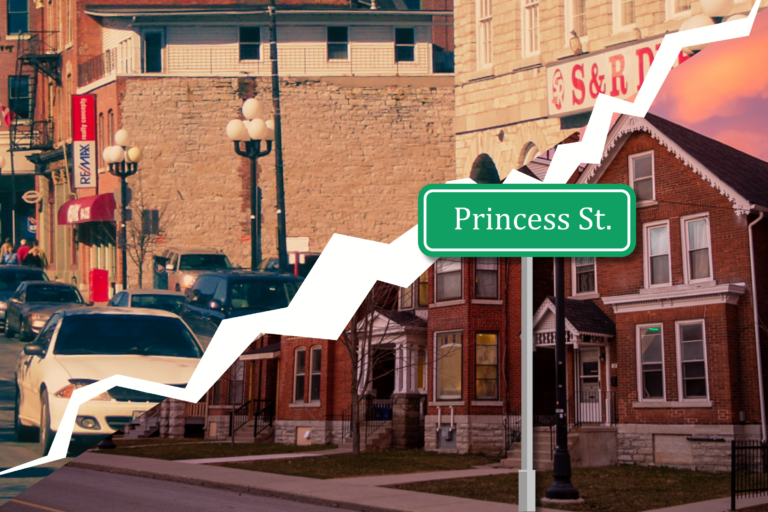
According to David Gordon, professor of Urban and Regional Planning at Queen’s, living north of Princess Street has long been treated by students as less desirable.
The widely recognized, highly concentrated student area exists on the south side of Princess Street. This has led to somewhat of a stigma developing against living on the “other side” of Princess Street, or NOP (North of Princess), with many students believing the north side is unsafe, less fun, and inconveniently located. The Journal set out to speak to students, landlords, and urban planning experts to determine whether there was validity to this stigma. What started as a simple question of geographical location turned out to carry far more factors: convenience, neighbourhood quality, connection to the student community, safety, and price.
Introducing the stigma
Princess Street functions as somewhat of a dividing line through downtown Kingston, separating more regular residential areas from much of the city’s student housing and campus. Although this is beginning to change as students are pushed north as the housing demand for students increases, with rising enrollment the amount of housing on the south side remains relatively the same.
Bobbi Spark, a north end resident, was quoted in Richard Harris’s 1987 novel Democracy in Kingston as having said: “Princess Street provides a very clear division of the “haves” and “have-nots” living in Kingston.”
Gordon told The Journal that, historically, low-income residents of Kingston have been concentrated north of Princess Street. Meanwhile, the south side of Princess Street housed the wealthy “haves.” As a result, this area has been gentrified, with the houses in the Old Sydenham neighborhood often being expensive, large 19th century homes. Wealthy individuals have moved into these historical Victorian homes on the south side, preserving and improving the homes, and creating a beautiful and antique living area south of Princess Street.
The divide between “north and south of Princess” is a class divide that has marked Kingston for decades, according to Gordon. This divide isn’t confined to the views of native Kingstonians. It has translated into the minds of students too in the form of the stigma against the north side of Princess Street that many Queen’s students continue to hold today.
Without much knowledge of what it’s like to live on the north side of Princess Street, many students try to seek out houses on the south side or even outwardly refuse to search for houses past Princess altogether. To many this stigma isn’t a fair one.
Marika Knapp, ArtSci ’29, agrees. “I think the stigma is probably stronger than the actual experience,” said Knapp, reflecting on her own experience living north of Princess Street.
The stigma, said Knapp, is “based on reputation and student culture” rather than actual experience living past Princess. Living north of Princess Street hasn’t lived up to its unsafe and inconvenient reputation for Knapp. She told The Journal since moving north of Princess Street she has felt safe, connected to students and campus, and the longer distance from campus “hasn’t really affected” her life at all.
The neighbourhood’s reputation can greatly affect the housing market in the area, Kingston landlord for over 20 years, Jason Eade, said in an interview with The Journal. Eade owns properties on both the north and south side. The stigma against the north side of Princess may be an unfair one, but fair or not, Eade believes students often start their housing searches with a desire to live south of Princess Street.
Community and location
The area in Kingston called the “University District” houses most of the Queen’s students living off campus, according to research by Myles Fox, a former Queen’s Masters student. Houses in this area have an extremely high demand rate, selling “faster and for more money,” said Eade.
Because this area is so popular, living in the student neighbourhood can be the basis of a wonderful collective experience. Madison Pires, ArtSci ’29, describes living in the University District as “lively” and “fun.” Olivia Ford, HealthSci ’29, shared her thoughts on living in the University District, “students really want a quintessential university experience”, she said, adding that for a lot of students the University District is part of that desired experience.
One downside, said Ford, is the noise. “It’s not a problem during the day, but during the night proximity to campus and the University District leads to a lot of noise on the streets that can disrupt sleep,” she said. “You can hear students coming home from nights out most nights of the week.”
Despite this, Ford still loves living in the University District. “It’s lively and feels like an extension of campus. It definitely provides a sense of belonging and something almost familial for students,” Ford said.
According to students, there is a perception on campus that living outside the University District means living completely outside a student area, or that the further you live from campus, the more of the quintessential student experience you will miss out on.
Students living on the north side, however, argue that this simply isn’t the case. Knapp says there’s “still a big student community” in the area she’s living in. According to Knapp, having less students can be a positive, as “it’s generally less busy than the main streets in the University District. It’s nice to have a bit more of a break from the constant noise and activity.”
The convenience of a house’s location is another factor in students’ choices of where to live.
It is undeniable that living on the far side of Princess Street certainly adds to the walk for students to get to campus. Many worry that the distance would keep them from attending classes, participating in on campus activities, or having easy access to school amenities.
Living south of Princess Street, Pires really likes her location, as it offers a “short walk to campus, easy access to bus stops, and easy access to Princess Street.” Pires highlighted the convenience of her location as a reason she chose to live south of Princess Street, and added that she wouldn’t consider living north of Princess Street out of worries the location would be an inconvenience.
Eade shared that student worries about houses further from campus being inconvenient are “valid concerns.” He explained to The Journal that further walks in Kingston’s turbulent winters can be a problem for students.
For Ford, proximity to campus is a huge plus of living south of Princess. “Being able to make it to your class in under five minutes is amazing,” she told The Journal.
However, for Knapp, living north of Princess Street hasn’t proved to be much of an inconvenience. The walk, she said, is only a few minutes longer than most houses on the south side. “I don’t think I’m any less involved than my friends who live South of Princess,” Knapp said. “A few extra minutes of walking hasn’t really affected my ability to participate in anything.”
It is worth noting that while living north of Princess Street is, for some, the biggest thing to consider in terms of location, students on the south side can end up even further than those on the north. Knapp commented that for her “east and west also played a role,” when picking a house. She was concerned that houses too far west would be an even further walk than houses north of Princess Street.
Neighbourhood charm
Another deterrent for students to avoid living north of Princess are the tangible differences in infrastructure and neighbourhood atmosphere between north versus south of Princess Street, Gordon shared.
North of Princess Street students only have close proximity to one park that, while improved in the last decade, is not in great shape, according to Gordon. The park most easily accessible to students on the north side of Princess Street is McBurney Park. According to a past Journal article, the park was built on top of a 19th century graveyard that was, for considerable time, the resting place of many Kingstonians who died from cholera, diphtheria, and typhus. Meanwhile, south of Princess Street students can access the Kingston waterfront and pier, City Park, and Victoria Park. Additionally, the environment of each neighbourhood is very different.
“The neighbourhoods aren’t as charming north of Princess Street,” said Gordon. The houses north of Princess Street are often newer builds or smaller wooden houses built on larger plots, built after the second world war for veterans. Meanwhile, south of Princess Street, the houses are larger Victorian homes made of masonry that became too big for families once they stopped keeping servants in the house and were often converted into rooming houses, Gordon mentioned.
Safety
While students have raised safety concerns about the north side, Knapp says her location hasn’t affected her feelings of safety in the slightest, adding that she hasn’t “had any incidents that have made [her] feel unsafe or less safe than [she] would have felt living closer to campus.”
Despite this, safety while living on the north side still seems to be a concern students have, with Pires sharing that while she feels safe living in her south of campus home, the idea of crossing Princess Street to get to a house on the north side at night doesn’t make her feel safe.
The perception of a lack of safety north of Princess Street isn’t a new one, Gordon added. “You didn’t go past Princess Street as a Queen’s student,” Gordon reflected on his time as an undergraduate student. “The north side was not safe for young men in a Queen’s jacket.”
From the south side, Ford shared that she generally feels safe where she lives. However, she has had a few issues. “One of my roommates witnessed an attempted car robbery, our neighbours have had issues with people entering their property and going through their garbage, and one of my roommates had her car mirror stolen,” Ford shared. Ford emphasized that despite this, she hasn’t felt unsafe living in the area, telling The Journal that “it feels really safe to be surrounded by people your own age all the time.”
Prices
The Kingston housing market is a competitive one, and as a result, rent prices in the area are growing more expensive. Zumper’s Canadian Rent Report in September 2026 placed Kingston as the 8th most expensive city to live in within Canada.
For students living in a city where the average rent is $2,140 a month, price is understandably a concern, and living on the south side can lead to much higher rental costs for students. However, Pires shared with The Journal that, in her opinion, the higher rental prices are “worth it for the location,” agreeing with the sentiment that the costs on the south side of Princess Street are reflective of the quality of the location.
Knapp shared that in her opinion, “being south of Princess, a lot of what you’re paying for is the location and being right beside campus.” Gordon agreed, “students will pay a large sum of premium to get up at 8:20 for an 8:30 class”. There is a reason for this.
Dr. Gordon explained to The Journal that there isn’t a convenient way for students to get to campus beyond walking. There’s a lack of parking for students on campus, biking lacks convenience due to the weather, and despite the push to use public transit, it hasn’t taken off amongst students yet. The lack of convenient ways to get to campus means students will overpay to live in the University District, Gordon concluded.
Knapp, meanwhile, feels the north side is the area where students are getting better value for their money. Eade agreed, telling The Journal that students searching for higher value properties look to the north of Princess Street. To live north of Princess, students are looking at “rent discounts around 10-20 percent,” Eade said. He added that students often begin by searching for properties on the south side, but many often end up on the north. He emphasized that location doesn’t equate to happiness for tenants, sharing that his tenants living north of Princess Street are often some of his happiest.
The diverging rent costs on either side of Princess Street outline an example of advice given to many first-year students when they begin searching for housing. Ford shared with The Journal that in her first year she was told that “when looking for a house you must look at three factors: quality, location, and price.” Due to the circumstances of the Kingston housing market, “you likely have to sacrifice one, if not two, of these factors,” said Ford. For students who are potentially willing to live a little further from campus, the north side may be the place to look. “For me, I would rather walk an extra few minutes and get a much nicer place for the same or lower price,” said Knapp on the matter.
***
While there are differences in housing, infrastructure, accessibility, and character of each neighbourhood north or south of Princess Street, whether one side is better than the other depends largely on individual preference.
Many students are willing to pay more to live as close to campus as possible, while those looking for lower prices or greater value for their money may choose to live north of Princess Street.
The University District may offer a different student living experience from the areas north of Princess Street, but students living farther from campus are not necessarily disconnected from the university community. Instead, according to Knapp, they have developed their own student community north of Princess Street.
For students, like Knapp, Pires, and Ford, the Princess Street divide may be less about north versus south and more about finding the community and living situation that suits them.
Tags
affordable housing, housing, Princess Street, stigma, Student Housing
All final editorial decisions are made by the Editor(s) in Chief and/or the Managing Editor. Authors should not be contacted, targeted, or harassed under any circumstances. If you have any grievances with this article, please direct your comments to eic@queensjournal.ca.