Reports of suspected drug overdoses in Queen’s residences have raised concerns among first-year students, with some questioning the drug safety information they’ve received since arriving on campus.
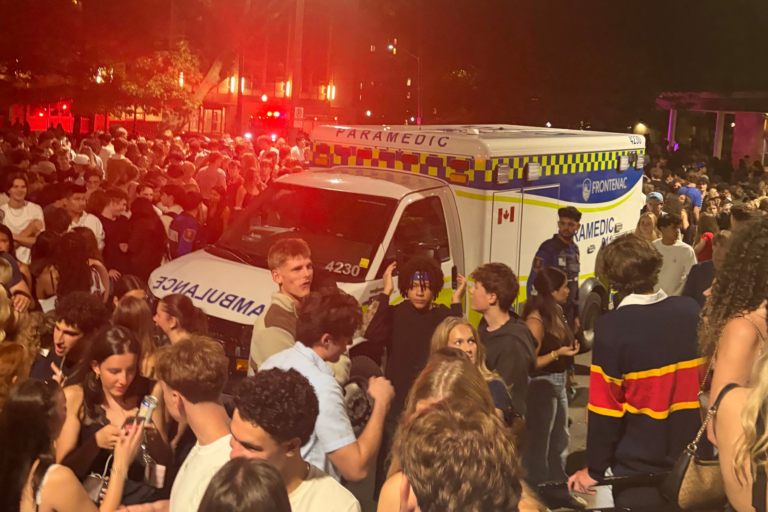
On Sept. 11, students gathered for what’s known as “Vic Pit,” a nickname for a common gathering of primarily first-year students outside of the residence building Victoria Hall. According to Evan Zakem, ArtSci ’30, during the Vic Pit on the 11th a student appeared to lose consciousness and require medical attention.
Zakem, who lives in Victoria Hall, said he and his friends witnessed the student passed out in a chair in the building’s first-floor lobby. He recalled the student vomiting and said an ambulance arrived to transport her from residence.
Students who witnessed or heard about the incidents suspected an over consumption of drugs or alcohol. However, The Journal was unable to confirm the nature of the student’s medical emergency.
Maya Pollien, ArtSci ’30, who lives on the first floor of Victoria Hall, said she heard about the incident.
“There were musings in the hallways. We didn’t get any confirmation,” Pollien said in an interview with The Journal.
Olivia Groscha, ArtSci ’30, who lives on West Campus, also heard about the incident. Pollien and Groscha said they saw an ambulance but didn’t witness the student receiving medical attention.
“I think it shocked a lot of people. A lot of people were talking about it,” Pollien said. “I hope she’s okay.”
Emily Li, HealthSci ’28, a don currently living on the sixth floor Victoria Hall, said she also heard about the incident. Although she didn’t witness it, Li said she heard from other dons that students had interfered with emergency responders.
“A lot of dons were upset that a lot of students were [apparently] dancing around the ambulance, kind of blocking the way,” Li said in an interview with The Journal.
Groscha and Pollien also said they heard of a second incident that night, where a student walked through the first-floor windows into the University’s Waldron Tower residence building.
In a statement to The Journal, Queen’s said Campus Security and Emergency Services (CSES) responded to nine drug-related calls in residence involving an ambulance during the 2025-26 academic year. The University said most calls involved reactions to recreational drugs.
This academic year, Queen’s said there’s been “no indication to date of a projected change in volume,” of these calls. The University did not confirm or deny the need for an ambulance at Victoria Hall on Sept. 11.
The University did not address the Waldron Tower incident in its statement to The Journal.
Southeast Public Health (SEPH) couldn’t confirm an increase in drug poisonings, explaining in a statement to The Journal that its surveillance data isn’t detailed enough to reliably identify suspected poisonings involving Queen’s students, university-aged individuals, or incidents specifically on or around campus.
Frontenac Paramedics also couldn’t provide statistics to The Journal, citing privacy requirements associated with calls to private dwellings.
University warns students following residence incidents
Following the Sept. 11 weekend, Queen’s sent an email to all first-year students warning about concerning behaviour in and around residence buildings.
In the email obtained by The Journal, Emma Ferguson, manager of residence conduct and support, and Christopher Scott, director of Campus Security and Emergency Services, addressed incidents involving large gatherings, aggression toward emergency responders, and property damage.
“Large and loud crowds have gathered in front of Victoria Hall; there has been reported aggression toward campus security staff and first responders, and intentional damage to property,” the email said.
The University also warned students against climbing onto residence rooftops, trees, and hydro poles.
The email encouraged students to make informed decisions about substance use and highlighted campus resources, including the Campus Observation Room, Queen’s First Aid (QFA), and AMS Walkhome.
Li, who has also worked as a don in Morris Hall, said she believes the partying and drinking culture at Victoria Hall has intensified compared to when she lived in the building as a first-year student two years ago.
She recalled Vic Pit gatherings taking place primarily on weekends when she was a first-year student. This September, however, she said large gatherings occurred outside Victoria Hall every night during the week of classes.
“It’s just so much more intense, the drinking culture and the party culture,” she said.
Students question drug safety education
Despite the University’s harm reduction efforts, some first-year students told The Journal they haven’t received information about drug safety directly from their residence dons.
Troy Fleming, ArtSci ’30, who lives in Watts Hall, said his don hadn’t provided him with drug-related safety training.
Fleming also said he’d heard reports of dons “handing out Narcan like it’s candy.” Narcan is a common brand name of naloxone.
Rachel Mekis, ArtSci ’30, similarly said her don hadn’t provided information about drug safety. She also heard about the incident involving the student at Victoria Hall.
Li said she believes residence dons receive more detailed guidance about alcohol-related violations than other forms of substance use.
“We have very specific protocols about alcohol,” Li said, pointing to restrictions on alcohol quantities, glass containers, and drinking games in residence.“[But] there’s so many different types of drugs that just weren’t really listed or talked about in our training.”
In its statement, Queen’s said residence dons receive annual training on substance use, recognizing the signs of an overdose, and administering naloxone.
The University said harm reduction education is promoted throughout the academic year, especially during periods with increased student activity.
Unregulated drug supply is unpredictable
While SEPH couldn’t confirm an increase in poisoning rates, it said reports from community partners continue to raise concerns about the unpredictable, unregulated drug supply.
The health unit specifically pointed to the presence of highly potent opioids, including carfentanil — which can be even stronger than traditional fentanyl, in samples expected to contain just fentanyl.
The health unit also pointed to an example from earlier this year in which a local sample expected to be cocaine contained no cocaine. Testing instead identified fluorofentanyl, MDMA, ketamine, medetomidine, and caffeine.
SEPH said the finding illustrates the difficulty of knowing what substances from the unregulated supply contain.
“It’s important not to make assumptions about who may be at risk, as stigma can prevent people from being open about their substance use,” the statement said.
Naloxone available in every residence
Queen’s said naloxone is available in wall-mounted cases in the front lobby of every residence building.
Dons on call between 8 p.m. and 7 a.m. also carry naloxone, as do CSES staff and on-call QFA teams. All residence dons are required to maintain first aid and CPR training and receive annual training on substance use, recognizing signs of an overdose, and administering naloxone, according to the University.
If someone in residence shows signs of a potential drug overdose, Queen’s said its protocol is to call 911. The don on call, CSES, and/or QFA responders can provide interim care and administer naloxone until paramedics arrive.
Corrections
A previous version of this story incorrectly stated that one of the students interviewed lived in Watson Hall. In fact, they live in Watts Hall.
Incorrect information appeared in the October 9 issue of The Queen’s Journal.
The Journal regrets the error
Tags
All final editorial decisions are made by the Editor(s) in Chief and/or the Managing Editor. Authors should not be contacted, targeted, or harassed under any circumstances. If you have any grievances with this article, please direct your comments to eic@queensjournal.ca.
Don
I am Don and we don’t hand out narcan like candy. That is false and irresponsible reporting. We have one unit with our on call bag and there is a station in the lobbies of buildings, but other than that, we don’t have access to cases of narcan. In what world does that sound like something we would do? I’ve never heard of Watson Hall. Where’s that?
Carly Robertson
wow that so sad , awful my heart breaks when see students get bash drunk free hugs blessings