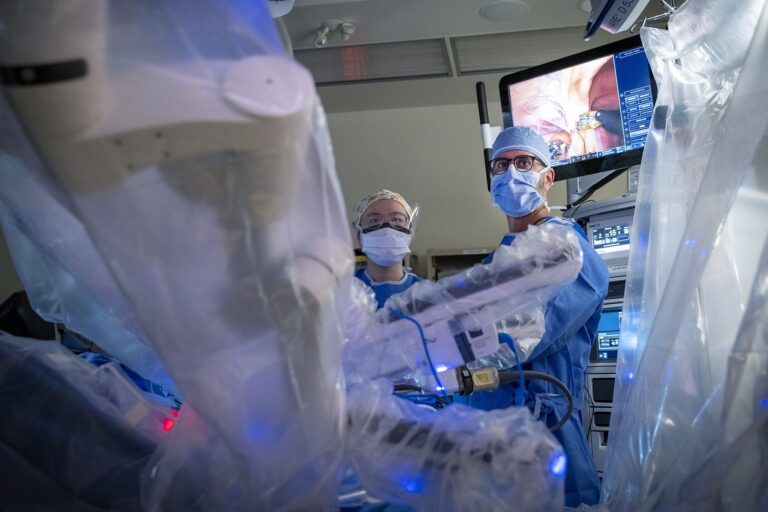
Kingston Health Sciences Centre’s (KHSC) robotic surgery program has received $300,000 in funding from CIBC, as demand for advancement in robot-assisted surgeries grows across Ontario.
The donation was made through University Hospitals Kingston Foundation (UHKF) and will support KHSC’s A. Britton Smith Q.C. Robotics program. According to KHSC, the program has grown to performing 400 robot assisted procedures each year. KHSC is the only health centre that offers the technology between Toronto and Montreal along the highway 401 corridor. Most of the surgeries performed with robotics treat colorectal, lung, prostate, kidney, and gynecologic cancers.
This investment comes at an important time for KHSC’s robotic surgery program,” Jason Hann, executive vice-president of patient care at KHSC, said in a statement to The Journal. “As demand has grown, we’ve expanded the number of procedures we perform each year across a growing number of surgical specialties using robotic technology.”
Rather than manually performing incisions on a patient, the robotic procedures allow surgeons to sit at a console and guide the arms through multiple precise incisions, by using a magnified 3D view of the inside of the body.
The arms can bend and move in ways that a human wrist can’t, which helps surgeons navigate their way through tight and awkward spaces within the human body. For patients, smaller and more precise incisions result in much less pain and a quicker recovery, with some going home the day after surgeries that once took up to a week.
The program has grown to keep up with demand. KHSC recently brought a second robot into service and upgraded the existing one, which allows it to treat more patients and train more surgeons.
That training is where Queen’s comes in.
“As an academic health sciences centre, we’re also building a program that gives Queen’s learners and surgical residents valuable experience with technology that is becoming an increasingly important part of modern surgery,” Hann said. “It is important to provide this kind of training to prepare the next generation of surgeons and helps attract talented learners and clinicians to our region.”
What’s less known is how hospitals receive funding for these initiatives. In Ontario, taxpayer dollars only support the hospitals day-to-day operations, but major equipment purchases and implementation of new technologies are often left to the hospital’s foundations and donors. The vast majority of robotic surgery equipment in Canada has been funded through donations.
This funding model has created unequal access across Ontario. Sudbury’s Health Sciences North recently began efforts to raise at least $10 million for robotic surgery equipment and training, after saying it was the only academic health sciences centre of its size in the province without the technology. Whether the patients have access can depend entirely on how successful their local hospital is at fundraising.
Going forward, robotics could help close these gaps by eliminating the need for the surgeon and patient to be in the same room. Canada has pioneered this concept. In 2003, Dr. Mehran Anvari, a surgeon at St. Joseph’s Healthcare Hamilton, operated on a patient in North Bay by controlling robotic instruments from Hamilton, marking the world’s first routine telerobotic surgery. More recently, a surgeon in London, England removed a patients prostate cancer using a robot in Gibraltar, around 2400 km away, with a delay time of just 0.06 seconds between the surgeons’ movements and the robots.
Remote surgery hasn’t become routine yet. But as robotics programs like this spread, the idea of a surgeon operating on a patient in 2 different cities becomes closer to reality, with successful programs like KHSC well-positioned to take part.
For now, donations like CIBC’s have helped keep Kingston on the frontier of innovation and allowed for patients to access top tier procedures in the area.
“Most importantly, this means patients across southeastern Ontario can access leading-edge surgical care closer to home, benefiting from the expertise and technology available through our growing robotic surgery program without having to travel to Toronto, Ottawa, or other major centres for care,” Hann stated.
Tags
All final editorial decisions are made by the Editor(s) in Chief and/or the Managing Editor. Authors should not be contacted, targeted, or harassed under any circumstances. If you have any grievances with this article, please direct your comments to eic@queensjournal.ca.