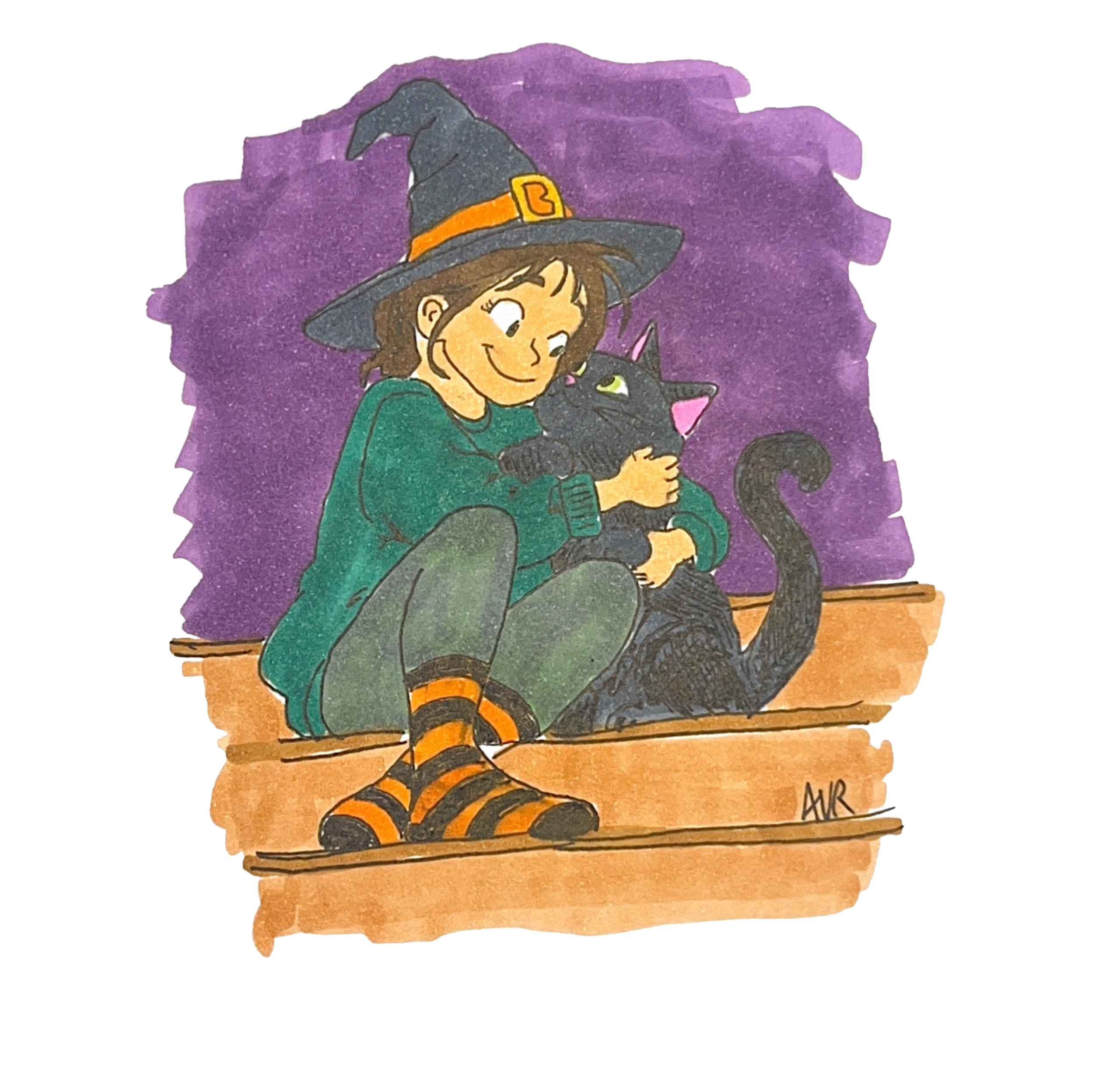
From Salem, the feline friend from Sabrina the Teenage Witch, to Hermoine Granger’s Crookshanks, a witch needs her cat.
This Halloween, I decided to read In Defense of Witches, which talks about the different ways women have been labelled as “witches” to villainize them throughout history. Through my read, I kept noticing that witches are almost always accompanied by their cats. For me, that cat is named Joni.
Really, it’s a love story like any other. I moved away from home to go on exchange, ending up in Istanbul, or as it’s lovingly referred to, It’s estimated that Istanbul is home to 120,000 to 300, 000 street cats. They would roam my university campus, hop onto my lap at local cafes, and even follow me up to my dorm room. The cats there are used to being pampered and adored by locals, holding no qualms about approaching humans.
As a lonely foreigner who didn’t have many friends initially, the happy surprise of a cat plopping up and purring in my lap was one that brought me immense comfort. I had never known a cat before, I wasn’t even entirely sure I knew how to pet one. Eventually though, as I grew and became more comfortable in the city, I came to know and love many cats, all of whom I had to leave behind on my return to Canada.
My family was always a steadfast “dog family.” I had only ever grown up around dogs. And I mean, I grew up in a zoo of dogs.
In my final year of high school, my two dogs had puppies together, which was an adorable and stressful experience that quickly became chaotic when my living room became a petting zoo of 10 puppies. Something that began cute quickly overwhelmed snotty teenage me. I came to associate family pets with disorder, mess, and turmoil.
That is until the summer I came back from exchange and my family friend offered me a small gray kitten with big green eyes who needed a home. Reminded of the many cats who turned Istanbul into a home, I immediately fell in love. This was Joni.
I named her after Joni Mitchell, a Canadian folk singer from the 1960s whose ballads on life and love kept me company while I was miles away from everything familiar and certain. It felt like a perfect tribute to the period of my life where, left to my own devices on the other side of the world, I fell in love … with cats.
Since then, my life has never been the same. I made an impulsive long-term commitment, and one I’ll never regret.
I got Joni at the start of my fourth-year and she quickly became the perfect university cat, hopping from housemate to housemate as we rewatched Game of Thrones in the living room and keeping me company when I had an influx of readings.
My university experience grew, not only opening for Joni herself, but my purpose expanded. Waking up each morning isn’t only defined by dragging myself to campus for an 8:30 a.m. lecture, but to ensure Joni is fed and happy.
One of my favourite books of all time, Milan Kundera’s The Unbearable Lightness of Being, argues that humanity’s relationship with animals is our true moral test. Kundera believes human beings naturally ask for something of everyone we interact with — for them to love us, or for them to care about us as much as we care about them — but with animals, we simply accept them for who they are, asking only for their company.
During my first two years of university, I was desperate to prove myself as a competent strong woman who could take care of myself. Coming to school as the oldest of five children, university felt like the first time I could be wholly selfish and untethered.
I was even reluctant to enter romantic relationships, because as a “girlfriend,” I saw my femininity in constant question and my independence always at risk. I rebelled against domesticity in any sense, obsessed with being a powerful “new woman.” I associated taking care of other people as a domestic and traditional act that only bound me further to the patriarchy.
I was scared to be loved, but mostly, I was scared to love, worried that I would be judged and remembered for who I am in relation to others, as women often are, rather than seen for who I actually am.
This is the exact version of femininity radical conservatism warns about. This distance from traditional femininity is associated with witchery by conservatives and feminists alike. It seems to be a strong, independent woman throughout history has always been associated with witchery. Whether that’s a powerful, reclaiming for the radical left or a condemnation of liberation for the alt-right, a “witch” has become synonymous with an unconventional woman.
For example, in Chollet’s non-fiction book about witches, American televangelist Pat Robertson once argued in a 1992 speech that “Feminism encourages women to leave their husbands, kill their children, practice witchcraft, destroy capitalism and become lesbians,” to which many women responded, “Where do we sign up?”
In many ways, I guess I am a witch. But again, what is a witch without her cat?
During the 16th century witch craze, women were being mass killed in Europe after being labeled witches. But they weren’t alone. Cats became associated with witchcraft and devilry as well, presumably because they were associated with the nighttime and the “suspicious, witchy” women who lived alone and kept cats as companions (most of the time relying on them to kill rodents).
Cats also do not perform unconditional loyalty the way that dogs do. Instead, they are selective with their affection. In medieval Europe, this was suspicious to the mobs.
Coming from the dog-heavy background that I do, I’m familiar with how dogs show affection. Endlessly, enthusiastically, almost goofily. When I walk through the door, whether I’ve been gone for 10 minutes or seven months, I’m instantly swarmed by a small mob of slobbery and energetic dogs, who have never hesitated to express love and trust — something I’ve never been great at. Neither have cats.
More independent than dogs, cats are autonomous creatures, not automatically reliant on their owners. Instead, they choose affection and security, not as a predisposition, but out of trust and a formed bond.
Taking care of Joni, I realized I didn’t need to be alone to be independent. I didn’t feel embarassed or weak to clean up after her or cuddle her to sleep. If anything, I felt proud and capable. After this realization, I felt sad, remembering all the times in my life I’d rejected softness, kindness, and love out of fear of being taken unseriously or being hurt by the beautiful experience of being human.
When I come home from work, the first thing I do is look for Joni, who often comes to meet me, already purring. This action reminds me that to open myself to love doesn’t make me feel less than, but builds me up.
One of my favourite albums of all time is Clairo’s Sling, an album that was deeply influenced by her relationship with her dog Joanie, another reason why I chose Joni’s name. When discussing taking care of her dog, she admits that she didn’t think domesticity is something she could ever benefit from or could co-exist with her young adult life. “I realised I was creating so much space for this animal to feel safe and secure and doing everything I can to do so, thinking about how I’d do that for my kid,” she said. “But also realising I hadn’t been doing that for myself.”
Writing this now after a nice meal in my own apartment, Joni is curled on my lap, purring. Not because she has to, but because she wants to. Taking care of her is a pleasure. It doesn’t sabotage my independence — it amplifies it. Because again, what is a witch without her cat?
I belong to Joni and she belongs to me and it really is just a love story like any other.
Tags
cats, femininity, Halloween, Independence, witches
All final editorial decisions are made by the Editor(s) in Chief and/or the Managing Editor. Authors should not be contacted, targeted, or harassed under any circumstances. If you have any grievances with this article, please direct your comments to eic@queensjournal.ca.