There was a time when getting into Queen’s Model Parliament (QMP) meant getting in line.
Zayden Vergara, ArtSci ’25, recalled hearing stories from older QMP alumni about a time when demand for the conference was so high that students had to compete for admission. Even after securing a spot, delegates reportedly arrived hours early outside the House of Commons, lining up to claim the best seats in the chamber.
“There was not just a wait list. There was a line that people would be essentially camping out,” Vergara said in an interview with The Journal.
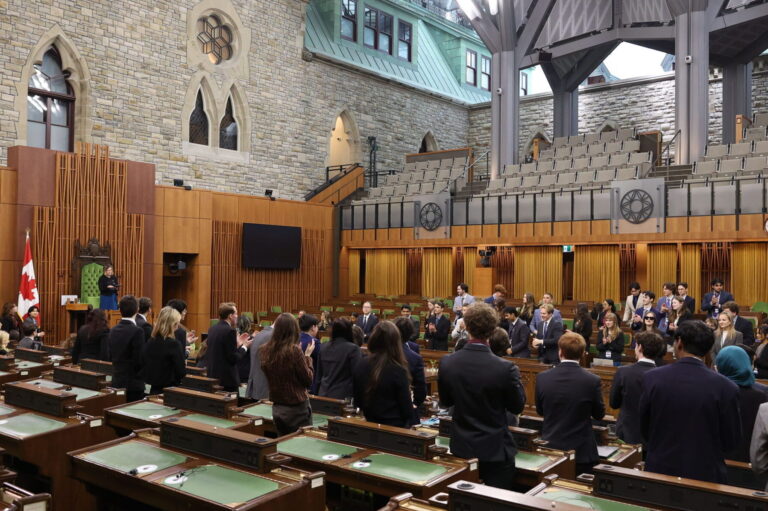
After COVID-19 interrupted the annual trip, a small executive team brought the club back to the House in 2023. Now approaching its 80th sitting, QMP is preparing to return to the House of Commons this school year from January 6-8 with registration open through December.
The premise of the club is simple. For three days, Queen’s students sit where MPs sit, form parties, and debate bills they’ve written themselves. Each party brings serious proposals and deliberately ridiculous ones. The bills won’t become law, but alumni told The Journal the experience changed how they spoke, approached politics, and understood one another.
Finding a way in
QMP began in 1947 when Queen’s students Kate Macdonnell, ArtSci ’47, and Mike Howarth, ArtSci ’49, proposed a mock parliament after the AMS opposed campus branches of national political parties, according to the Queen’s Encyclopedia. After being invited by the Commons Speaker Gilbert Parent, the conference moved from Grant Hall to the House of Commons in the 1990s.
When the conference returned after the pandemic Julia Luong, ArtSci ’25, helped organize its first sitting back in the House. She joined in her third year, after spending much of university feeling she’d missed her chance to get involved.
“I remember feeling like I was already so behind,” Luong said in an interview with The Journal.
Luong was working as a McDonald’s team leader and hoped to enter public service, but she didn’t know how to make that leap. At QMP, she met Mark Holland, then an MP and later federal health minister, and was surprised by how approachable he was.
“He just made it seem so human,” Luong said. “It was like talking to an average person.”
Holland introduced her to MP Ryan Turnbull. Luong later helped expand a constituency youth council in Turnbull’s riding from five members to more than 100, using a model similar to QMP’s.
Luong also pushed for greater democracy within QMP itself. In 2024, she filed a complaint with the AMS after the club selected its co-chairs without a vote by members. An investigation found the process violated QMP’s constitution, leading the club to hold an election for its next two co-chairs.
While Luong entered QMP looking for a way into politics, Giulia Paikin, ArtSci ’25, arrived having grown up around politics.
The daughter of broadcaster Steve Paikin, she said her family name helped her get a foot in the door for her first government job. Now a press secretary and issues manager in Ontario politics, she sees QMP as an opportunity, not a guarantee of a career.
“At the end of the day, if you want a career in politics, it is all about connections,” Paikin said. She cautioned that students must take the effort to approach people themselves.
“It just depends what you make with the experience,” she said.
Yet even Paikin, who had attended political events since her childhood, found something new at QMP: the chance to debate and enjoy politics with people her own age, without having to treat every exchange as professional business.
Seriously ridiculous
For students with no intention of working in politics, QMP offers another invitation: the freedom to have fun arguing serious policy one minute and then defending a ridiculous proposal — with all the ceremony of Parliament — the next.
Vergara’s favourite example was the Farmer’s Party, a caucus that could turn almost any bill into an agricultural double entendre.
“They were effortlessly working every single one of their jokes about plowing or knowing how to work a hoe into every single bill they talked about,” Vergara said.
What amused him most was the delivery. In the House of Commons, a joke about a gardening tool could sound like a matter of national importance.
Abhay Katoch, Sci ’25, recalled joining fellow delegates in a spontaneous rendition of “God Save the King” inside the House of Commons, moments after visiting speakers had praised them as the future of Canadian politics.
“QMP is very unique in that it’s a club on campus that is both satirical yet serious and earnest at the same time,” Katoch said in an interview with The Journal.
Tristan Jones, HealthSci ’25, recalled his caucus proposing a return to life before the Industrial Revolution as its serious bill. It satirized conservative resistance to change but also opened a debate about the costs of technology, from social media to artificial intelligence.
“It was mostly a joke, but not completely a joke,” Jones said in an interview with The Journal.
Allan Savini, ArtSci ’28, who co-leads this year’s QMP Conservatives, said his party similarly exaggerates elements of Conservative rhetoric, despite its members not necessarily sharing those politics.
“Most of us are actually quite liberal,” Savini said.
The funny bills also offer newcomers an entry point. Savini said delegates who aren’t ready to defend serious policies can begin with humour, but speaking at all can be intimidating.
Jones persuaded his housemate Vergara to join, but Vergara spent his first sitting unsure when to heckle or shout a joke or objection across the chamber. When he finally tried, nobody laughed.
“My first heckle completely missed, and nobody cared,” Vergara said.
The debate simply continued. What he remembered was not the failed joke but the permission to try again.
“You’re allowed to stumble, you’re allowed to fall, and everyone picks you up, and you keep going,” Vergara said.
Beyond the banter
The lessons delegates take away from QMP extend beyond the House of Commons, shaping how they approach their careers and the people around them.
Jones is now in medical school, where he draws on the speaking experience he developed at QMP when presenting patient cases to his medical team during hospital rounds.
“QMP and debate club are perhaps some of the most important things I did in undergrad,” he said.
For Katoch, QMP provided an introduction to politics that later informed his work at the Federation of American Scientists in Washington, D.C. Government cuts to research funding showed him how directly political decisions could affect scientific work.
“I realized that you can’t really pursue science in isolation of politics,” Katoch said.
For Vergara, the lasting lesson was more personal. At QMP, even the delegates who heckled him across the aisle earned his respect beyond the debate.
Paikin described a similar scene at the Ontario legislature, where politicians who clash during question period may speak amicably moments later.
“When question period is over, they all exit from basically the same doors and they just start chatting and it’s pretty normal,” Paikin said.
“QMP taught me that everyone is a person,” Vergara said. “Whether it’s a politician, a leader of a party, the prime minister, [at] the end of the day they’re just a person and you can have the confidence to talk and be yourself in front of anyone.”
After the House
Some of QMP’s former delegates went on to lead the institutions they once imitated. Peter Milliken, ArtSci ’68, took part in the 1960s and later became Canada’s longest-serving speaker of the House of Commons, a role in which he helped preserve QMP’s access to the chamber.
In 1988, fellow alumnus Nik Nanos, ArtSci ’88, conducted his first political poll as a Queen’s student, predicting Milliken’s election to Parliament. Nanos went on to found Nanos Research and become chancellor of Carleton University.
Other alumni have reached positions in cabinets and diplomacy. John Baird, ArtSci ’92, served as Canada’s foreign affairs minister; David Lindsay, Comm ’81, became an Ontario deputy minister and now chairs Infrastructure Ontario; and Gregory Galligan, ArtSci ’02, is Canada’s ambassador to Lebanon and Syria.
Although these careers don’t prove that QMP made them possible, alumni accounts suggest what stayed with them. In 2017, Lindsay told The Queen’s Gazette that the skills learned through parliamentary debate “transition well to the real world, regardless of what field you work in.”
Asked about his favourite university memories in a 2011 interview for the Department of History’s newsletter, Adam Daifallah, ArtSci ’02, named QMP first. He recalled both the privilege of sitting in the House of Commons and Milliken’s support for Queen’s students.
Passing it on
Keeping QMP in the House was only part of preserving its legacy. For this year’s co-chairs, Perla Dertavitian and Carolyn Messer, both ArtSci ’27, the challenge is also to help new students see a place for themselves there.
Dertavitian told The Journal students often hear about QMP, not from advertising, but from former delegates, including parents and teachers, who still talk about their time in Ottawa decades later.
“It’s really the 79 different years that were there before us that encourage others to join,” Dertavitian said.
She joined in her second year while feeling lost at Queen’s. QMP helped her discover an interest in federal politics and foreign policy, while a connection made through the conference led to an opportunity to work in public service. She sought a leadership role, she said, hoping to bring “the same feeling that I felt doing QMP for the first time to other people.”
For first-time delegates, that feeling begins before the trip, with training sessions and events where they can practise speaking. Dertavitian has watched hesitant delegates “flourish at the House of Commons and really get the strength to get up and speak.”
Messer described that confidence as something returning delegates pass on, since older students coach newcomers through their first speeches by reminding them that they once needed the same push.
“I started where you started,” Messer said in an interview with The Journal, recalling what experienced delegates tell first timers.
Messer said the aim she and Dertavitian share is “inclusiveness” and “confidence,” which means students don’t have to arrive with political expertise or leave with ambitions to become politicians.
“People come in knowing absolutely nothing and leave with more than they came in with,” Messer said.
What they leave with might be the confidence to speak, an unexpected career interest, or, as Messer put it, the sense that “you can be someone that actually makes a difference in the world.”
Tags
AMS clubs, Club, Club profile, Politics, Queen's Model Parliament
All final editorial decisions are made by the Editor(s) in Chief and/or the Managing Editor. Authors should not be contacted, targeted, or harassed under any circumstances. If you have any grievances with this article, please direct your comments to eic@queensjournal.ca.