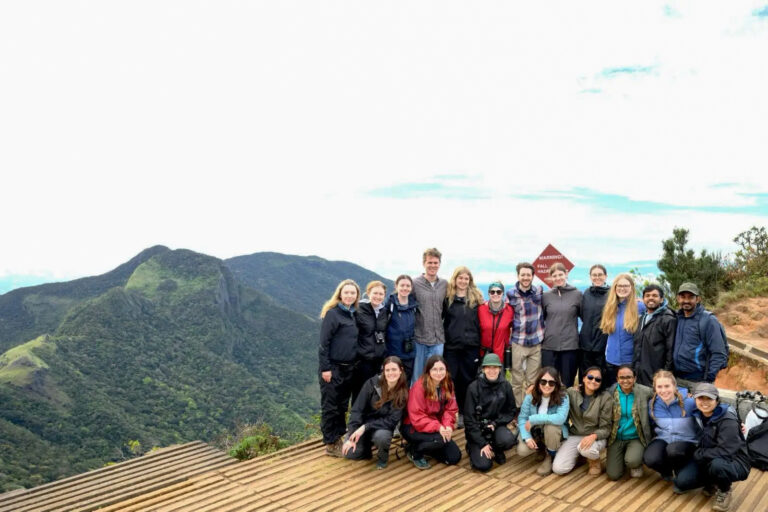
16 biology students and one professor have arrived back in Canada safely after being trapped in Qatar due to an ongoing conflict in the Middle East.
After nine days of being stranded in Doha, Qatar, due to the ongoing war between Iran, Israel, and the United States, 16 Queen’s biology students and Professor Stephen Lougheed safely arrived home to Canada on March 9. The students were originally on what was supposed to be an 11-day overseas field course in Sri Lanka, but found themselves trapped in a Qatar airport as the conflict in the Middle East escalated.
READ MORE: Queen’s students and faculty left in Doha amid regional airspace shutdowns
According to a recent article in the Queen’s Gazette, the Government of Canada helped arrange transportation from Doha to Riyadh, Saudi Arabia, where the students were able to safely travel home.
In an interview with The Journal, a student who was on the field course, Kirsten Blyskosz, MSc ’27, confirmed this. She explained what it was like when they were initially told their flight was turning around amid escalating conflict in Iran.
Blyskosz said the group was confused when they saw the plane turn around on the in-flight tracking map, before one student received a notification that there had been an attack in their airspace.
“Initially, it was kind of like a shock to all of us. Immediately, anxiety starts to build up because you’re not really sure what’s going on. We don’t know how safe we are in the airspace we’re flying through,” Blyskosz said.
Eventually, they got back to the airport; although it was a chaotic scene, as she described it.
“There were people rushing everywhere because it wasn’t just like planes that were flying to Doha that landed, it was also anybody in the airspace [being] redirected to land at the airport, so it was very hectic situation.”
She said the Queen’s group planned to wait it out in the airport, not knowing how long it’d take but hoping to get back on a plane soon. They settled in an airport lounge, but after a missile struck near a separate airport in the Middle East, they were forced to evacuate to a hotel for their safety.
After the evacuation, security concerns persisted, with Blyskosz recounting hearing explosions in the distance even after arriving to the hotel.
“[We were told that] Qatar has a fairly technologically advanced air defence system, so they explained to us that a lot of what we were hearing was actually interceptions and not missiles actually hitting land, which kind of made us feel a little bit better, but it’s still not a comforting noise.”
They were given a hotel voucher for a day, hoping that was all the time they’d need to stay there. Little did they know, they’d be stranded in that hotel for over a week.
Over that time, though, Blyskosz explained that a bond was formed between the students, their professor, and the other individuals stuck in the hotel.
“We learned more about each other, it was a sense of togetherness, and we were able to come together as a little family and support each other in any ways that we could while we were there.”
She said that while Professor Lougheed served as the group’s main liaison with Queen’s and government agencies, students were also in direct contact with the University by e-mail, receiving messages telling them not to worry about schoolwork and directing them to available supports.
Eventually, they received an e-mail from International SOS offering them a charter bus to Saudi Arabia if they were interested. They opted to take it, being transported in a taxi from their hotel to the bus, where they were ultimately met with the Canadian Ambassador to Qatar and other governmental officials. After some administrative passport checking, they boarded and endured an 11-hour bus ride through the desert.
“[The bus] was also very eerie, because we were safe in our hotel and felt [unsure about] driving through a space that wasn’t as secure as we were previously used to, being in the hotel,” she said. “We were receiving national security alerts on our phones saying, ‘you’re in a dangerous zone,’ so that definitely made us all nervous.”
After arriving in Saudi Arabia safely, she said that Lougheed made sure they had a flight that supported all 17 students, employing a “no man left behind” approach.
Ultimately, they secured a flight, only gaining a sense of partial relief once they landed in Rome for a layover.
“But certainly, arriving at Pearson and seeing all of our family and friends and all of our loved ones was the epitome of our welcome home,” she said.
The reunion was emotional, she explained.
“I think all of us, and our parents included, and everyone that was there, was in tears. It was definitely such a great way to be welcomed home, be greeted by all the people we love and who supported us throughout this time.”
Now, she says students are still reintegrating back into school slowly, but that everyone is dealing with things differently.
She added that she doesn’t want their situation to be used to discourage field courses in the future, explaining their situation wasn’t foreseeable and that these trips are important for shaping biologists.
Queen’s thanked Global Affairs Canada for its assistance and Lougheed for his leadership in creating a positive space for the students during such a trying time.
The University also recognized the event’s stressful and challenging nature, commending the students for their strength and resilience. They also added that Queen’s is currently arranging counselling and other supportive measures for the group.
Tags
Field trip, Iran, Stranded, Stranded flight
All final editorial decisions are made by the Editor(s) in Chief and/or the Managing Editor. Authors should not be contacted, targeted, or harassed under any circumstances. If you have any grievances with this article, please direct your comments to eic@queensjournal.ca.
Ramiro Ratke
Really liked this post, very easy to follow. I enjoy your content, keep sharing more like this.