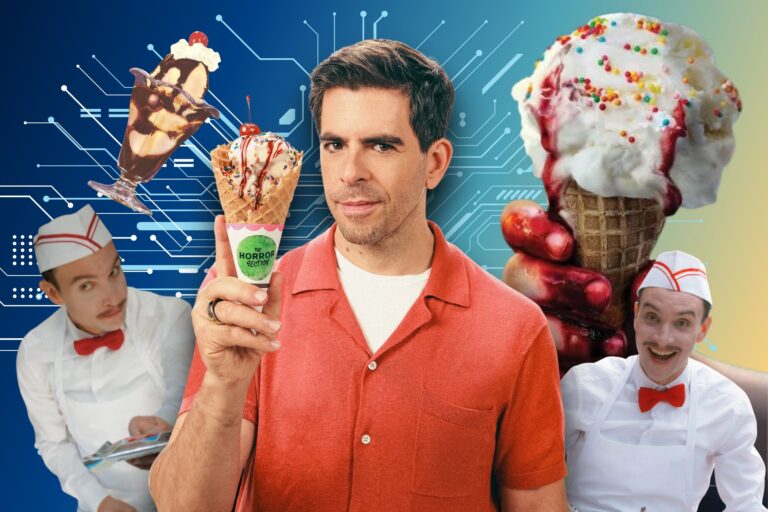
Despite mashing the ingredients of Cooties, Weapons, and Terrifier together to produce a satisfying splatter-slasher-comedy, Eli Roth‘s Ice Cream Man‘s reliance on generative AI is a recipe for disaster that’s giving audiences and critics alike a brain freeze.
Released on Aug. 7, Ice Cream Man follows Bayleen Bay’s ruin as children eat sweet treats that give them bloodthirsty appetites. As possessed kids gruesomely kill off every teacher, parent, and adult in sight, young lactose-intolerant Jared Mayfair and his older sister, Lizzie, must stop the carnage.
Although b-movie horror anticipates campy storylines and excessive bloodshed, Ice Cream Man lacks the low-budget flick’s quintessential charm, making it impossible to even believe it’s so bad that it’s good. Underneath Ice Cream Man‘s whimsical playground mayhem and practical gore lies a half-baked storyline without compelling characters or a cathartic ending that makes its violence worthwhile.
The film’s only intriguing character is its titular Ice Cream Man, who is brought to life by Kingston-born Ari Millen. Despite Millen’s short screentime, he carefully characterizes the Ice Cream Man through creepy gestures and unsettling smiles to give each of his scenes an eerie atmosphere.
However, the character itself is written as less of a terrifying Art the Clown-type of antagonist with sickening kills and more of a silent background role. For a horror feature with the sole focus of graphic violence, it’s unfortunate that the killer cannot kill. Instead, the Ice Cream Man weaponizes kids to do his evil biddings as he waits in his ice cream truck.
Don’t worry gorehounds, Ice Cream Man still has plenty of unnecessary violence, to the point where it’s boringly repetitive. When gore is used as a substitute for suspense, slaughter goes from shocking to predictable. Sure, it’s cool at first to watch kids play jump rope with guts, behead their mothers, and eat scoops of brains for dessert, but it’s exhausting when gore is all that happens during an hour-long runtime.
It should be mentioned though that these disguising prosthetics and gross practical effects are masterfully designed. Steve Newburn, the prosthetic effects supervisor for Guillermo del Toro’s Frankenstein, and Academy Award winning Adrien Morot, the special effects artist for The Wale, are amongst Ice Cream Man‘s effects team. Their human artistry gives gore its grit, but the lifelong skills behind these practical effects contradict Roth’s blatant use of AI.
If it wasn’t obvious by its uncanny cartoons and flashbacks, Ice Cream Man used generative AI through Dark Half, a visual effects company that blends generative AI with traditional filmmaking.
Although Roth said the animation was hand-drawn, after being confronted by Polygon, Roth admitted, “I misspoke. AI was used in a very small portion of a few scenes. It was an opportunity where technology and creativity came together to help bring my vision for the film to life.”
But for anyone who managed to sit through an entire screening, “very small” appears to be an understatement.
While Roth has not confirmed the extent of AI in Ice Cream Man, several scenes are speculated to have been generated or enhanced by AI, including its animation and flashback sequences.
It’s unfortunate enough that the Mickey Mouse cartoon-style thought bubbles, which represent the children’s distorted perspective of the world, seem to be AI-generated. Beyond Roth’s missed opportunity to hire animators, the flashback sequences that explain the Ice Cream Man’s villain origin story are also theorized to be AI-generated.
However, Dark Half’s tools also have the power to “compos[te] AI into live-action footage.” As some modern post-production studios move away from CGI in favour of merging real footage with AI-generated visual effects, final cuts can be cost-effectively generated with prompts and references. Thus, it’s difficult to determine how AI was involved in the creation of Ice Cream Man without clarification from Roth.
While Ice Cream Man‘s use of generative AI leaves a bad taste in the mouth, its problematic humour is nauseating. Ableist slurs and controversial jokes about eating disorders are carelessly thrown around as if the script was written by a teenage edgelord rather than an established filmmaker.
Unsurprisingly, Ice Cream Man is not financially backed by massive media production companies.
In fact, Roth dodged major studios to preserve control over his film’s content, leading him to create his own studio, The Horror Section, to own his creations and produce horror films in his vision.
“Why should I create something and then give away ownership?” Roth said in an interview with Variety.
While it’s admirable to avoid the studio system, his concern over losing creative freedom and ownership is contradictory given the endless debates on who can claim authorship over AI-generated art. Ice Cream Man was created with frontier AI models trained on vast amounts of data containing existing human art that Roth has no claim over.
As a well-known director in cinema’s most boundary-breaking genre, Roth’s new slasher is an anomaly amongst this summer’s radical horror releases.
What could have been his next Cabin Fever or Hostel, Ice Cream Man is an AI slopfest devoid of the passion his previous works had. His style of chaos and creativity is what makes his other films worth watching, but this one is worth skipping.
Tags
AI, Eli Roth, horror, Ice Cream Man
All final editorial decisions are made by the Editor(s) in Chief and/or the Managing Editor. Authors should not be contacted, targeted, or harassed under any circumstances. If you have any grievances with this article, please direct your comments to eic@queensjournal.ca.