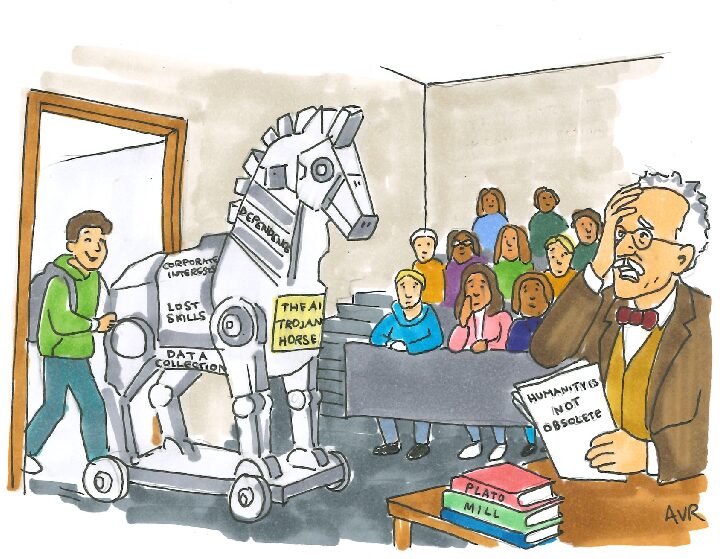
AI is growing everywhere, but it has to stay out of education.
As the usage and technological advancements made in AI have accelerated, so too have the number of conversations surrounding how it should be used. Central to this debate is the question of where AI does, and does not, belong. These kinds of policy discussions require a balance of pros and cons, but in the case of education, the scale is quite lopsided.
Societal reluctance notwithstanding, AI clearly isn’t going anywhere, and it will only improve in its capacity and capability. A blanket ban on the technology, even in universities, would be equally unenforceable and futile.
It may also be argued that AI does present tangible use cases and has proven to be useful in certain sectors — most prominently in business administration and certain STEM-related fields. As such, the case for AI is often presented through a business, profit-oriented lens.
However, as students, and as the first generation to have this technology imposed on us, we are acutely aware that AI is actively transforming broader society.
In the student body alone, AI use is nearly ubiquitous. AI is being used to write essays, to take reading notes, provide seminar material, and to complete assignments. The issue is so prevalent that courses now explicitly designed with the usage of AI in mind, either through an open acceptance of the technology, or through prioritizing more in-person exams where AI cannot be used.
Our proximity to AI merits serious concern. AI is killing our creative thinking and hindering our artistic expression. It subverts, sublimates, and replaces our faculties for critical thinking, and even our ability to develop invaluable life skills such as presenting ourselves as individuals.
In fact, AI is precisely the antithesis of individuality. It is impersonal and output-oriented, focusing only on results, not process.
Perhaps for this reason, when AI is touted as valuable technology to integrate into education, it’s almost exclusively directed at fields such as computer science and engineering, but never the arts.
That is not by accident.
The arts rely on the ability to express a unique and individualized perspective on the world, a process that innately requires the ability to think critically, precisely what AI actively represses.
Given the broader societal push away from arts towards impersonal, output-oriented fields, it shouldn’t surprise us that those who advocate implementing AI in education place little emphasis on how the arts will be disproportionately harmed.
For students, however, incorporating AI into our education will not teach us how to use the technology effectively; it will only make us more dependent on it.
All these questions matter because as this technology progresses, and as Queen’s works to develop its AI policy, this issue will become more prevalent.
It’s becoming more obvious now that AI is a systemic issue that is fundamentally changing the nature of post-secondary education. Queen’s is not alone here, as this impacts every university not only in Canada, but around the world.
Core academic principles are required to address the crisis: A commitment to academic integrity, collaboration with international institutions around the world, and a clear emphasis on human-centric learning, not machine centric learning.
Despite the seemingly inevitable integration of AI into virtually every aspect of society, we must resist incorporating this technology into our education. Our values must be concrete, and our core educational goals must remain interpersonal, rather than impersonal.
AI has already changed the way we approach education, and its negatives impacts are obvious. We need to recognize those impacts and approach change through less AI, not more.
— Journal Editorial Board
Tags
AI, AI policy, Education, Queen's
All final editorial decisions are made by the Editor(s) in Chief and/or the Managing Editor. Authors should not be contacted, targeted, or harassed under any circumstances. If you have any grievances with this article, please direct your comments to eic@queensjournal.ca.