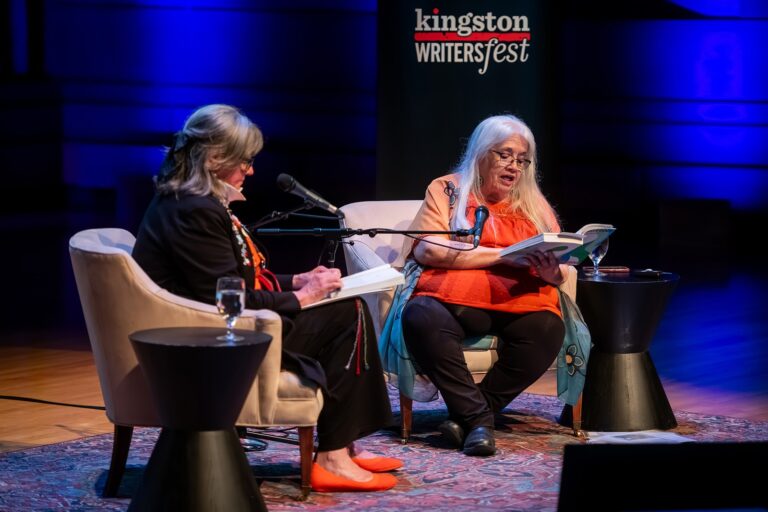
On the National Day for Truth and Reconciliation, Cree writer and lawyer Michelle Good commenced this year’s Kingston WritersFest festival with her panel, “Sculpted by Storms,” collaboratively produced alongside LodgePole Arts Alliance.
In conversation with former Métis broadcast-journalist and Queen’s chancellor Shelagh Rogers, ArtSci ’77, Good and Rogers discussed colonial violence, intergenerational trauma, and how resilience can emerge from survival. The panel was hosted at the Isabel Bader Centre on Sept. 30 at 7:00 p.m.
A member of the Red Pheasant Cree Nation, Good started her career as an activist then earned her law degree as a single mother to advocate for residential school survivors. While practicing law at her own firm, Good earned a Master of Fine Arts in Creative Writing to explore how historical fiction can document Indigenous history.
Good’s critically acclaimed debut, Five Little Indians, explores five survivors rebuilding their lives after enduring Canada’s abusive residential school system. Written in response to why Indigenous peoples cannot “get over” their collective trauma, Good answered why reconciliation requires truth.
In her new novel, Eliza Sunshine, Good confronts the question of “how Indigenous women became disposable.” Spanning three generations of Cree women to explore their freedom over the last century, the story follows Eliza Sunshine, her Nôhkom, which means grandmother, Swan, and her daughter, Ella.
The panel began with Armand Garnet Ruffo, an associate professor in the Department of English and Languages, Literatures, and Cultures, starting the night by inviting Kanonhsyonne (Janice Hill), Queen’s retired associate vice-principal (indigenous initiatives and reconciliation), to the stage to recite a Mohawk prayer.
Afterwards, Indigenous Juno-nominated singer-songwriter Kym Gouchie performed.
“What a beautiful sea of orange,” Gouchie said to the crowd, who filled Isabel’s performance hall with orange shirts.
Gouchie performed “Strong Women’s Song,” “Water is Life,” then taught the audience how to count to ten in Dakelh, a Carrier language experiencing a resurgence, through a call and response song.
At around 7:40 p.m., Good and Rogers began the panel by acknowledging the National Day for Truth and Reconciliation as a “signpost of profound success and progress.”
“In spite of all of the influence in the colonial toolkit that are designed to destroy us, here we are,” Good told the crowd.
Rogers began by asking Good about the origin story of Eliza Sunshine, as it is a response to her own family’s history.
In 1999, Good’s mother, Martha Eliza, nicknamed Sunshine, was diagnosed with terminal cancer.
“She just looked out the window and she said, ‘Somebody tell my story,” Good recounted. “I’m pleased that I kept my unspoken promise to my mother.”
Influenced by her family, Good presented scanned photographs to the crowd and explained how their history shaped the novel’s intergenerational narrative. The photos depicted her Nôhkom’s cut hair, her family standing behind barbed wire fencing, and her mother on her wedding day.
“It was a reckoning writing this book. It was a reckoning with the truth of our history […] to promote an understanding of Canadian history through an Indigenous lens,” Good explained.
As she read Eliza Sunshine‘s first paragraph, Good recalled the quote: “Every dead buffalo is an Indian gone.” Throughout the talk, Good returned to the decimation of the buffalo as a means to destroy Indigenous culture and risk their survival.
Further, Good discussed her own mother’s experiences marrying into a white family, and how those adversities shaped Eliza Sunshine’s relationship with Ella.
“What is so ironic about, you know, how brutal my grandmother was to her is that it was my mother that cared for her during palliative plans, and it was my mother that my grandmother wanted to care for her,” Good explains.
The family’s tension in the novel over cultural expression “takes Eliza back to making peace with that part of herself.” Eliza Sunshine’s daughter, Ella, “raised with the freedom of a white girl,” leaves the city she was raised in to reconnect with her Indigenous culture, eventually becoming involved in the Indigenous Friendship Centre movement.
An activist herself, Good then told a story regarding the ignorance surrounding Indigenous culture during her time advocating for the Child Welfare Caravan. Although her panel was packed with stories, one left the crowd heartbroken as Good discussed one encounter with a family whose children had been stolen.
“The reason that they were apprehended was because the social worker said there was no food in house. Now, this was a family that was living traditionally on their trapline in their own part of British Columbia,” Good explained. “The rafters were jam packed with dry meat and the social worker said: we thought they were rags.”
After a brief question-and-answer period, Michelle Good concluded the panel by reading an excerpt from Eliza Sunshine‘s ending to discuss her novel’s possibility of hope amidst its grief.
“Hope is a fire,” Good told the crowd.
Tags
Kingston WritersFest, National Day for Truth and Reconciliation, Shelagh Rogers
All final editorial decisions are made by the Editor(s) in Chief and/or the Managing Editor. Authors should not be contacted, targeted, or harassed under any circumstances. If you have any grievances with this article, please direct your comments to eic@queensjournal.ca.