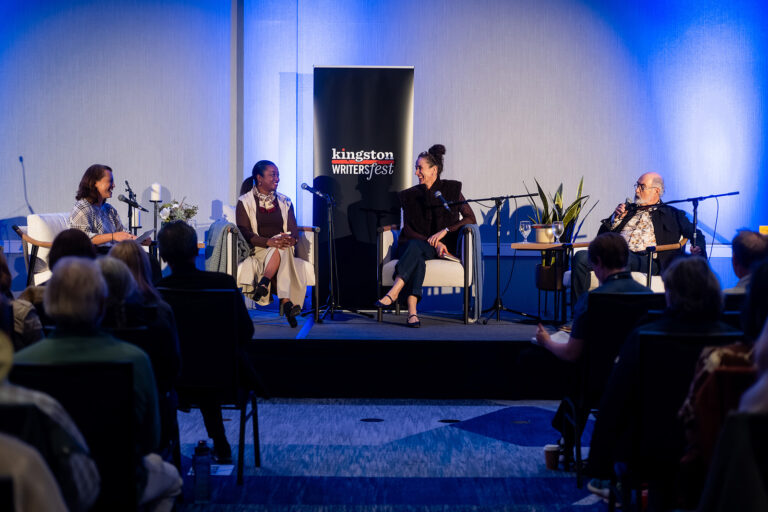
At the Kingston WritersFest‘s Short Story Showcase, three writers discussed their writing influences, food symbolism, and different approaches to the short form.
On Oct. 1 at 7:00 p.m. at the Kingston Marriott, the moderator, writer and Queen’s Professor Sarah Tsiang, introduced the three panelists: Chanel Sutherland, Jess Gibson, and Wayne Grady, all of whom debuted their short story collections this year.
Tsiang began by asking the panelists who influenced their writing journeys.
Chanel Sutherland‘s soulful debut, Layaway Child, explores her experience as a Caribbean immigrant from Saint Vincent through stories about girlhood, displacement, and longing.
Sutherland’s first storyteller was her grandmother, who inspired her to start storytelling.
“I grew up in a culture where we actually told stories. We didn’t have access to books, so [my grandmother] had to get creative,” Sutherland explained. “I was about six years old when I realized I wanted to be like her. I wanted to tell stories the way my grandmother tells stories.”
Similarly, art-historian-turned-writer Jess Gibson grew up in a “storytelling family,” having been raised by literary legend Margaret Atwood and novelist Graeme Gibson. In her short story collection, The Good Eye, Gibson follows unexpected encounters across a range of characters and settings, many of which were inspired by her family’s stories.
Whereas in Wayne Grady‘s short story collection, The Cartel and Other Cover Stories, he shared that he found creative influence in the Canadian short story anthology he put together in 1980, which includes authors he admires.
During the talk, Tsiang noted that some short stories from their collections all share food as a symbol for culture, class, and identity.
Here, Tsiang asked Sutherland to read an excerpt from “Friends Like These”. This passage explores the significance of cultural dishes, such as couscous and ducana, and how the narrator is taken aback when these dishes are served to those who do not respect them.
Sutherland explained that food is significant to her collection because food represents home.
“Coming to Canada, in my experience as an immigrant moving here, food was a connection to home. […] That’s why we call it comfort food. So, in that way, I think it’s very integral to the immigrant experience,” Sutherland explained.
Then, Tsiang asked Gibson to read an excerpt from “Intake,” which follows a caregiver who comes across a retired chef’s old French cookbooks. After, Gibson shared that she inherited her paternal grandmother’s cookbooks, which had handwritten notes, shopping lists, and bills, and how these keepsakes shaped her approach to food as caretaking.
“They were all tucked inside this worn copy of essentially an early copy of The Joy of Cooking,” Gibson said. “This gave me this sense of a person through what they had been making for other people, which is effectively what happens in this story.”
Following Gibson’s reading, Tsiang asked Grady to read an excerpt from “La Gordita.” Inspired by Guy de Maupassant‘s “Boule de Suif.” Grady similarly approaches food as a symbol of obligation with the protagonist, Gordita, nicknamed after the traditional Mexican dish.
“From the very beginning, she is kind of a meal herself,” Grady said. “So, they look down on her until they get hungry.”
Eventually, the panel progressed into a discussion about the writers’ approaches to short stories and their processes.
In Layaway Child, Sutherland connects her short stories through recurring characters.
She shared with the crowd that she immerses herself into the characters by striking up conversations with herself acting as the different characters.
“I need to completely embody them,” Sutherland said.
In The Cartel and Other Cover Stories, Grady said that he approached covering the works of other authors like translating a story from another language. “It’s like their story, but it’s also your story,” Grady said.
For The Good Eye, Gibson explained that while she is drawn to the short form’s precision, she approached her stories with this specific form in mind because it was “circumstantially helpful” when raising her child while writing, as she could write during the duration of a nursing session.
Gibson then read an excerpt of “The Lady of the Moonlight” to explore her abrupt and ambiguous approach to ending stories.
“I like uncertainty,” Gibson told the crowd. “I’ve intentionally pulled back a little bit at the end, which I know that some readers might find frustrating.”
Gibson reflected on this matter further. “Looking back at these stories, I think I like to end a beat before,” she said, an answer that marked the perfect conclusion to the panel.
Before attendees left, Tsiang plugged the Kingston WritersFest’s “Poetry 2 Go” fundraiser.
Tags
Canadian literature, Kingston WritersFest, short stories
All final editorial decisions are made by the Editor(s) in Chief and/or the Managing Editor. Authors should not be contacted, targeted, or harassed under any circumstances. If you have any grievances with this article, please direct your comments to eic@queensjournal.ca.