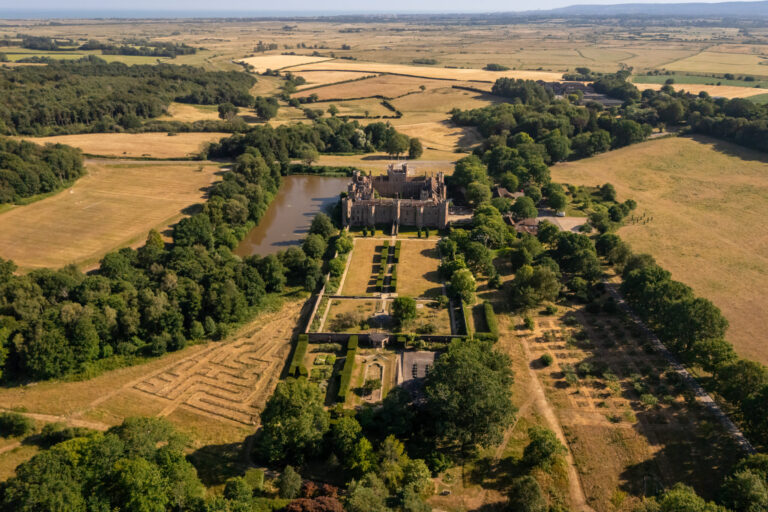
Bader College will officially launch a long-term rewilding initiative at the Herstmonceux Castle estate in East Sussex, United Kingdom.
The college is partnering with Nattergal, a U.K.-based nature restoration company, to restore 240 acres of the 600-acre estate into a rewilding area and living laboratory where students and researchers can study changes in biodiversity over time. The project will officially launch on Oct. 25 and 26.
In an interview with The Journal, Provost and Vice-Principal (Academic) Matthew Evans said the project will return previously farmed land to nature using what he described as a “relatively low intervention” approach to rewilding.
Rather than relying heavily on restoration methods such as tree planting, the project will let nature run its course by allowing trees to regenerate naturally, animals to disperse seeds, and plants to establish themselves with limited human intervention.
“We’re trying to let, you know, nature lead the way,” Evans said.
Evans said he hopes the project will be viewed as a positive contribution to Queen’s values, specifically the University’s sustainability goals. He pointed to the University’s Climate Action Plan, which includes a goal of reaching net-zero greenhouse gas emissions by 2040.
Planning for the project began before the castle closed in November 2023. The college closed for two years because of serious structural issues at the castle estate, including the roof requiring repair and the south side of the castle at risk of collapse.
READ MORE: Bader College closed, uncertainty remains
The estate had previously rented portions of the land to local farmers for agricultural use, but Evans described it as “relatively unproductive farmland.”
“There’s more value to be obtained by devoting it to rewilding,” he said.
The project will be funded through the U.K.’s Biodiversity Net Gain (BNG) system.
According to Essex Wildlife Trust, the BNG system was first introduced through the U.K.’s 2021 Environment Act and requires that developments “deliver a measurable increase in natural habitats and ecological features compared to their pre-development state.”
According to the U.K government, BNG is part of England’s planning system and requires most developments to deliver at least 10 per cent increase in biodiversity compared with a site’s pre-development value. Developers that can’t meet the requirement entirely can purchase biodiversity units — the standard currency used in the U.K. to measure the ecological value of land — generated through registered off-site habitat projects.
“Because [they are] essentially destroying the biodiversity over there, [they are] going to pay you to increase the biodiversity over here,” Evans said.
Evans said revenue generated through the BNG system will be reinvested into the estate and rewilding project. Queen’s provided upfront funding for the initiative, which Evans described as “not a huge amount of money,” and he expects revenue from the project to repay that investment within a few years.
He added the University could potentially raise £15 million through the BNG system. According to a 2026 Queen’s Gazette article, Nattergal will manage the sale of BNG units generated through the estate’s habitat restoration to developers seeking to meet biodiversity requirements.
According to ACP Consultants, BNG units can be purchased by developers who cannot achieve the required 10 per cent biodiversity net gain on their own development site.
Evans said the University also plans to sign a Conservation Covenant — a voluntary legal agreement used to protect land for conservation purposes — with the British government. He expects the agreement to be signed before the end of the year. It will protect the rewilding area for a minimum of 30 years.
“We want to be very clear that we are committed to this for a long period of time,” Evans said.
Nattergal is now designing interventions to help accelerate the return of nature to previously agriculturalized land, Evans said. These could include cutting grass in a particular way, placing dead wood on the ground, and using grazing animals to manage the landscape.
The interventions are expected to begin as early as next spring, followed by regular monitoring. Evans said work is already underway to determine what species currently live on the land so researchers can track changes over time.
When asked what success would look like, Evans said the project could produce a mixture of “spectacular things,” including the return or expansion of species previously lost or diminished on the estate.
He pointed to waxcap mushrooms, which are already common in some areas of the estate, as an example of a species the project hopes to see spread over larger areas.
While there are currently no concrete plans for Kingston-based students to participate in the project without going to the estate itself, Evans said students could potentially use data collected from the site for capstone projects.
According to Evans, two Queen’s students travelled to the estate this past summer to begin research on the land.
Tags
Bader college, Herstmonceux Castle, Provost Matthew Evans
All final editorial decisions are made by the Editor(s) in Chief and/or the Managing Editor. Authors should not be contacted, targeted, or harassed under any circumstances. If you have any grievances with this article, please direct your comments to eic@queensjournal.ca.