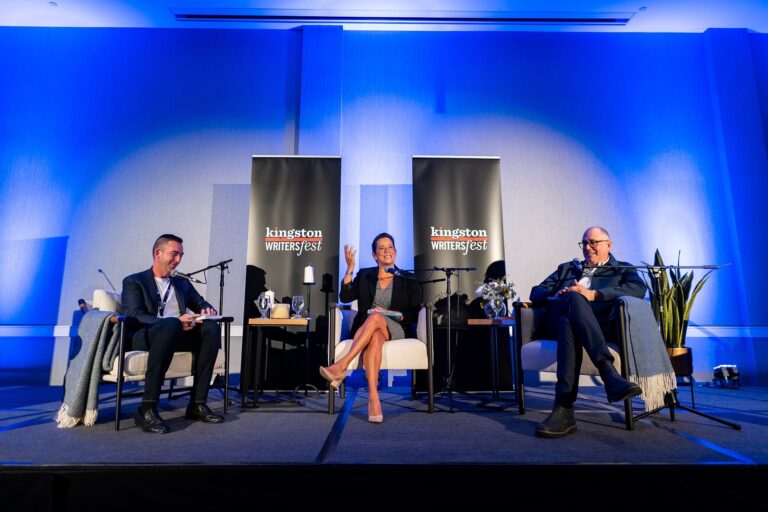
In Seattle, a store clerk gave former Minister of Justice and Attorney General of Canada Jody Wilson-Raybould the words that convinced her to write another book.
“Nothing really makes sense anymore. Our leaders don’t make sense,” Wilson-Raybould recalled him saying.
She shared that story at Kingston WritersFest on Oct. 3, where she and co-author Roshan Danesh joined moderator Kyle Wyatt, Editor-in-Chief of the Literary Review of Canada, at the Kingston Marriott. Their answer to that cynicism is The Inbetween Leader: Cultivating Courage and Unity in a Complex World, released Sept. 29. Drawing on interviews with 80 people, the book argues leadership begins not in title or power, but in the difficult work of standing between people.
Wilson-Raybould, a member of the We Wai Kai Nation, was a Crown prosecutor and Regional Chief of the B.C. Assembly of First Nations before becoming Canada’s Minister of Justice and Attorney General. Danesh, a lawyer and educator whose work spans Indigenous rights and peacebuilding, served as her special counsel on Indigenous reconciliation. Their partnership began around 2009, developing principles for how First Nations in British Columbia would engage with the Crown — work that now grounds the book’s concern with crossing silos without erasing difference.
The book begins by separating leadership from power.
Wilson-Raybould calls those who hold a title without fulfilling its responsibilities “LINOs”— leaders in name only.
“Simply by virtue of achieving a position, a corner office or a political position does not make a leader,” she said during the panel.
Against the “LINO,” the book offers the “inbetweener:” someone who stands neither above nor apart, but between people divided by institutions, history or ideology.
“Where do you position yourself as a leader? […] Above, below, or in between?” Danesh said.
For the authors, standing in between does not mean flattening disagreement. Unity, Danesh stressed, is not uniformity. It requires the slower work of listening, repair, and staying in relationship across difference.
“Building unity is hard,” Danesh said. “We have to do repair and restoration.”
Wilson-Raybould recalled how difficult that work can be inside hierarchical institutions. Early in her time as justice minister, she phoned the public servant whose name appeared on a briefing note rather than routing her question back through the hierarchy.
“They, I think, had a heart attack,” Wilson-Raybould said.
She contrasted Ottawa’s hierarchy with the community-based governance she was raised with, where everyone has a role to play. That approach can collide with politics, where consensus-building meets institutions shaped by speed, partisanship, and rank.
Still, neither author treated that mismatch as a reason for resignation.
“When the world’s horizon darkens,” Danesh said, drawing on his own tradition, “hope is a scarce and precious resource.”
He connected that hope to “constructive resilience”: not simply enduring difficulty, but moving through it in a way that allows change to emerge.
The book repeatedly returns to people whose influence extends far beyond what they could have imagined. Danesh spoke about Wilson-Raybould’s grandmother, who worked alongside others “in the shadows” to help preserve the potlatch, never knowing what her efforts might make possible for future generations.
“Sometimes we don’t see the change that we have facilitated even within our lifetime,” Wilson-Raybould said.
During the question-and-answer period, the final audience question brought that idea directly to younger people entering institutions. A PhD student in leadership studies asked how to know when to push quietly for change, when to disrupt a system, and when to walk away.
Wilson-Raybould advised her to keep a personal “board of directors:” a small circle of people who share her values and will tell her honestly when a risk is worth taking.
Then, she offered a test she uses herself.
At the end of difficult days, Wilson-Raybould said, she looks in the mirror and asks, “Do I still see myself, who I am, who I was raised to be?”
“If that image was getting at all blurry, then I knew I wasn’t making the right decisions.”
Her answer returned the evening to an idea Wilson-Raybould had raised earlier: everyone will eventually be called on to lead, title or not. Her mirror test offered a simpler measure of leadership, one found not in the positions people hold, but in whether they can recognize their values in the choices they make.
Tags
Justice, Kingston WritersFest, Politics
All final editorial decisions are made by the Editor(s) in Chief and/or the Managing Editor. Authors should not be contacted, targeted, or harassed under any circumstances. If you have any grievances with this article, please direct your comments to eic@queensjournal.ca.