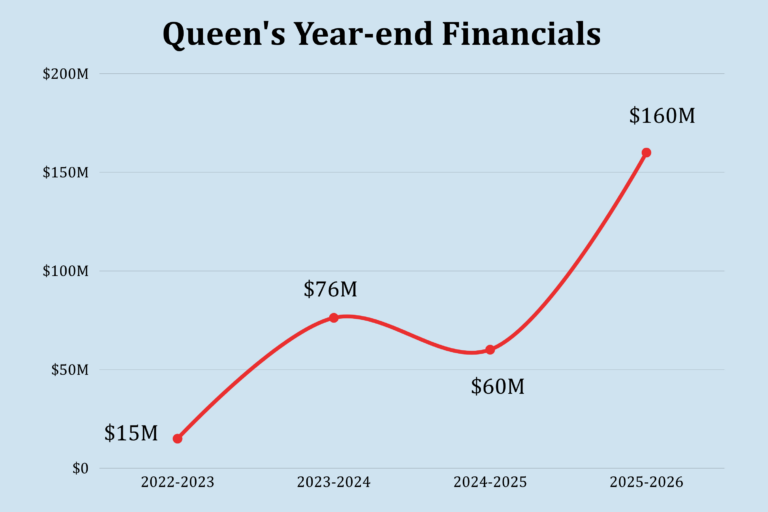
Queen’s reported a $160.4 million consolidated surplus for the 2025-26 fiscal year, largely driven by investment returns, as some faculty question how the University is allocating its resources.
The Board of Trustees approved Queen’s audited consolidated financial statements at its Oct. 2 meeting. The University reported the nine-figure surplus for the April 30 year-end, up from $35.7 million the previous year. Queen’s attributed the increase primarily to strong investment returns.
Although Queen’s reported a $160.4 million surplus, most of that money came from investments rather than its regular operations. Without those investment earnings, the University’s surplus was $16 million.
The difference was even greater in Queen’s operating fund, which funds teaching, staff, and other day-to-day expenses. While the fund reported an $87.5 million surplus, only $800,000 remained when investment income set aside for daily operations was excluded.
In its report, Queen’s said investment returns can fluctuate considerably and shouldn’t be relied on to fund ongoing expenses. The University allocates $10 million annually from its Pooled Investment Fund (PIF) to operations.
The Queen’s Coalition Against Austerity (QCAA) criticized the University’s priorities in an Oct. 2 post, questioning why Queen’s continues to build its financial reserves while faculties face staffing reductions and hiring restrictions.
The group argued more of the University’s investment earnings should be directed toward teaching, faculty hiring, and maintaining existing campus infrastructure instead of accumulating in reserves.
Samantha King, a professor and director in kinesiology and health studies, questioned the University’s approach to allocating those returns.
“Investment income is treated like an aberration every year, despite these consistent surpluses,” King said in an interview with The Journal.
Investment income contributes to growing reserves
Queen’s reported $189.6 million in general capital reserves at the end of 2025-26, up from $127.7 million the previous year. The financial statements describe general capital reserves as funding available for strategic capital investment priorities.
QCAA calculated Queen’s total capital reserves grew from $164 million in 2023, when the Faculty of Arts and Science (FAS) hiring freeze began, to approximately $306 million in 2025-26. That figure includes both the University’s $189.6 million in general capital reserves and approximately $116.5 million categorized as other capital reserves and projects in progress.
At the Oct. 2 Board of Trustees meeting, Provost and Vice-Principal (Academic) Matthew Evans said using variable investment returns to fund permanent positions could leave the University unable to support those expenses in years when returns fall.
King suggested a portion of the reserves could be maintained to offset years with weaker investment returns, allowing some investment income to support operations more consistently.
“The other thing would be to use some of that $142 million for reserve that could buffer down the years when investments do dip,” King said. “There could be an amount of investment that goes to operations safely on a yearly basis with this buffer in place.”
The University’s Transition Fund has also grown, increasing from $39.9 million in 2024-25 to $49.7 million in 2025-26, prompting questions from King.
“What is that fund being used for, and why is it being prioritized over funding faculties and funding teaching?” King said.
In a November 2025 statement to The Journal, Queen’s said the Transition Fund supports academic and administrative priorities, including the Queen’s Renew program, technology investments, and efforts to maintain a sustainable operating budget.
Faculty reductions raise concerns over teaching
Ending the hiring freeze in the FAS would be King’s first priority for additional University spending.
She argues these policies have affected the number and types of courses faculties can offer as the University continues to enrol more students.
She said hiring more faculty should be “the immediate thing to invest in so that we can run enough courses and run our programs and students can get the quality of education they deserve.”
Larger classes and fewer instructors have changed how students are taught and assessed, she argues.
“Students aren’t getting the chance to write as much as they used to,” she said. “They’re not getting the kind of individual attention that we know benefits students.”
Tags
Financial statements, Operating fund, surplus
All final editorial decisions are made by the Editor(s) in Chief and/or the Managing Editor. Authors should not be contacted, targeted, or harassed under any circumstances. If you have any grievances with this article, please direct your comments to eic@queensjournal.ca.