The cancellation of military fellowships sends a troubling message about the role of education in the military.
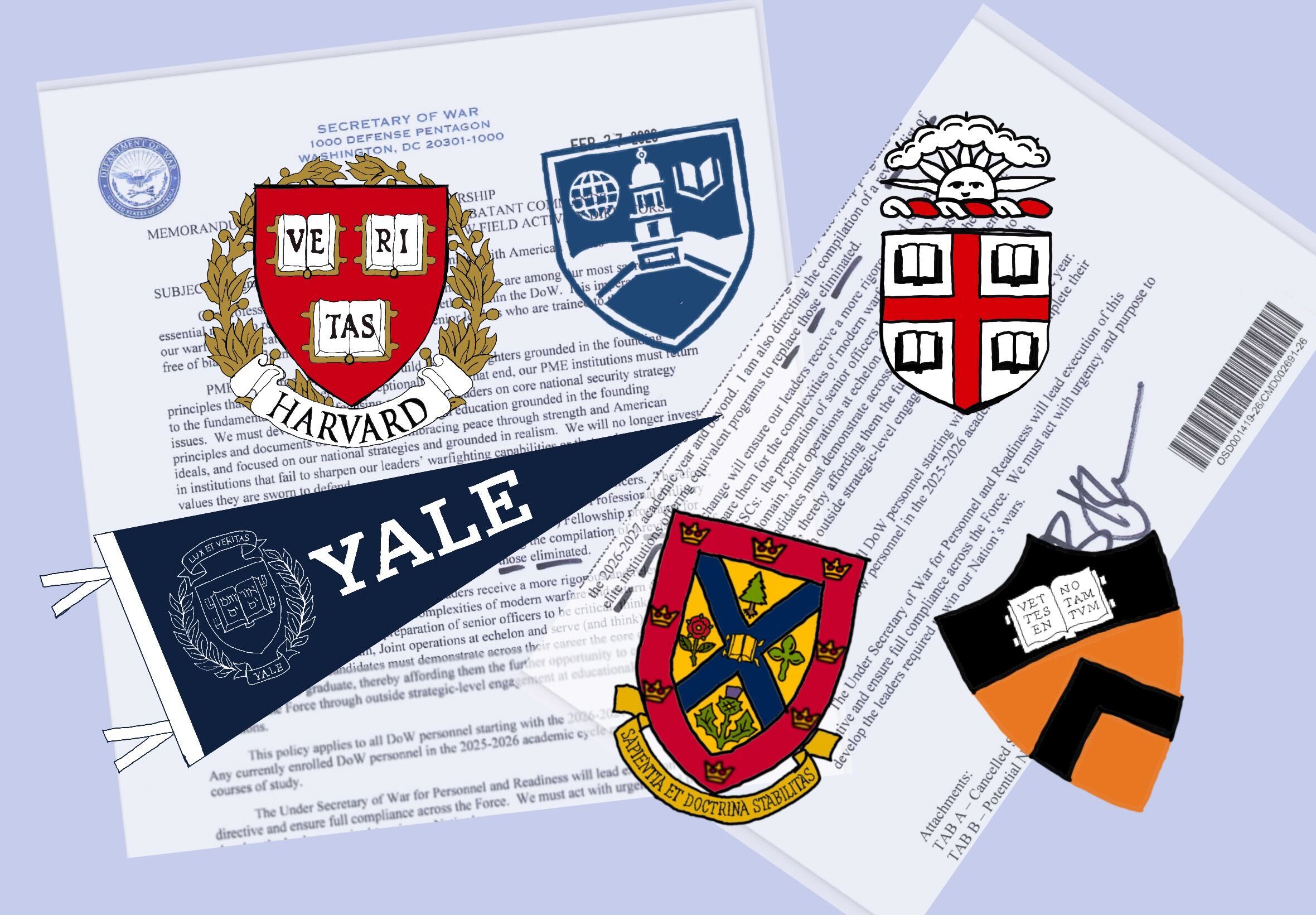
On Feb 27, the Pentagon released a memo announcing that they’ll be cancelling Senior Service Fellowships at 22 different institutions, Queen’s included as the only Canadian university. Following the announcement, Pete Hegseth, the U.S. secretary of war, stated on X that the listed universities were subjecting the U.S “warriors” to “woke indoctrination.” It’s unfortunate to see condemnation of educational institutions in the military, especially because critical thinking is essential for senior service members. The memo comes as yet another symbol of the Trump administration’s attack on higher education.
Time and time again, the Trump administration has sought to vilify higher education as “woke” instead of acknowledging the importance of education and critical thinking. Framing education as a tool of indoctrination dismisses its value, and forbids important lessons such as those on diversity and gender identity.
Universities are supposed to be the cite of knowledge and critical thinking. If these institutions are producing people “indoctrinated with wokeness,” it’s possible graduates just have the right ideas.
“Wokeness” refers to an active awareness of systemic social injustices, particularly racism, sexism, and inequality, awareness that should be important to senior service members. Hegseth’s condemnation of higher education suggests he doesn’t want service members to be attuned to these injustices, indicating a concerning shift away from critical thought in the military.
Many of the schools included on the list were from the Ivey League, which is especially ironic as Hegseth himself attended Princeton, and clearly it failed to “indoctrinate” him with “wokeness.” Ivy League schools are among the top ranked universities in the U.S. It’s surprising to see well renowned educational institutions deemed inadequate for senior military service members.
In some ways, Hegseth’s post on X was paternalistic, assuming senior service members can’t form their own opinions. The pervasive belief that people can’t think for themselves can cause inadvertent censorship, stemming from the belief that the public, or in this case the military, needs to be protected from dangerous or unsuitable information. These assumptions create bias and build echo chambers—the last thing senior service members should be exposed to.
The document said the Department of War would be “strategically refocusing.” The content of this refocus has yet to be revealed, but one notable point is that the document has mostly replaced secular institutions with private Christian universities. The shift in alignment is especially concerning for a military that claims to be officially neutral and secular in policy.
Senior Service members navigate complex challenges. Doing this without a well-rounded education is challenging, and unsupported by the recent cancellations. While military education is set to be refocused, it remains to be seen if the new effort will support a critical education.
Framing education as ideological “indoctrination” not only misrepresents the purpose of universities but erodes the value of critical thought for senior service members.
—Journal Editorial Board
Tags
Education, military, Military Fellowships, Trump
All final editorial decisions are made by the Editor(s) in Chief and/or the Managing Editor. Authors should not be contacted, targeted, or harassed under any circumstances. If you have any grievances with this article, please direct your comments to eic@queensjournal.ca.
Anon
You can’t declare a war on wokeness a “war on critical thinking” when so many woke beliefs require unquestioning loyalty, with penalties for those who hold alternate opinions and beliefs. The whole notion of critical thinking is being open to questioning everything and developing one’s own coherent worldview, rather than being told what and how to think.
“The Coddling of the American Mind” should be required reading for anyone unconcerned with “wokeness” on North American university campuses.
Anon but left
“Wokeness” involves questioning existing systems and how they were built to negatively impact certain groups. Much more critical thinking than the cult that is MAGA.