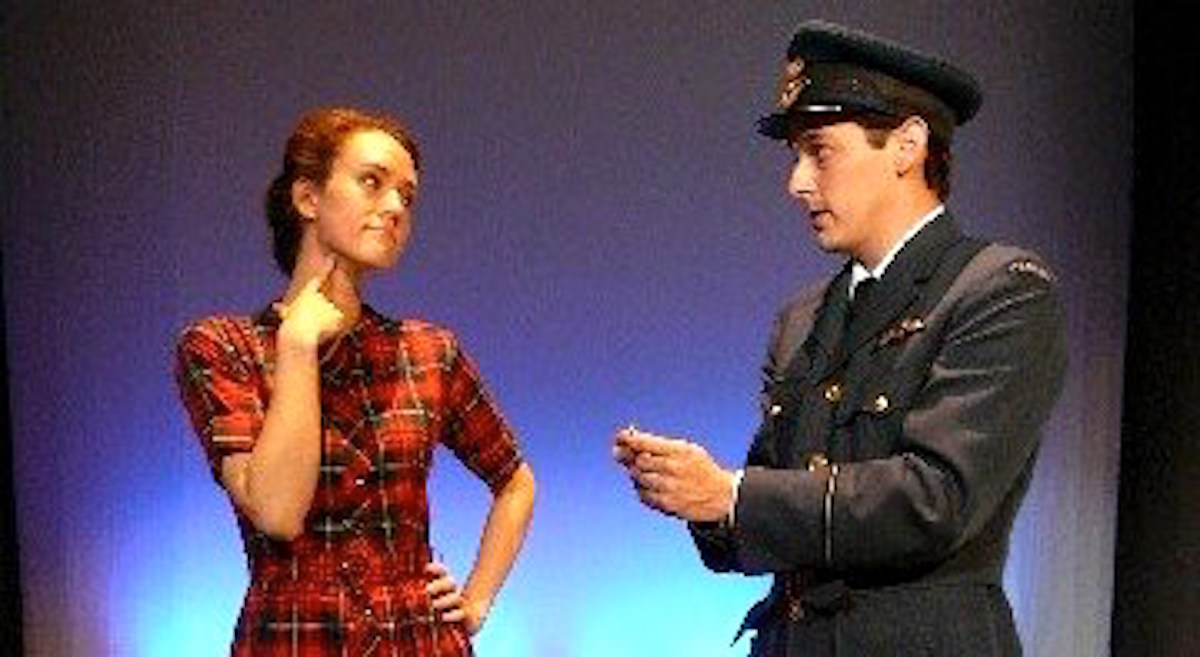
Domino Theatre’s production of Letters in Wartime follows a young couple surrounded by the stresses of war.
The play runs from Sept. 3-19, from Thursday to Saturday. It’s held in the intimate Davies Foundation Auditorium.
Set during the Second World War, this dramatic production features a two-person cast playing the characters of Allan and Moira. The tiny cast, along with the small crew and simplistic stage production, together make for a truly unique show.
Sarah Burton, a Masters student at Queen’s who plays the role of Moira, said the crew quickly understood that a two-person play was both a blessing and a curse.
“Letters in Wartime is a very personal and intimate play comparatively to a lot of the larger casts that they have. It added a lot of diversity to the roster,” Burton said.
“Of course, the threat with a play like this is that you don’t want it to be too static. You can’t rely on slapstick or comedy for this play.”
Burton said the show’s director, Frances Berry, is exceptionally knowledgeable when it comes to the background of the production.
“Frances was a wealth of knowledge on all these little anecdotes that help you get into the mindset of the character,” Burton said.
The play is meant to educate the audience and portray veterans as humans rather than products of war. The story sheds light on some of the experiences of the veterans, particularly the struggle with mental health issues.
“The playwrights wrote the play originally as a rebuttal to the documentaries about World War II,” she said.
“They felt there had been an injustice as most documentaries focused on the politics of the war rather than things like PTSD [Post-Traumatic Stress Disorder] where there was radio silence.”
The play also includes themes such as female empowerment — explored through Moira’s unconventionally ambitious female character — and the difficulty of maintaining relationships throughout the war.
“People very much had to compartmentalize their emotions during the war. For men, it was sort of a questioning of their masculinity,” Burton said.
Most of the play’s dialogue is based on a series of letters sent back and forth between the couple. The letters take the audience through the emotional and mental turmoil of war, and as the characters struggle to uphold their relationships during wartime, the audience begins to empathize with them and their need for stability.
The ultimate aim, Burton said, to help audiences understand the hardships of maintaining long-distance relationships in such tough circumstances.
“The main messages would probably be ones of empathy and humanity in war, on all sides,” Burton said.
All final editorial decisions are made by the Editor(s) in Chief and/or the Managing Editor. Authors should not be contacted, targeted, or harassed under any circumstances. If you have any grievances with this article, please direct your comments to eic@queensjournal.ca.