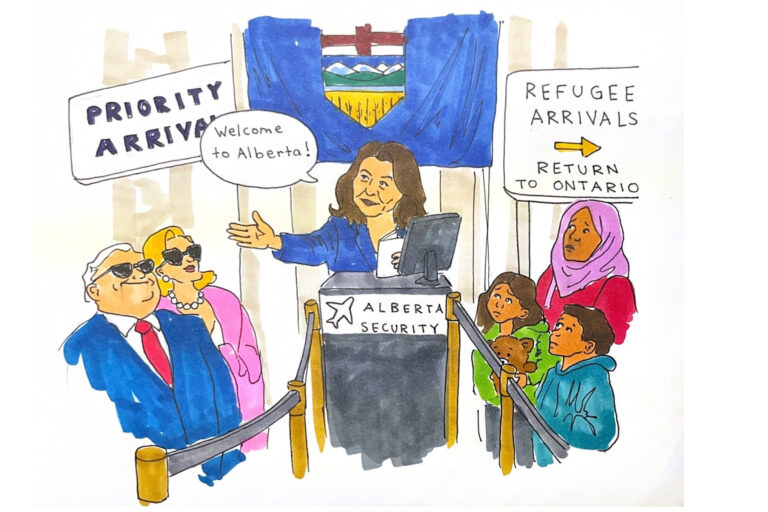
While Alberta’s referendum was defined by the question of separatism, the responses to the other nine questions should raise alarm bells.
On Oct. 19, Albertans voted in a province-wide referendum on 10 controversial questions, the most prominent of which was about Alberta’s future in Canada. The question of whether to hold a binding referendum on separation was decidedly rejected, with roughly 75 per cent of respondents voting to remain in Canada.
The notion of Albertan separatism has finally been put to rest, at least in an official capacity, and this should be cause for a sigh of relief. However, the closer you look at the Albertan referendum, the more problematic it becomes.
Take, for example, the issue of education and healthcare. Question four asked Albertans whether they’d support forcing non-permanent residents — which would include refugees and international students, among others — to pay a “premium fee” to access the Canadian educational and healthcare system.
In effect, this would imply that both the healthcare and education system would deny basic societal amenities to a non-permanent resident.
In the case of healthcare in particular, Canadians have fought for decades to ensure the right of all people residing within Canada to have access to free healthcare, a process that question four actively sought to undermine. Notwithstanding the fact that healthcare is a human right irrespective of immigration status, free healthcare is also a clear expression of Canadian values and Canadian identity.
And yet, in what should have been a resounding rejection, roughly 52 per cent of Albertans voted in favour.
But it’s no surprise that Danielle Smith pushed a question to undermine the current system, especially considering Smith has made no real effort to conceal her desire to privatize Canadian healthcare.
Not only was she able to bring this conversation to the forefront of the political discourse, but she also succeeded in legitimizing her point of view through the vote outcome, both of which is incredibly alarming.
In that same respect, Smith had campaigned previously that provinces should have the power to appoint federal judges — the exact wording of question seven. The response was essentially a deadlock, with 49 per cent voting in favour.
In a veiled effort to appeal to the grievances of Albertans to separate from Canada, which was already tenuous at best, Smith instead used the opportunity to advance her far-right political agenda. It was an assertion of political legitimacy and a mandate to pursue far-right policies — not of separatism.
However, to those who stand to lose their access to healthcare, education, or a fair trial devoid of political partisanship, this referendum could lead to significant issues now that these topics have been legitimized through public support.
Alberta is meant to be part of Canada, and we should celebrate that they voted against a binding referendum. However, Canadians must also recognize that this referendum was about more than separation, and its ramifications are yet to be seen.
— Journal Editorial Board
Tags
All final editorial decisions are made by the Editor(s) in Chief and/or the Managing Editor. Authors should not be contacted, targeted, or harassed under any circumstances. If you have any grievances with this article, please direct your comments to eic@queensjournal.ca.