The AMS Assembly ratified its incoming executives and advanced an overhaul of club’s policy during its final meeting of the academic year.
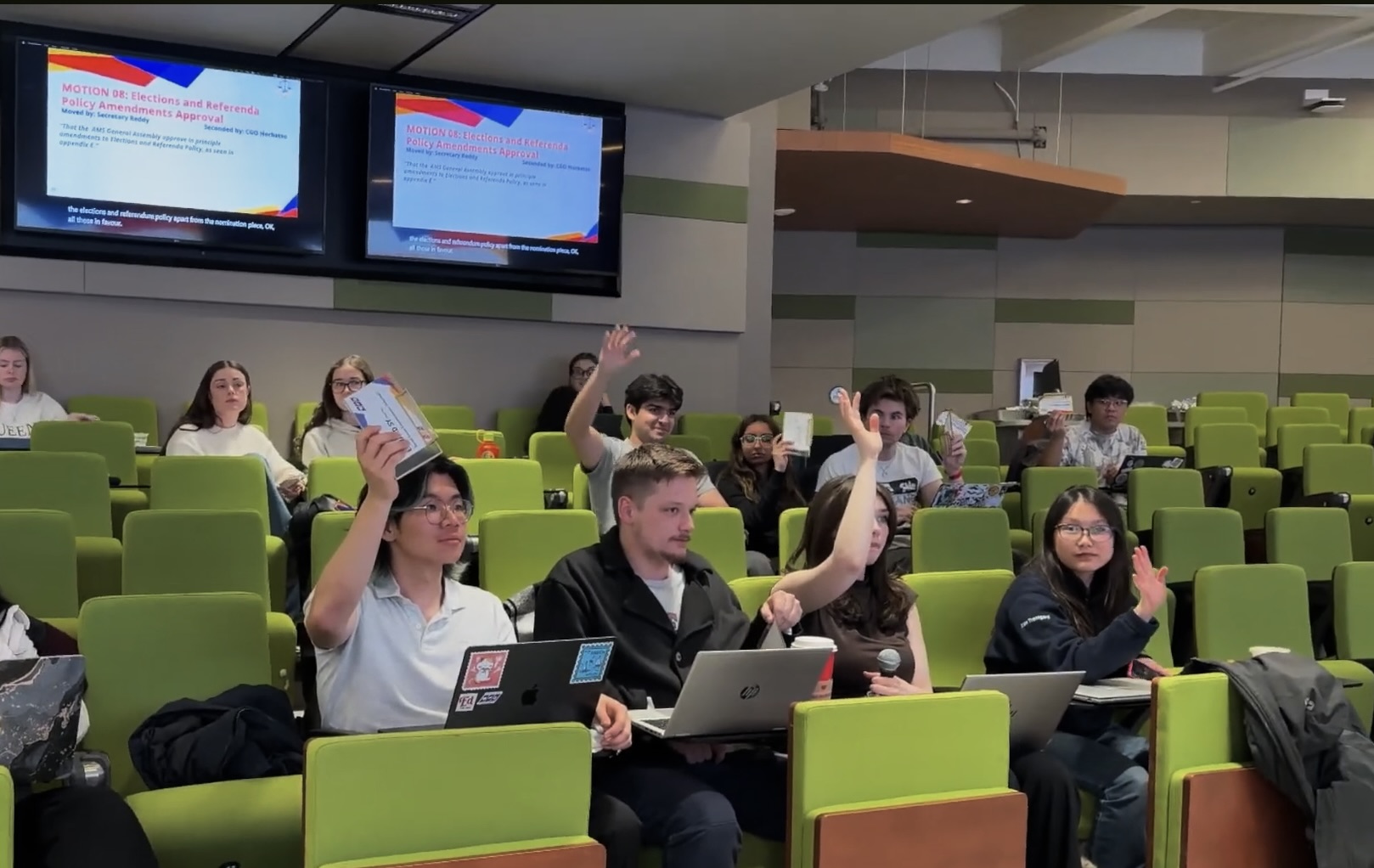
Held in Biosciences Complex 1102, Assembly began at 5:50 p.m. on April 7 with a land acknowledgment and was chaired by Solomiia Horbatso, chief governance officer. At an annual general meeting, all attendees hold voting rights. Approximately 35 people were in attendance, including three general students.
Secretariat Racheal Reddy opened the meeting with a statement marking the final Assembly, thanking members, AMS staff, and The Journal for its “impeccable attendance.”
Following the approval of the agenda and March 24 meeting minutes, Assembly moved into executive and observer reports.
Vice-President (University Affairs) Alyssa Perisa summarized the relocation of resource centres and commissions and reflected on her term, saying she was “really excited to be done with this job.”
Executive ratifications
Assembly then ratified incoming executives. Reddy was confirmed as the incoming commissioner of external affairs following a question period, during which she noted that she was most excited about municipal advocacy due to the upcoming fall elections.
Caroline Ding, HealthSci ’27, was ratified as incoming commissioner of clubs, followed by Alexander Wong Ma as incoming commissioner of environmental sustainability, Samantha Rogers, HealthSci ’27, as incoming commissioner of campus affairs, Ravneet Kaur, ArtSci ’26, as incoming commissioner of social issues (external), and Eshal Ali, HealthSci ’27, as incoming commissioner of social issues (internal). Zaraha Groenewald, ArtSci, 27, was also ratified as secretariat. Each motion passed unanimously.
Following a break, Assembly approved several reports and extensions, including delays for the release of the 2025-26 consolidated equity and sustainability reports until the May Assembly.
Election policy amendments
Debates began during the motion considering the proposed amendments to the AMS Elections and Referenda Policy, which included changes to the roles of Civic Affairs Officers, updated rules governing how candidates may engage with The Journalduring election periods, and revision to nomination requirements.
The amendments would more clearly define the responsibilities of Civic Affairs Officers, who oversee elections and enforce policy, particularly during campaign periods. They also introduced guidelines for candidate interactions with The Journal, aimed at clarifying expectations around media engagement and ensuring fair and consistent treatment of candidates.
The most contentious issue was a proposed change to nomination requirements. Under the existing policy, candidates are required to collect student signatures as part of their nomination packages. The proposed amendment would’ve removed that requirement.
Rector Niki Boychuk-Hale argued these signatures serve as a way to demonstrate student support and increase transparency.
The discussion also led to confusion over what it meant to approve the policy “in principle,” like stated on the motion, with members disagreeing on whether that constituted full approval or left room for further changes.
Reddy amended the motion to remove changes to nomination requirements while proceeding with the rest of the policy updates. The amended motion passed unanimously.
Clubs’ policy overhaul
Much of Assembly focused on Motion 10: AMS Clubs Policy Approval. Presented by Clubs Commissioner Xian Tronsgard and Perisa, the changes aimed to address longstanding gaps in governance and support for student clubs.
“When we look at the enforceability and what is actually happening, again, there’s like a gap between policy and reality,” Nursing Science Society President, Claire Nolli said.
READ MORE: Issues raised internally and externally with AMS Clubs and Campus Affairs Commissions
The proposed policy introduced a standardized complaints process which includes approved communication channels and the creation of a clubs appeals committee to handle disputes. The policy also introduces clearer ratification procedures, separating new club applicants from amendments to existing clubs, as well as a probation framework for clubs that fail to meet requirements.
The proposal would phase out the current dual ratification process, replacing it with a single ratification system for clubs.
During discussion, Perisa raised concerns about how insurance requirements would apply under the policy and later introduced an amendment to address those provisions.
Assembly approved amendments clarifying how insurance requirements would apply to clubs adding provisions related to procedural fairness, including expectations for how complaints and disciplinary processes are handled, before voting to adopt the revised clubs policy.
The meeting concluded by approving updates to the AMS sustainability policy before adjourning at 8:44 p.m.
Tags
AMS Assembly, Elections policy, ratification
All final editorial decisions are made by the Editor(s) in Chief and/or the Managing Editor. Authors should not be contacted, targeted, or harassed under any circumstances. If you have any grievances with this article, please direct your comments to eic@queensjournal.ca.