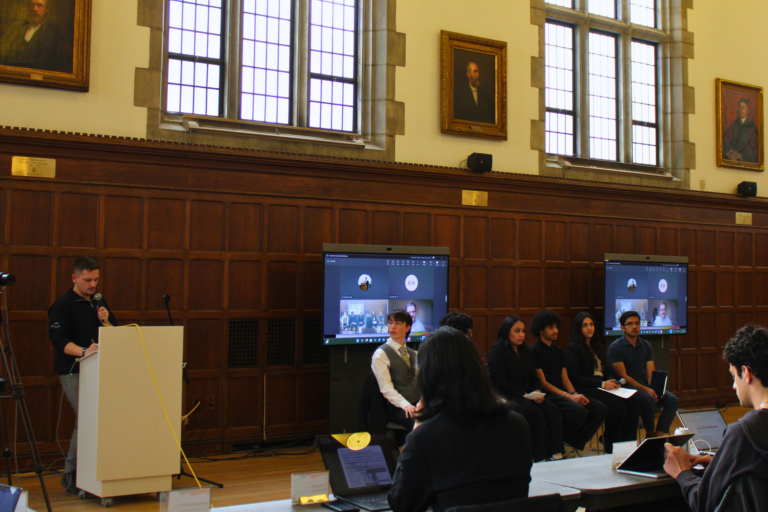
Assembly members approved bylaw changes and heard reports on a rising operating deficit at the AMS Corporate Annual General Meeting (CAGM) on March 24 in Wallace Hall.
The CAGM is where AMS corporate members—who are regular AMS Assembly members—vote on matters, including bylaw amendments and receive updates from the Board of Directors and its committees. The meeting began at approximately 4:15 p.m. and lasted for about two hours.
Bylaw changes passed unanimously
One of the central items on the agenda was a set of bylaw amendments which enable the AMS to formally implement policies related to executive, administrative leave, and complaint procedures.
AMS Board Chairperson and President-elect Dreyden George said the changes were necessary to allow the Board to move forward with policy development.
The motion passed unanimously.
During discussion, Rector Niki Boytchuk-Hale raised concerns about access to meeting materials, saying she hadn’t received the members’ release documents in advance. George directed AMS Secretariat staff to follow up and redistribute materials.
Nine-month consolidated budget update presentation
A focus of the meeting was the AMS’s financial position, with AMS Vice-President (Operations) Elena Nurzynski presenting the consolidated operating statement for financial activity from May 1, 2025, to Jan. 31, 2026.
Throughout this time frame, the AMS has accumulated a deficit of $852,202.
The Queen’s Pub (QP) is the primary driver of that shortfall. While most AMS services performed close to expectations, QP generated less revenue than projected, ultimately working out to a $570,777 deficit.
Nurzynski explained the AMS had built its budget assuming increased student engagement following its move back into the JDUC, along with rising costs tied to inflation and supply chain issues.
“This is the first year of operating in the JDUC, so this was definitely one where we were able to get our hands on actual, tangible data,” she said.
Engineering Society Vice-President (Finance & Administration) Ian Schaffer asked how the AMS expects the deficit to evolve by the end of the fiscal year.
Nurzynski declined to provide specific projections but said the team is “working as hard as we can to alleviate that deficit,” pointing to cost controls, scheduling adjustments, and new revenue strategies such as catering and private bookings.
Schaffer also asked about administrative costs charged to the QP, as all AMS services are expected to pay a fee for general administrative support, asking whether the QP pays more given that some of the salaries for permanent staff housed within the AMS general office only support the QP, such as the QP head chef.
George confirmed that approximately $260,000 is charged annually to QP to cover shared services, including HR, IT, insurance, and administrative support.
The Journal ran a separate story on these updated projections.
Committee reports
The meeting also included updates from the Board of Directors and its standing committees.
The Finance and Risk Committee reported ongoing monitoring of the AMS’s financial health and updates to its risk management framework. The committee has also been reviewing monthly financial statements and identifying potential risks across the organization.
The Investment Committee reported that AMS investments performed better than expected, with returns exceeding projections, for a total of $934,986 in returns. Most of the AMS’s investments are in U.S.-based stocks, and the portfolio is managed with guidance from external financial advisors.
The Personnel Committee outlined updates to HR policies and a revised restructuring process for AMS departments, including new guidelines limiting how frequently major structural changes can occur.
Board candidates’ priorities
The meeting concluded with presentations from candidates seeking appointment to the AMS Board of Directors.
Abdur-Raheem Mohamed, HealthSci ’29, emphasized accountability and long-term decision-making, saying the Board should ensure the AMS is “being stewarded in a way that will benefit students in years to come.”
Areeb Shekhani, ArtSci ’28, focused on consistency in leadership and transparency, arguing that accessibility, not just information availability, is key to accountability.
Kay Hartwick, Kin ’27, highlighted her experience in student government and said she hopes to “make an impact on the entire Queen’s student body” through Board service.
Richard Violo, LifeSci ’27, centered his pitch on accountability, arguing the Board must ensure the AMS remains financially viable and responsible to students.
Rishab Chakraborty, ArtSci ’27, pointed to his experience in the AMS Clubs Commission and said he hopes to support long-term organizational growth and financial sustainability.
Sehnoor Klare, ArtSci ’29, framed the role as one of the stewardships, emphasizing thoughtful decision-making and long-term impact.
Yara Bashoory, Comm ’27, highlighted her background in finance and governance, saying she would bring “attention to detail” and a focus on risk management to the Board.
Student directors appointed
Following the presentations, Assembly members voted virtually to appoint new directors.
Announced by George, Hartwick and Bashoory were ultimately elected to one-year terms. Shekhani and Klare were appointed to two-year terms as the only two candidates in consideration.
Community directors approved
Assembly members also approved two community directors.
In an address to the Assembly, former AMS President and current PhD student Zaid Kasim, Sci ’21, said he hopes to use his governance experience to support future student leaders and strengthen the organization.
In the other address, former Queen’s Journal Editor in Chief Sean McGrady, ArtSci ’03, said he wants to “pay forward” his experience by supporting students through Board service. He cited his background working with non-profit boards as preparation for the role.
Both candidates were approved, with no voting needed as they were the only candidates in consideration, with one abstention recorded.
During the discussion, Boytchuk-Hale noted the importance of ensuring gender representation in future community director appointments.
The meeting adjourned shortly after 6:30 p.m.
Tags
AMS, budget deficit, Corporate Annual General Meeting, corporate members
All final editorial decisions are made by the Editor(s) in Chief and/or the Managing Editor. Authors should not be contacted, targeted, or harassed under any circumstances. If you have any grievances with this article, please direct your comments to eic@queensjournal.ca.