
The AMS’s budget deficit is set to more than double over last year—a change they’re willing to stand behind.
Presented and approved at the AMS Corporate Special General Meeting on Dec. 2, the AMS operating budget oversees the various initiatives and services aimed at supporting students run by students in the society. To get a better picture of the AMS’s finances, The Journal sat down with AMS Vice-President (Operations) Elena Nurzynski to discuss the 2025-26 budget.
Across the society, the AMS is projecting a $514,412 deficit, stemming from a projected $600,552 deficit in the offices portfolio and a $0.04 deficit in the governance portfolio, partially offset by a projected $86,140 surplus in the services portfolio. Overall, this deficit’s an increase from last year’s finalized deficit of $247,526, reflecting a $266,886 increase.
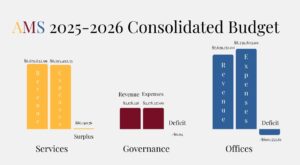
AMS Consolidated Budget breakdown by portfolio. GRAPHIC BY ARDEN MASON-OURIQUE.
Nurzynski explained that increased expenses in the general office are primarily driving this deficit, adding that the move to the JDUC, salaries, and personnel expenses, and higher legal and professional fees all played a role.
“As I stated in my presentation on Dec. 2, it’s an intentional deficit due to us investing in the AMS’s future and its growth,” Nurzynski said. “And as our services and our responsibilities increase, so does our need for professional support and appropriate risk coverage,”
There’s also been a $5,531,737 increase in the AMS’s overall expected revenue this year, alongside an increased $5,798,623 in expenses. According to Nurzynski, this is due to expected increased interaction with AMS services following the move to the JDUC.
“We’re now in a new, more centralized location on campus. Our previous locations at Rideau and LaSalle were more out of the way. And the opening of The Queen’s Pub (QP), specifically, is driving this [increased expected revenue and expenses],” Nurzynski said.
In total, the AMS projects $16,497,210 in revenue and $17,011,623 in expenses, with the shortfall made up through “various internally and externally restricted funds that we have in our investment portfolio, and our net assets as well,” according to Nurzynski.
Offices
The Office portfolio’s projecting a $600,553 deficit; a $366,720 deficit increase from the previous year.
Overseen by President Jana Amer, the AMS offices are primarily funded by the mandatory AMS membership fee and an administrative fee collected from AMS services. The office hosts seven specific offices, including Human Resources, Information Technology, Communications, Marketing, Internal Affairs, and the Student Life Centre (SLC).
Nurzynski explained that this year has seen a 15.7 per cent increase in personnel costs, a 23 per cent increase in insurance, and an additional $26,000 in legal fees. While the addition of two new permanent staff for the QP has contributed to the personnel increases, Nurzynski added that other salaries and wages, including executive salaries, have been raised with the minimum wage increase.
The Office portfolio also hosts the AMS General Office, with the General Office’s expenses being primarily permanent staff and executive salaries. Of the Office portfolios, $8,239,803 in expenses, the AMS General Office accounts for $2,737,897.
However, The Journal observed that the office subsection on the budget incorrectly calculated the revenue and expenses, although they were correctly calculated in the AMS consolidated budget section.

Governance
Vice-President (University Affairs) (VPUA) Alyssa Perisa is overseeing the governance portfolio this year, including the five commissions and their $0.04 expected deficit.
The Campus Affairs, Clubs, External Affairs, Environmental Sustainability, and Social Issues Commissions comprise most of the budget, alongside specific expenses for the VPUA budget and the Ontario Undergraduate Student Association (OUSA). All commission expenses and revenue remained similar to previous years budgets, with the biggest change being a $35,000 decrease in the expected expenses for the Campus Affairs Commission.
Nurzynski explained that while most revenue for the commissions comes from student fees, not all does, so Assembly looks at various factors when making allocations.
“When you’re providing allocations to these commissions, you’ll generally want to take a look at other sources of revenue [such as grants, donations, or funds] and you want to ensure that you’re covering, at the minimum, covering personnel costs and any non student activity fee related grants and bursaries that they disperse to students,” Nurzynski said.
Services
With the addition of The Brew and the QP, revenue in the Services portfolio is set to rise by $3,035,999 when compared to the results of 2025, along with an increased $3,004,910 expenses.
Overall, the services are projecting $6,679,633 in revenue and $6,593,492 in expenses, bringing a total of $86,141 in surplus. All services except for the Food Bank and The Queen’s Journal are expected to break even or end in a surplus, with the Media Centre’s expecting the biggest surplus of $32,520 surplus, and the QP predicting a $13,382 surplus.
With QP expecting over $2 million in revenue this year, Nurzynski expanded on how they calculated this figure, acknowledging there’s been a five-year gap of missing data since the QPs closure and reopening.
“Essentially, what we did is we created an average receipt price of $21, which equates to a drink and an appetizer, and then we multiplied that by having full seating for lunch and dinner.”
She added their new “state-of-the-art kitchen with streamlined new equipment” means getting customers in and out quicker, along with a new food menu and a centralized location on campus, which were all factors that informed their decision.
As for The Brew, Nurzynski explained that their estimate of $325,000 in revenue came from a daily expected average of $2,000 in sales, an increase from the old Brew’s $1,500 in sales a day on average. She said this increase is due to their new location near one of the main entrances of the JDUC and their new equipment.
More broadly, Nurzynski encouraged students to stay informed on the AMS’s finances by reviewing their annual report on the AMS website.
Tags
AMS, AMS Operating Budget, Budget
All final editorial decisions are made by the Editor(s) in Chief and/or the Managing Editor. Authors should not be contacted, targeted, or harassed under any circumstances. If you have any grievances with this article, please direct your comments to eic@queensjournal.ca.