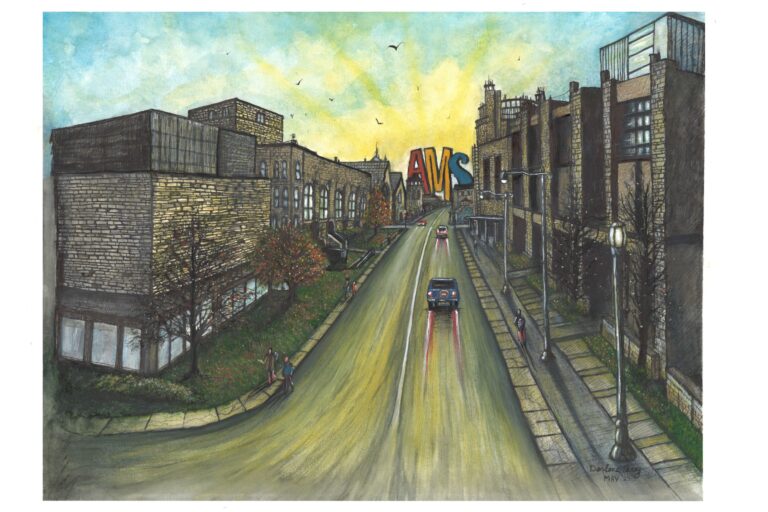
A painting of the JDUC is Darlene Perry’s invitation to help a community far beyond the University by trading her artwork for donated supplies.
Perry, an AMS accounting assistant and artist, is offering prints of her watercolor painting depicting the JDUC before its renovations to support the people of Pinar Del Río, Cuba, and their access to essential supplies amid food, medicine, and power shortages.
Students can receive a free print by donating school supplies, medicine, hygiene products, and other essential items. Donations can be dropped off and prints can be picked up at the AMS office on the first floor of the JDUC to support the cause.
“[The people of Pinar Del Río] go days without power,” Perry said in an interview with The Journal. “Their food is rotting […] They can’t afford food.”
In April 2026, Global Affairs Canada described Cuba as facing a deepening humanitarian crisis, with power grid failures, blackouts, and fuel shortages disrupting access to food, clean water, health care, and other essential services.
“It’s had to turn into a humanitarian effort,” Perry said in an interview with The Journal, referring to how this initiative has evolved from its initial goals.
Perry became involved about 10 years ago when painting professionally in Nova Scotia. While helping install Same Yet Different, an exhibition by Jude Caborn featuring Canadian and Cuban artwork, she was introduced to the Cuba-Nova Scotia art exchange.
Organized by Caborn, the initiative connected artists from the two countries through art exchanges, exhibitions, and workshops, while also providing art supplies to artists in Pinar del Río and promoting their work in Canada.
After Caborn invited her to Cuba, Perry began visiting and connecting with artists, living with the Cuban families in Pinar. She has since taken over Caborn’s responsibility and keeps in touch with the artists every day, hearing directly about the worsening conditions in Cuba.
Perry supports any artist in the region, but she currently works with three: painters Naiby Gonzalez and Orlando Ramos, and photographer and documentary filmmaker Dayam Gonzalez Cabera.
“They’re just absolutely incredible people. And my artists are so talented. I’d like them to have as many opportunities as possible,” Perry said.
The needs of these Cuban artists and their families have become the priority of her work as the crisis in Cuba worsens. The initiative that started as a cultural exchange between Canadian and Cuban artists now expands into relief aid.
“It’s growing, and my role is kind of morphing,” Perry said. “I’m willing to go with whatever they need me to do.”
She said the eight-year-old daughter of Gonzalez has been erasing entire notebooks to reuse them to the point that the pages have begun falling apart, as they lack school supplies.
“I mean, for the sake of a notebook that cost us a dollar at the dollar store,” Perry said. “Imagine going to university with no books, with no pencil.”
Perry said a lot of the operational cost of her project has come out of her own pocket. Her living room is currently full of medical supplies awaiting shipment, although shipping two bags would cost approximately $400.
Collecting donations reduces how much she spends purchasing items herself, leaving more of her money available for shipping.
“And I have no problem with that. Because I think [the people of Pinar have] given me back more than I’ve ever give them,” Perry said.
She said those friendships have changed her life. During her visits to Cuba, Perry lived as part of the Pinar community and shared meals with the people, watching the families grow over the past decade.
“When I was [in Cuba], I was struck by the people. I can’t even explain it,” Perry said. “They’re the most generous, hospitable people I think I’ve ever met in my life.”
In the future, she wants to help Cuban artists document their work, develop websites, and connect with Canadians who can share skills in areas like technology and accounting.
Perry also wishes to bring the artists she supports to Canada and organize an exhibition to showcase their work, with the goal of generating income to support them financially.
While the AMS has been supportive, Perry said it does not fund the initiative. She is currently coordinating the effort herself but hopes to involve more people as it develops.
For now, providing food, medicine, school items and essential supplies are her priority.
“I’m more concerned about keeping them fed,” Perry said.
She hopes the Queen’s community will help carry this initiative forward by building connections with people in Cuba or donating supplies.
Tags
AMS staff member, charity, humanitarian crisis
All final editorial decisions are made by the Editor(s) in Chief and/or the Managing Editor. Authors should not be contacted, targeted, or harassed under any circumstances. If you have any grievances with this article, please direct your comments to eic@queensjournal.ca.