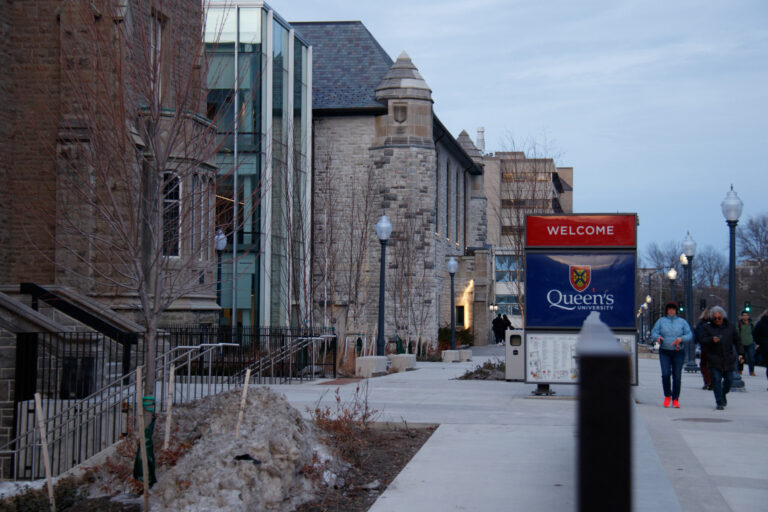
While Queen’s says Arts and Science remains secure, enrollment shifts and growing financial imbalances suggest the University is steadily reorganizing around programs that are easier to monetize.
The Ontario government has authorized an increase of two per cent to tuition costs effective September 2026. Yet, this increase remains far from enough to solve the larger $8.5 million deficit that Queen’s is predicted to face, which is largely attributable to the Faculty of Arts and Science (FAS). Programs within the FAS are among those currently charging the lowest tuition and, as such, a two per cent increase in tuition fees is not enough to move the needle in the face of rising costs within the faculty.
The key imbalance remains that Queen’s is, at present and historically has been, an institution with tuition as the primary revenue driver. Each seat in a program is valued differently by the University, reflecting how the tuition rate varies between programs.
The disparity in value between a seat in a FAS program compared to that of a Smith School of Business program is a major driver in changing institutional priorities.
From an institutional perspective, a Commerce student is worth approximately 2.4 times more than a student enrolled within the FAS based off tuition fees. As a result, Queen’s has and will likely continue to prioritize higher-fee education over programs that see a lower rate of return.
The shift away from traditionally offered FAS courses to other programs that are easier to price, market, and monetize is clear.
Queen’s isn’t alone in having their business school as the favorite child either. These higher-margin, high-demand, and labor-market-ready education models are what universities across the higher-education landscape are prioritizing.
Take the Harvard Business School. It is a prime example of a business school that has traditionally remained isolated from the rest of campus that is now being called upon to financially rescue the University. Clearly provincial and federal policies create financial headwinds, but the struggling higher education industry is an international problem.
Within Canada, the trend is similar. Business schools are subsidizing the larger universities deficits through increasing professional and executive educational programs, as well as higher undergraduate tuition rates. While Smith Business does not directly subsidize Queen’s, revenue from the school pays into the Deficit Mitigation Fund, which is primarily used to make up the FAS budget shortfall.
At present, FAS is the only faculty facing structural imbalance in which costs are rising, yet revenue continues to fall. However, the numbers are deceiving; Queen’s reports FAS as one of the highest revenue generating faculties, yet that is attributed to headcount rather than per capita tuition. The FAS faces a problem where the per-student revenue and cost picture is discouraging.
Students simply cost more than they bring in for many of the current programs offered.
The largest tailwind for Queen’s this upcoming year is in the form of Smith Business professional graduate programs. Professional graduate programs are seeing declining enrollment University wide, however this is offset by the increase in Smith Business’s executive education expansion.
The FAS appears to be safe for now, though the traditional model is changing.
The intake for the FAS will decline by around 200 students for the 2026-27 academic year, and this will allow for increased admissions to Commerce, Health Sciences, and Engineering.
Within the FAS, there are further structural shifts. The general admissions process that has been used in previous years will be replaced with an emphasis on direct-entry programs, such as Computing, Kinesiology, and Life-Sciences, which all charge higher tuition rates. This shift will result in lower general arts admissions, which could leave lasting damages on the state of humanities at Queen’s.
The dissipating interest and greater inability to take diverse humanities courses may eventually lead to the loss of more programs as seen in recent years with Fine Arts.
READ MORE: Reflections on the final year of the Queen’s Bachelor of Fine Arts
Despite all this, the FAS is not at risk for disappearing anytime soon; an almost $40 million internal subsidy drawn from the University Fund to sustain the faculty ensures that.
Programs, however, are increasingly being asked to justify themselves within a financial system that directly correlates educational value to job-market outcomes. When the money gets tight, as it is currently, institutions stop valuing broad education and subsequently, they stop funding it.
This means the FAS and humanity programs are safe for now, but at risk come 2030 when the current deficit subsidies require renewal.
Corrections
A previous version stated that a lack of interest in humanities courses may lead to the loss of more programs, such as Classics. In fact, Classics is still a recognized program at Queen’s.
The Journal regrets the error
Tags
ArtSci budget, Harvard Business School, Queen's budget, tuition cost
All final editorial decisions are made by the Editor(s) in Chief and/or the Managing Editor. Authors should not be contacted, targeted, or harassed under any circumstances. If you have any grievances with this article, please direct your comments to eic@queensjournal.ca.