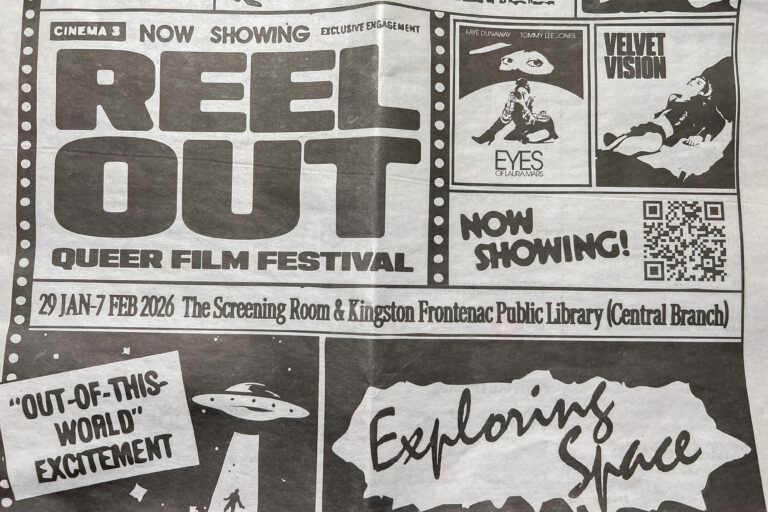
This weekend at ReelOut, two screenings connected the past, present, and future of Black queer artistry.
On Feb. 1, short program WE CALL IT BALLROOM (2025) from director Odu Adamu screened ahead of feature documentary Assembly (2025) from directors Rashaad Newsome and Johnny Symons. Both works were shown at The Screening Room in downtown Kingston as part of the 27th annual ReelOut Queer Film Festival. The works examine vogueing and other forms of Black Queer artistic expression as prompting liberation, resistance, and community worldwide.
WE CALL IT BALLROOM (2025)
Before the showing, director Adamu and co-collaborator Michael Roberson took the stage to explain the short film’s backstory. Adamu was inspired by Roberson’s book Ballroom: A History, A Movement, A Celebration, which takes a multi-media approach to telling the story of ballroom as a space for survival and artistry for QTBIPOC communities. WE CALL IT BALLROOM unfolds onscreen almost a collage, which director Adamu explained at the screening stems from how he visually perceives the world.
Dialogue from Roberson’s 2019 TED Residency talk, “The enduring legacy of ballroom,” plays over meticulously-arranged clips from the ballroom community, and seminal ballroom documentaries like director Jennie Livingston’s Paris Is Burning (1990). WE CALL IT BALLROOM works perfectly as a short program blending together other mediums as part of its collage concept; the viewer feels drawn in to the concept of Black Queer art as a freedom movement. The film is educational, but it challenges its audience to engage further with the art forms it presents.
WE CALL IT BALLROOM is an engrossing gateway seminar into the world of ballroom, prompting me to do a lot of googling when I got home about the prominent creatives and revolutionary leaders mentioned onscreen. It works as a historical guide and a joyful celebration, engaging its audience across both deeply emotional level and stunningly visual dimensions.
Assembly (2025)
The evening’s feature presentation documents the conception and painstaking creation of artist Newsome’s 2022 installation, “Assembly,” at the Park Avenue Armory Wade Thompson Drill Hall in New York City. According to ReelOut’s program, Assembly “merges art, AI, and performance to create a multimedia tribute to vogueing and Black queer culture.” It’s hard to describe all that Assembly is. It examines the character of a visionary artist through Newsome, it challenges the seemingly mutual exclusivity of high art and AI, and it introduces an interpretation of Black Queer art as infinitely resilient through natural, geometric perfection.
The latter is one of the film’s most interesting concepts: geometric fractals present in traditional African culture, representing the diaspora of Black artwork worldwide. Newsome beautifully connects this concept with images from his Louisiana roots: shells, plants, and scenes of nature. Through this lens, Assembly becomes a kaleidoscope, refracting many different artistic disciplines through the lens of this idea.
Newsome’s use of AI and digitally-rendered animation takes a minute to get used to. In one scene, his self-made AI “digital griot,” Being, conducts a decolonization workshop. An audience member steps up to the microphone, decrying the use of AI in facilitating moments of connection to cheers from fellow attendees.
What struck me was how little time the film devoted to addressing this critique, choosing to include a clip of Newsome on a panel explaining calmly how simply dismissing AI as part of the larger artistic project represented a dismissal of Black creatives like himself working to bring his vision to life. As a young person whose concerned about AI’s role in art become more pressing every day, I felt disappointed at first by what I misinterpreted as Newsome and Symons’ stance on the issue.
But then, as the rest of the film unfolded, I realized Assembly itself is the answer. Newsome’s complex reverence for Being and the blend of Black art and technology was astounding, resonating most deeply with me when he showed young Black girls engaging with one of Being’s workshops at the “Assembly” installation in New York City. Being was created by Newsome—a rare moment where art itself literally has the power to espouse its creator’s vision—and this allowed Newsome to spark conversations of decolonization and liberation beyond individual interpretations of his work.
Assembly is a dizzying experience, beautifully encapsulating the ideas of an artist brave enough to harness emerging technologies to shape his own ideas of the future. At ReelOut, Assembly and WE CALL IT BALLROOM tell illuminating back-to-back stories of the past and future of Black Queer art.
ReelOut Queer Film Festival continues in Kingston until Feb. 7.
Tags
Assembly, cinema, documentary, Film, Movies, ReelOut Queer Film Festival, WE CALL IT BALLROOM
All final editorial decisions are made by the Editor(s) in Chief and/or the Managing Editor. Authors should not be contacted, targeted, or harassed under any circumstances. If you have any grievances with this article, please direct your comments to eic@queensjournal.ca.