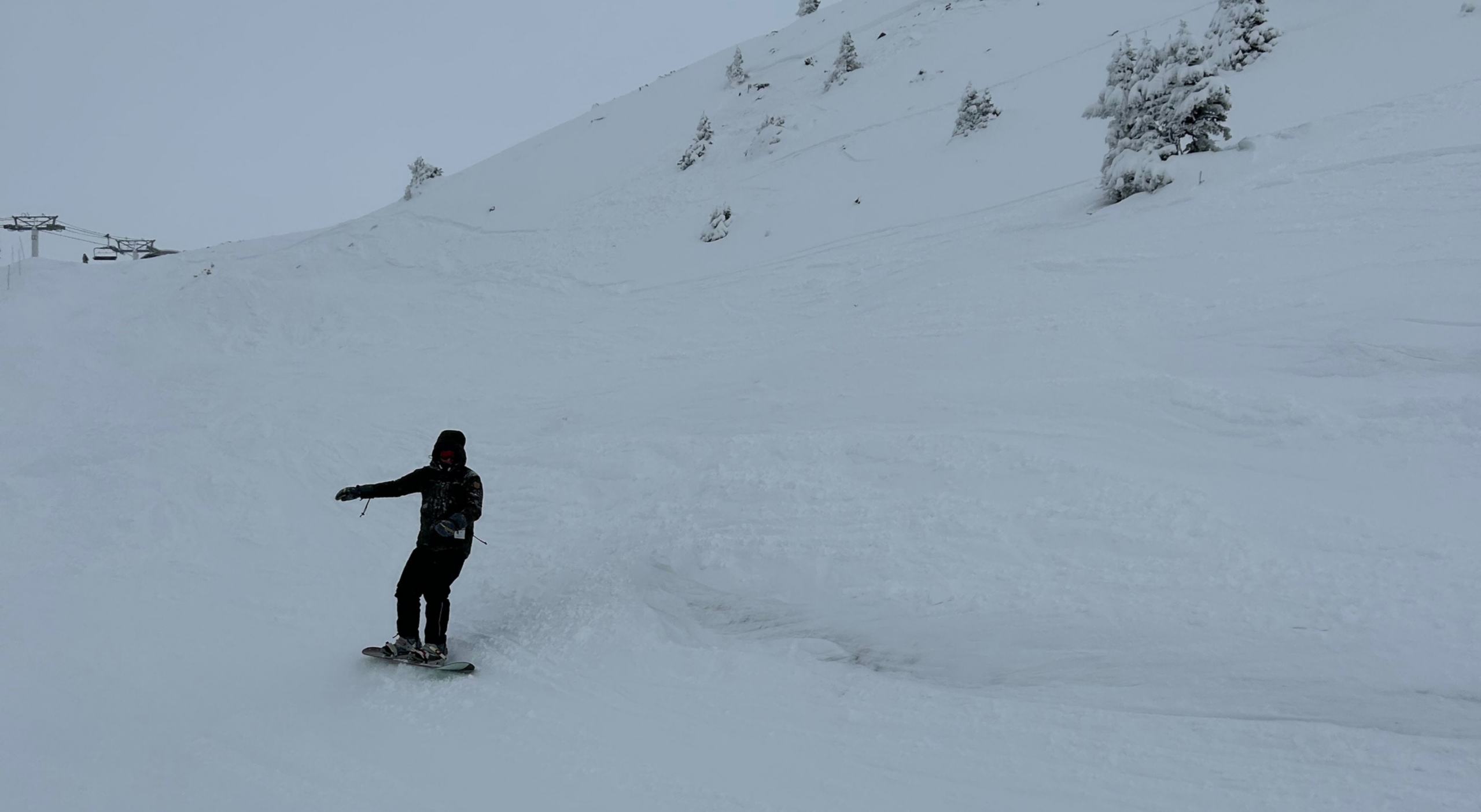
Spring skiing’s carefree image—bikini tops, bright sun, and soft snow—is quickly fading, replaced by shortened seasons and ski hills creatively scrambling to adapt to a warming climate.
Canadian winters have become significantly warmer, with average national winter temperatures rising by approximately 3.7 degrees Celsius over the past 78 years, 1948–2025, according to Environment Canada. In fact, the 2023-24 season was recorded as Canada’s warmest winter ever, averaging 5.2 degrees Celsius above the 1961-90 baseline. And with increasing temperatures comes the challenge of maintaining snow for adequate snow sports, with a MDPI article reporting that “more than half of the ski resorts in North America have closed since the early building booms—many facing a warming climate and pressures to find water to make artificial snow.”
This begs the question: how on Earth are ski hills managing the complicated business of snow in the pressing issue of climate change? From covering snow in blankets to “snow farming,” it’s clear that ski hills are pulling out all the stops to try to combat the effects of warmer temperatures shortening snow sports seasons.
NPR recently reported that Bogus Bason, a Idaho Mountain Recreation Area and Ski Resort, is actually wrapping snow in blankets. Inspired by Finnish brand SnowSecure, the hill has launched ‘Project X’, which consists of a football field-sized pile of snow covered in polystyrene plastic blankets interlinked together with Velcro and straps. The Basin’s operations director explained that once the panels covered the snow, the grounds crew wrapped the pile in white plastic to keep the heat out.
Overall, the project has seemed to be successful thus far, with temperatures reaching the high 70s and 80s, but NPR reported that last October, 80 per cent of the snow was still viable for use, the snowmaking crews then used tractors to spread out the snow across the hill, something likened to “frosting a cake.”
While effective, the operations manager stated that the total cost of the project was approximately $120,000 USD, noting it was expensive but cheaper than other snow creation methods, such as storing water to fuel snowmaking machines, a cost sitting around $6-7 million. In preparing for the next season, he estimated a $600,000 cost of wrapping snow.
Turning more locally, Canadian hills aren’t free from the challenges posed by climate change. According to Daniel Scott, a professor in geography and environmental management at the University of Waterloo, in a CBC article, “Ontario, Quebec and the northeast U.S. will see shorter seasons by as much as 13 per cent under a low-emission scenario and as much as 22 per cent under a high-emission scenario by 2050.”
The article further reported that “under a high-emission scenario, only 29 ski areas in Quebec and high-elevation areas of the U.S. northeast will be able to maintain a 100-day season and open regularly for the Christmas-New Year holiday, traditionally one of the biggest revenue periods, by the end of the century.”
He finds that Western Canada may be spared due to resorts being located on higher elevations, yet for resorts sheltered by this elevation, such as Sunshine Village Ski Resort, located in Banff National Park, they aren’t free from the effects of climate change—they just haven’t seen them yet.
To ensure every snowflake is being captured, Sunshine instead has turned to snow farming—the practice of collecting, storing, and preserving snow over the summer to ensure early-season, high-quality snow for ski trails and resorts—something covered by media outlets as “helping the [ski] industry survive climate change.”
They “farm” snow by using specially placed fences to trap and collect windblown snow before it drifts away. The team sets up rows of bamboo and plastic fencing in areas where wind patterns naturally carry falling snow. As snow blows across the mountain, the fences slow the wind down, causing the snow to drop and pile up behind them instead of being scattered or lost.
By studying wind direction and speed, the crew identifies the most effective spots to install the fences. Over time, this creates deeper, concentrated snowbanks that can later be redistributed onto ski runs, helping extend coverage without relying entirely on artificial snowmaking.
The Canmore Nordic Centre has adapted by combining covering snow with the practice of snow farming. As the CBC reports, the Canmore Nordic Centre gathers large piles of snow in December or early January and covers them with thick layers of sawdust to preserve them through the summer. In the fall, around Thanksgiving, the snow is dug up and used to create an early-season ski track known as Frozen Thunder.
All ski hills are in agreement about one thing: to avoid making snow. Well, maybe not agreement per se, but a widespread understanding that creating snow requires a lot of water and produces greenhouse emissions, which indirectly are causing further issues for resorts in maintaining ski-able terrain. Better put, it becomes a negative feedback loop.
Whether or not ski resorts can survive climate change is a question I’m skeptical of answering with a straightforward ‘yes.’ While Western hills report strength in the face of climate change’s effects, other factors, such as high ticket prices reaching $299 for daily passes at some hills, as consumers’ reluctance to participate in expensive ski seasons, might make it more challenging to cover the costs associated with preserving snow.
I’m interested in seeing what my ski season will look like over the next 10 years, but I’m confident to say it won’t look the same as when I first started skiing over 15 years ago.
Tags
Climate change, Rising temperatures, Ski resorts, skiing
All final editorial decisions are made by the Editor(s) in Chief and/or the Managing Editor. Authors should not be contacted, targeted, or harassed under any circumstances. If you have any grievances with this article, please direct your comments to eic@queensjournal.ca.