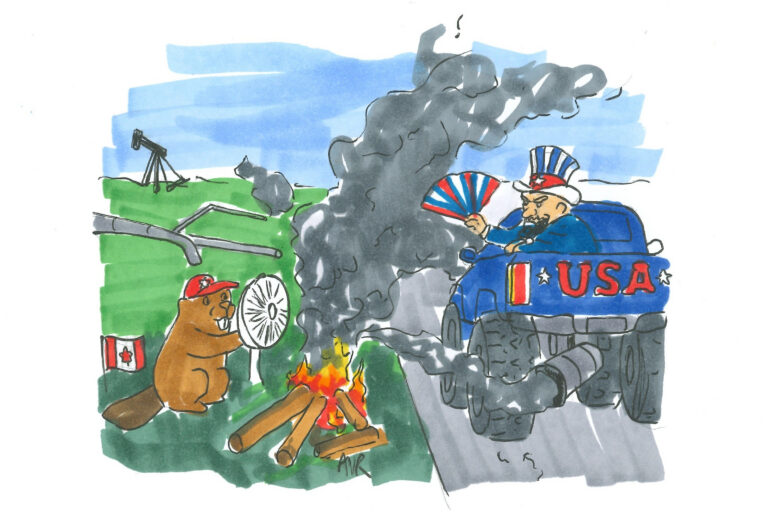
Canada is burning, and our inaction is partly to blame.
When Canada’s smoke drifted south again, a handful of Michigan Republicans met it with a letter to Mark Carney, accusing Canada of letting its forests burn and threatening that the United States will “act on our own,” a clear aim at Canadian sovereignty.
The bad faith is obvious; the American politicians had weaponized a climate disaster while carefully avoiding any responsibility as one of the world’s biggest polluters and cast Canada as the sole culprit of a crisis that belongs to everyone. However, the Republicans aren’t entirely wrong, as Canadian wildfire prevention and preparedness is grossly inadequate.
Canada claims to take wildfires and climate change seriously, but the concern never becomes actual policy. Our politicians grandstand against the United States while our wildfire-fighting capabilities quietly erode.
In British Columbia and Alberta, yearly forest firefighting costs routinely double the allocated yearly budget. In Saskatchewan, the approved budget covered barely a fifth of what the 2025 season actually cost. In the Northwest Territories, 70 per cent of the population was evacuated in 2023 alone. And this year, Ontario’s budget set its wildfire fund at $150 million for 2026-27 after spending $271 million the year prior.
At a time when Canada’s last three fire seasons have been among the 10 worst on record, instead of taking the threat more seriously, we are doing the exact opposite.
And it goes further. We aren’t simply failing to address the problem; we’re actively making it worse. By our own government’s admission, Canada is the “worst performing” member of the G7 at reaching the emissions goals set in the 2015 Paris Accord.
The reality is bleak: Canada is the only G7 country whose emissions have risen, rather than fallen since 1990. Canadians are among the highest per capita emitters in the world, and we rank among the top 10 carbon emitters globally, despite being a fraction of its population.
In a country actively threatened by wildfires, it’s inconceivable that we are the only G7 nation without a national wildfire agency. As much as we chastise the Americans for treating climate change as somebody else’s problem, we need to admit that provincial infighting, jurisdictional bureaucracy, and petty squabbles over resources have left us hopelessly ill-prepared every time summer rolls around.
Perhaps we accept the science more readily than the Americans do, but that only makes it worse that we still don’t seem to care enough to act on it. The only time we hold a meaningful conversation about wildfire is once we’ve passed the point of no return.
There is value in seeing our climate crisis in real time, but we need sustained pressure, not periodic spurts of debate.
No doubt, much of what burns is beyond our control, and the opportunistic lawmakers jeering from Washington obviously care nothing for our forests, our air, or us, but rather are trying to push a political message.
However, that doesn’t mean Canada has been adequate in dealing with this crisis, and we shouldn’t allow our frustration with these lawmakers to make us defensive.
Yes, Trump and the Republicans are trying to undermine Canadian sovereignty, and their unconvincing attempts to present a concern for the environment are laughable, but a broken clock is still right twice a day.
Regardless of American intentions, Canada should be criticized for our unpreparedness infighting wildfires. We underfund our forces, cut our budgets, and still increase our emissions.
While wildfire prevention is far from our sole responsibility, readiness is a responsibility we keep declining to meet.
— Journal Editorial Board
Tags
Climate change, climate crisis, Mark Carney, Trump administration, wildfires
All final editorial decisions are made by the Editor(s) in Chief and/or the Managing Editor. Authors should not be contacted, targeted, or harassed under any circumstances. If you have any grievances with this article, please direct your comments to eic@queensjournal.ca.