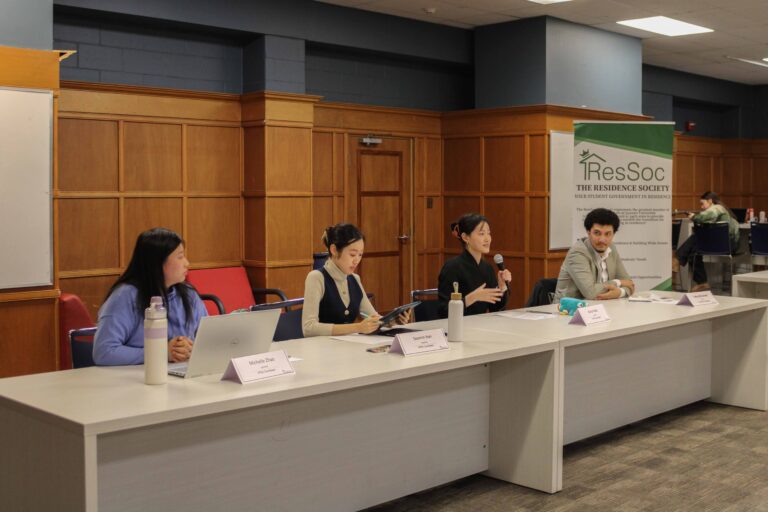
On Jan. 24 at 7 p.m. in Victoria Hall Upper Commons, four Residence Society (ResSoc) candidates shared their platforms and hopes for the 2026-27 academic year, in front of a crowd of approximately 15 students.
Candidates include individuals from two uncontested races, including Michelle Zhao, ConEd ’27, running for vice-president (society operations), and Presidential candidate Yahya Mohamed, Sci ’27. The final executive role is contested, with Soomin Han, ConEd ’27, and Kailyn Mao, HealthSci ’28, running against each other for the role of vice-president (residence operations).
Vice-President (Society Operations)
The VPSO candidate opened the debate by introducing herself, reiterating her pillars that she explored in her online campaign. Zhao highlighted her commitment to streamlining communication and clear individual responsibilities within ResSoc.
“When our internal structure is strong, everyone’s job becomes easier and students benefit directly from that.”
Moving forward, the VPSO candidate stated that she believes her role ensures ResSoc’s credibility to students, as she’s the one who is directly managing the ResSoc executive team, consisting of Chief Financial, Human Resources, and Programs and Marketing Officers. Because a large part of her role consists of overseeing these officers, Zhao says she’s able to ensure they’re committed to visibility and trust.
“I’ll make sure we have our month ends and budgets really accessible to students for financial literacy and transparency. I’ll also make sure that each event is inclusive of all students and making sure that the PMO runs events that are targeted to most students in residence.”
The candidate ended her portion of the debate by answering what small problem she would fix and how she would go about fixing it, explaining she would like to find a solution to long lines outside of the campus dining halls at mealtimes.
“One of the key components of [the role] is sitting on external committees and one of them is the food and advisory committee, so I would like to represent this [problem] as a person going on that committee and bringing it to the attention of the people there and see how we can fix that main issue.”
Vice-President (Residence Operations)
Advocacy for students was the topic of the first questions asked by the moderators. In her response, Han brought up the heating and flooding problems that can occur on residence, stating that she intends to work with facilities staff to have them addressed.
“Even if we can’t solve the situation, I believe honesty and transparency with students is very important,” Han said.
Mao was most proud of advocating for her students as the McNeil House President. She’s aware that there are many problems on campus that she can’t fix as quickly, but she plans to keep pushing to ensure that these problems are solved.
The candidates both agreed that the best way to measure the success of the role was through obtaining event feedback from students, as well as House Presidents.
“At the core of this, it’s about building rapport, building community, and doing what I promised in my campaign,” Mao said.
Both candidates agreed that inclusivity is important and had similar answers to a question about what a fair residence experience looks like. Mao wants to ensure ResSoc is more accessible by improving the availability. Han intends to communicate with students and House Presidents consistently.
In closing, Han restated that she would prioritize natural connection, approachable leadership, support, and inclusivity.
“I’m running because I want to be the kind of leader who listens first and supports intentionally,” Han said.
Mao emphasized that the ResSoc experience doesn’t end after first year. She stated that making sure students are aware of all the resources is a priority, and that she intends to build community through collaboration and communication.
“I’m here to remind you that your impact on residence and ResSoc doesn’t end after you go to second year.”
President
Mohamed opened his portion of the debate by restating the main pillars of his campaign. The candidate discussed what he believes a strong leader to be which he said was someone who is a good listener.
“That [listening] is what I’m here for, to be able to listen to all of the students and advocate for them and represent them on the tables where ResSoc is at.”
Mohamed later discussed a moment when he advocated for others. The presidential candidate spoke on a time when he worked within pre-established systems in residence to bring loanable game equipment to the front desks of residence buildings. When explaining how he succeeded in bringing the game equipment to residences, Mohamed credited his knowledge of the infrastructure that ResSoc is working within.
“Advocacy isn’t just about listening, its not just about doing what the people want you to do, it’s also about understanding the infrastructure and the system you’re fighting against.”
The presidential candidate was also critical of ResSoc during his debate, speaking about his wishes to improve the society by broadening their reach with marketing and advocacy. He argued that ResSoc can’t properly support the students in residence if nobody knows what they do.
“Sometimes I look at [ResSoc] and I think we’ve lost our purpose. Sometimes I think we’re glorified event planners, more or less. We shouldn’t have a budget of half a million dollars to be glorified event planners. How can we advocate for those students, how can we better support them.”
Mohamed closed the debate by stating his hopes to have a more collaborative relationship with the AMS, hoping that improving the bonds between groups will help better address student concerns.
“[The] AMS is a very big advocate for the students, which ResSoc is just more or less excluded from, we go to assembly with them and that is pretty much it,” Mohamed said. “So making sure we increase that [relationship].”
***
Voting will take place from Jan. 26 to 27 for all students and staff living on residence, with results to be released on Jan 28.
Tags
debate, debate recap, Elections 2026, ResSoc elections, ResSoc executive
All final editorial decisions are made by the Editor(s) in Chief and/or the Managing Editor. Authors should not be contacted, targeted, or harassed under any circumstances. If you have any grievances with this article, please direct your comments to eic@queensjournal.ca.