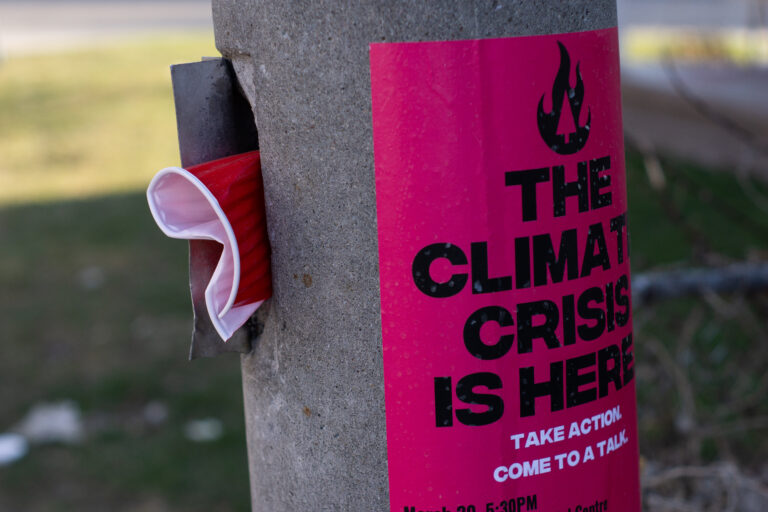
For Queen’s Backing Action on the Climate Crisis (QBACC), Queen’s isn’t doing enough to address the climate crisis.
Student-run group QBACC is demanding the University take their decarbonization plan one step further and divest from companies degrading the environment. In a divestment report by QBACC Vice-President (Sustainable Investing) Ashley Canete, QBACC asks the University to contribute to a net-zero carbon emission footprint by 2050.
The University will reduce their carbon footprint by 2030, according to their decarbonization plan. They will allocate a minimum of 15 per cent of their funds to Queen’s Climate Action Allocation (QCAA) and investment in companies with carbon emissions lower than the global benchmark, set by the Morgan Stanley Capital International (MSCI) All Country World Index.
The MSCI index helps the University interpret which companies have practices supporting the environment by evaluating their carbon emission, energy efficiency, and environmental initiatives.
In a statement to The Journal, Donna Janiec, vice-principal (finance and administration), said the University is committed to investments with carbon emissions 25 per cent lower than the global benchmark.
For QBACC, the benchmark isn’t an adequate measure of Queen’s environmental impact. Queen’s still invests in companies with high carbon emissions, but which are comparatively lower than the big fossil fuel emitters. Queen’s invests in British Petroleum (BP) and Exxon Mobil, according to their Endowment Holding Report.
“We believe divestment remains a more direct and impactful tool for institutions seeking to align their investments with environmental and ethical considerations,” QBACC’s divestment report said.
The University has $32 million invested in direct fossil fuel holdings and $6.7 million in five of Canada’s largest banks who are heavily invested in fossil fuels, according to QBACC’s report. In 2022, The Royal Bank of Canada (RBC) was named the biggest financier of fossil fuels in the world, with a $41 billion stake to fossil fuel companies, Banking on Climate Chaos said.
Janiec said divesting could negatively impact their financial returns and go against their duty to effectively manage their assets.
QBACC argues the University’s failure to divest and address the climate crisis is dangerous. In a private meeting with the University, Queen’s Board of Trustees Investment Committee Chair Todd Mattina told Canete “one can’t conflate ethics with fiduciary responsibilities,” according to the report.
Despite QBACC’s divestment demands, Janiec said the University has a strong relationship with the student group. QBACC supported their approach to decarbonization and contributed to the Environmental Social Governance (ESG) questionnaire sent to Queen’s investment fund managers.
Unaware of the divestment report, Janiec said they welcome QBACC to share it with the University.
Queen’s will be providing an in-depth look at the University’s green investing commitments in the Responsible Investing Report published this spring.
QBACC is having a Divestment Protest on campus on April 2. The Journal reached out to QBACC for additional comment, but didn’t receive a response in time for publication.
Tags
Activism, Climate change, climate crisis, Divestment, QBACC
All final editorial decisions are made by the Editor(s) in Chief and/or the Managing Editor. Authors should not be contacted, targeted, or harassed under any circumstances. If you have any grievances with this article, please direct your comments to eic@queensjournal.ca.