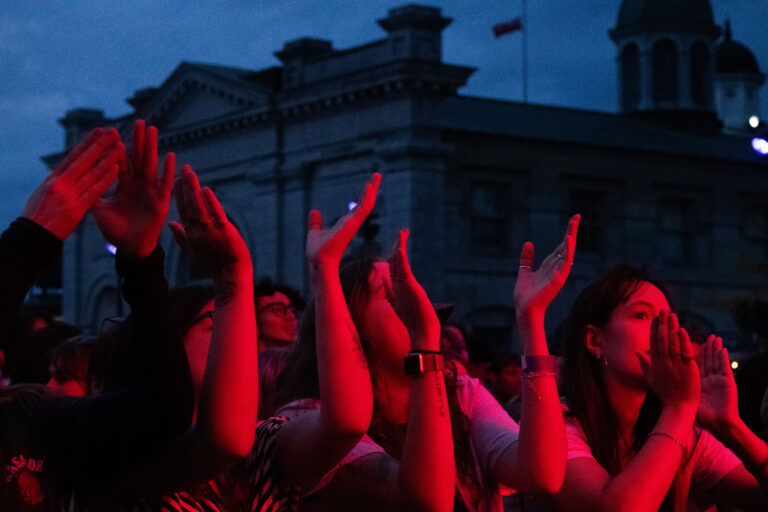
Concert pits hold a kindness and community that’s unfamiliar to us in our day-to-day lives.
As Gen Z attempts to find belonging, there is a perception that young people are rejecting community entirely, calling into question how society creates inclusive spaces.
Concert culture romanticizes coveted general admissions tickets, sparking races to the barricade and fierce Ticketmaster wars. However, concert-goers are competing not just for the music.
From the pit has emerged a microcosm of society where there is a unique etiquette and shared understanding of cultural norms that aren’t present when walking along the street.
Concert-goers who frequent the pit have subconsciously agreed that first come, first served. No karate. If someone falls, pick them up.
In a space where thousands are standing close together, hot, sweaty, and drunk, joining the pit means entering a social contract in which you agree to a level of closeness that is not often found elsewhere.
That level of closeness is becoming less accessible. From 2019 to 2025 the average ticket price has increased by 40 per cent. These rising prices correlate to ongoing criticism of the degradation of concert etiquette. Nowadays, the pit is less of an inclusive community space and more of an exclusive area reserved for affluent concertgoers seeking premium experiences.
The penultimate value of the pit is respect. While shoving each other in the middle of a mosh, the dominant expression is not one of aggression but one of belonging. With new crowds entering the pit, belonging within the group as a whole and the culture of respect comes into question.
Despite the chaos, a paradoxical truth about society makes itself known; where social boundaries are constantly crossed, the pit is a rare space in which strangers routinely take care of each other. The pit’s crowds do not swallow newcomers but instead embraces them with a love not typically reserved for strangers. This welcoming emphasizes relationship building, not only between friends and lovers, but between strangers too.
University of Sussex Psychology professor Gillian Sandstrom found belonging in her daily ‘hello’ to a woman running a hot dog stand. When Sandstrom “felt very out of place,” the kind stranger “more than anyone else, is who made [her] feel OK, which was a bit puzzling.”
To Sandstrom, “it really meant something much bigger than it seemed like it should, and it made [her] feel like [she] belonged there.”
While not everyone has a local hot dog stand, forming a micro-relationship is a common experience at the foot of the performers stage. In a several-hour show, a community is weaved from nothing into all-encompassing. From ‘hello’s’ to picking a stranger up, these acts of kindness and physical closeness form an intimacy through shared experiences.
Gen Z desperately fights for pit tickets to protect access to a community they are meant to be a part of. People may lack the means or desire to access traditional forms of community, but the effort to build and protect new inclusive spaces is not in any way lacking.
When Gen Z claims general admission, they are claiming their place in society as an act of resistance against the greater societal machine.
Tags
All final editorial decisions are made by the Editor(s) in Chief and/or the Managing Editor. Authors should not be contacted, targeted, or harassed under any circumstances. If you have any grievances with this article, please direct your comments to eic@queensjournal.ca.