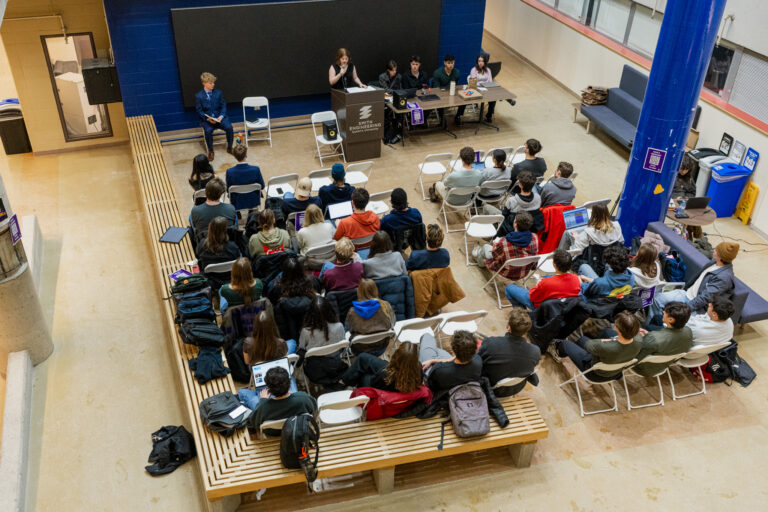
Applause filled the room as engineering students stepped forward to make their case for leading the Engineering Society (EngSoc) in the year ahead.
EngSoc’s executive debates brought together candidates for president and vice-president roles, which collectively oversee student advocacy, internal operations, finances, and services within the society. The debates gave students an opportunity to hear how candidates across executive portfolios plan to represent engineering students and guide EngSoc’s priorities ahead of the upcoming election.
Vice-Presidential Debate
The EngSoc vice-presidential debate began at 7:00 p.m. on Jan. 20 at the Integrated Learning Centre (ILC), with free pizza and a turnout of around 30 people.
The first contested debate was over the position of Vice-President (Student Affairs) (VPSA) which saw a showdown between Madeleine Provost and Panav Velpandi, both Sci ’27, and Saige Poliwoda, Sci ’28.
The relationship between EngSoc and their Design Teams was a point of contention that each candidate planned to approach differently. Discussion of this relationship took up quite a bit of the debate, and Poliwoda proceeded to remind the crowd not to believe in false rivalries [between EngSoc and design teams].
Velpandi suggested more advocacy and funding, Poliwoda promised to hear out Design Teams goals and attempt compromise before saying no, and Provost proposed a “resource side” within EngSoc for struggling Design Teams to ensure there’s someone they can talk to within EngSoc.
Velpandi also claimed that monthly meetings with all design teams would be the “most important piece of the puzzle” for better relations.
The second contested debate of the night took place afterwards between Dala Shawabkah, Sci ’28, and Hadrian Cornwell, Sci ’26, for the position of Vice-President (Finance and Administration) (VPFA).
Both candidates opened the debate with a brief summary of their platform pillars and what drew them both to become involved in EngSoc at the start of their first-years.
Cornwell emphasized that EngSoc needs stronger transition manuals and more targeted advertising, whereas Shawabkah promises to update the websites to help affiliated groups get the exposure they may need.
Afterwards, the two also discussed strained relationships with affiliated groups. If elected, Shawabkah claims she will speak with finance directors to open more workshops for design teams to offer realistic advice. Cornwell discussed working closer with design teams’ financial officers to help improve transparency, mentioning that right now, they can’t log-in and see their balances.
In both of their closing remarks, they reiterated their passion for EngSoc and encouraged students to converse with them through Instagram or in-person to ask questions and learn more.
For the final and only uncontested debate of the night, Ella Doris, Sci ’28, spoke to her hopes for the position of vice-president (operations). She opened by outlining that operations “shouldn’t be confusing” for students, and she would provide transitory documentation throughout her term to ensure knowledge doesn’t disappear.
“One issue [with operations] is students enter roles highly motivated, then when they don’t have support during the transition process, they fall off,” Doris said.
She spoke of improving virtual resources for Queen’s Undergraduate Internship Program students using social media, bettering first-year outreach with clearer advertising, and handling Clark Hall accessibility challenges by offering alternate days and locations for certain events.
In closing, Doris restated her three core pillars of opportunity, clarity, and continuity.
Presidential Debate
EngSoc presidential candidates Fin Roberts and Stephie Leitch debated their platforms during the society’s presidential debate on Jan. 21 at 7 p.m. in the ILC, with a turnout of about 50 people.
Both candidates opened by outlining campaign pillars. Roberts said his platform centres on “expanded impact, student advocacy, and future resilience,” arguing EngSoc should “serve more students,” and reduce pressures such as employment stress.
Leitch framed her platform around “support, engagement, and student empowerment,” emphasizing that her campaign is not to add more resources, but to connect students with existing supports through formalized partnerships.
When asked about obstacles to implementing their platforms, the candidates highlighted different challenges. Leitch pointed to the difficulty of building inter-faculty collaboration, saying “being a leader that asks and explains why, and is ready to hear why,” is necessary to establish lasting connections. Roberts focused on participation barriers, saying awareness for new initiatives would require outreach through emails, Instagram, and in-person engagement.
The candidates diverged on how to address EngSoc’s reputation for being insular. Roberts said it’s what his campaign is all about, proposing initiatives such as housing assistance programs and expanded professional development to “help burst the bubble.” Leitch argued engagement begins with first-year students and stressed sharing EngSoc’s community with other parts of the campus and community.
Professional development emerged as a point of agreement. Roberts said the portfolio is “absolutely underutilized,” calling for expanded workshops and long-term industry partnerships. Leitch similarly emphasized improving transparency and communication, including updating accessibility to financial information/guides and increasing in-person outreach.
Candidates also addressed representing student voices to the faculty. Leitch said bringing faculty into student spaces could help students feel heard, while Roberts argued advocacy requires understanding faculty perspectives.
In closing, both candidates reiterated their commitments to broadening EngSoc’s reach, with Roberts arguing students who are not involved should still benefit from the society, and Leitch saying she is “confident” she would be successful in the role.
***
Voting will take place online from Jan. 26 to 27, with the Elections Reveal Night on the 28th in the Atrium of Beamish-Munro Hall, with an after-party at Clark Hall Pub.
Tags
Elections 2026, EngSoc elections, EngSoc executive
All final editorial decisions are made by the Editor(s) in Chief and/or the Managing Editor. Authors should not be contacted, targeted, or harassed under any circumstances. If you have any grievances with this article, please direct your comments to eic@queensjournal.ca.