Faculty urge for more teaching support regarding international students and the rising number of AI misconduct cases.
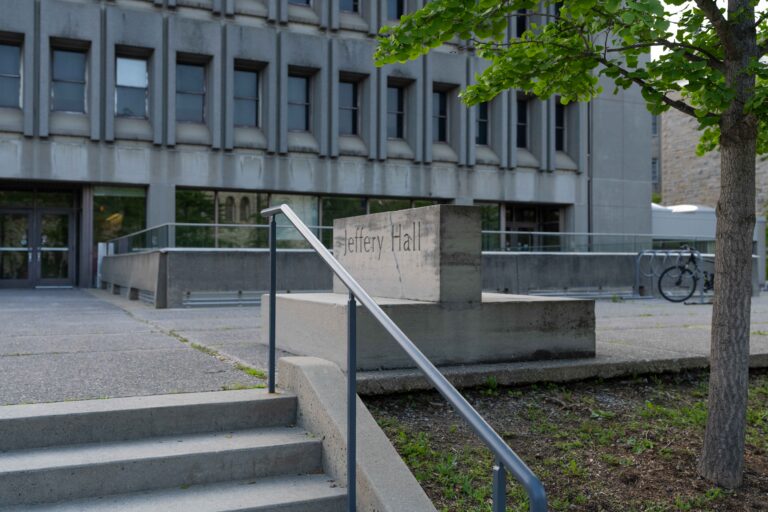
The Faculty of Arts and Sciences (FAS) hosted a board meeting on Nov. 21 in a hybrid format, where members could join virtually via Zoom or in-person at Jeffery Hall, room 128. The meeting lasted two hours and included a presentation by Interim Dean of ArtSci Bob Lemieux, the approval of 2026-27 sessional dates, updates on increased use of Artificial Intelligence (AI), and several back-and-forth discussions among faculty board members.
Jeffrey Wammes, assistant professor in the Department of Psychology, offered a tribute dedicated to the late Dr. Jonny Smallwood, a professor in the Department of Psychology. Wammes shared in his remarks that Smallwood had passed away from cancer on Oct. 24 in Scotland. Wammes also spoke highly of Smallwood’s academic contributions to the field of Psychology and that he and his work will be remembered and appreciated.
“If you were a young researcher studying mind-wandering, you basically owed it to Jonny. He was a titan in the field,” Wammes said.
Reports
After the commemorative speech, Interim Dean Bob Lemieux briefed the Faculty Board on a recent delegation to Asia, which included visits to Shanghai, Beijing, and Hong Kong.
Lemieux said Queen’s is exploring an articulation agreement, a written agreement outlining how credits are earned and transferred between schools, with HKU Space, the community college arm of the University of Hong Kong, as well as possible new agreements with other universities in China and further agreements with the University of Hong Kong regarding visual and creative arts.
He said early estimates suggest the University could see “approximately 40 to 60 students” arriving next year.
Some staff showed concern about the new agreements. Film and Media Professor Susan Lord pressed administrators on staffing and resource allocation.
“I’m just wondering if we’re going to get some modelling about how, with these fast-tracking admissions, how we’re going to sustain that [new international students] in terms of teaching support and staff support,” Lord said.
In response, Lemieux said there will definitely need to be additional support, and since these new students would be revenue-generating, the school will make sure the support is in place for teaching. Lemieux did not specify what that support would specifically be.
Associate Dean (Academic) Dorit Naaman presented a Report after Lemieux. One area of the report that was highlighted was data showing a rise in unauthorized use of generative AI. Naaman shared that although the number of academic misconduct cases remained relatively unchanged, cases involving AI rose from 13 to 40 per cent this year.
Faculty members suggested there needed to be more support when it comes to handling cases of AI misuse, as many staff were feeling like they were “left to fend” for themselves.
Associate Professor in the Department of History, Adnan Husain, urged for more support when addressing AI incidents, citing that everyone he had talked to felt “overwhelmed.”
“Instructors really feel like they don’t have much support,” Husain said.
Naaman assured that there are measures being taken to improve support, including a working group to support AI policies. She admitted that “the scope of what services should and could be expected is not very clear.”
Motions
In its most debated vote of the afternoon, the Faculty Board approved increasing the maximum number of elective units ArtSci students may take in other faculties from six to 12.
Naaman said the current limit, which was reduced from 24 units to six units in 2016 for financial reasons, has stranded dozens of students at graduation time. Noting that about 25 to 50 students each year discover they’ve exceeded the cap and must graduate with a BA general before taking the extra required ArtSci courses to graduate with their proper specialized degree.
She stressed the change effects electives only, and won’t alter breadth requirements.
Several members questioned the financial and academic implications. English Associate Professor Margaret Pappano said she wouldn’t vote for the motion because it would weaken the FAS.
“I would rather that we hire somebody in Kinesiology and that the student gets to take that course in Kinesiology,” she said.
Naaman countered that Health Sciences courses serve different pedagogical purposes and that “hiring another adjunct” wouldn’t solve graduation backlogs. She added that most faculties already cap enrolment, limiting any surge.
After the questions and debate, the motion passed 42-20.
The meeting was adjourned after a brief question period, and the next FAS board meeting’s set for Dec. 12.
Tags
AI, FAS Board, Sessional Dates
All final editorial decisions are made by the Editor(s) in Chief and/or the Managing Editor. Authors should not be contacted, targeted, or harassed under any circumstances. If you have any grievances with this article, please direct your comments to eic@queensjournal.ca.