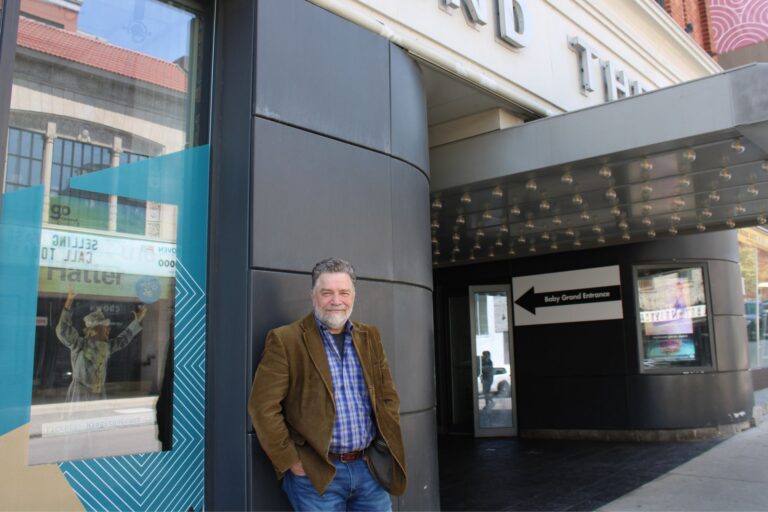
Finnegans Wake: A Dream Play re-opened at Kingston’s Grand Theatre on May 21 in honour of the 25th anniversary of the original production.
Written and directed by Queen’s Drama Professor Craig Walker, the play adapts James Joyce’s notoriously challenging novel of the same name.
As soon as the doors to the theatre are opened, audience members were immersed in the play. The room was entirely transformed, taking on the look of an Irish tavern. Sean Roberts, who plays H.C.E., was already in character, sleeping in a bed placed above the bar.
Many audience members seemed to be familiar with the play, its directors, and its actors. Before the lights dimmed, many discussed having seen the original production or having tried to read the source material in the past.
Joyce’s original novel is known for its use of multiple languages and dialects, and many readers, including Walker, have considered it a challenge. Walker explained that the book only started to make sense once it was read out loud, which inspired him to take on the adaptation.
“This works better as spoken, or heard, literature, then silently read literature,” Walker said in an interview with The Journal. Though the perplexing nature of Joyce’s language was not removed entirely, the play proved to be more digestible in a different way. Walker’s production put audience members in the same situation as H.C.E., (who spends the entire show in a dream), struggling to follow along and constantly being turned around.
“The book can be very, very entertaining, though it doesn’t always give up that pleasure immediately to everybody who reads it. But the production is entertaining immediately,”Walker said.
The jumbled phrasing, Irish accents, and the speed the actors speak at, often meant that some audience members missed a few jokes. However, Siobhán McMahon gave a standout visually comedic performance, using her facial expressions and physicality to make the entire crowd laugh.
“The best pleasure of reading Finnegans Wake comes from this odd state in which you clearly understand some things, and you don’t fully understand others, but you can take pleasure in them anyways,” Walker stated.
Walker confessed to The Journal that this was likely the most challenging text that any of them had encountered. However, despite a few slip ups over tongue twisters, the actors knew exactly how to successfully state their complicated lines.
While it isn’t exactly a musical, there are several songs throughout the play, which required all the performers to sing, dance, and sometimes even play an instrument. Walker discussed having to adapt his characters slightly in the 2026 adaptation to fit the needs of his actors. For actor Melissa Morris, he played on her musical ability and introduced an accordion to the production. Morris, who portrays A.L.P., played impressively while simultaneously dancing and acting. These small adjustments helped each actor shine, placing an emphasis on their strengths.
Like a painter, Walker stated, “you need to recognize what the tools you have can do and try to use their best effect.”
Aiden Robert Bruce and Jake Henderson, playing Shaun and Shem, were two of Walker’s most anticipated performances, and it was evident why when watching them on stage. The two actors worked well together and excellently portrayed the bickering brothers.
Kevin Head and Rosemary Doyle were both part of the original cast and returned to the stage 25 years later once more. Head returned to the role of Tom, while Doyle played Rosemary instead of her original role, A.L.P. These seasoned actors were essential to the play, bringing the experience and talent required to play these parts and support the new cast members.
25 years after its original debut, Finnegans Wake: A Dream Play remains ambitious and confounding. The play takes the novel’s theses of cyclicality and recurrence and turns them into something audiences can enjoy by leaving them with a sense of curiosity for all the things they may not understand in the moment.
Tags
Grand Theatre, James Joyce, Play, Theatre
All final editorial decisions are made by the Editor(s) in Chief and/or the Managing Editor. Authors should not be contacted, targeted, or harassed under any circumstances. If you have any grievances with this article, please direct your comments to eic@queensjournal.ca.