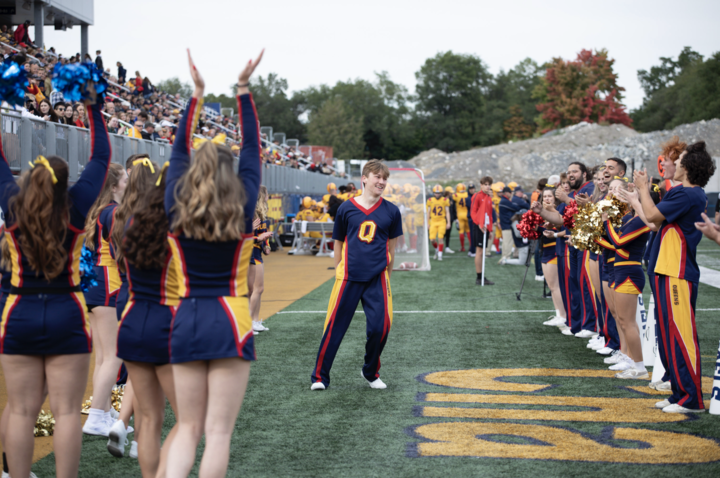
Max Aus, ArtSci ’27, never pictured himself trading cleats for cheer shoes when he arrived at Queen’s. As a second-year eager to embrace new experiences, Aus was captivated by an unexpected display during this year’s Orientation week.
“My first exposure to cheerleading was during orientation week when the cheer team put on a display for the incoming first years. They were doing flips and throwing people in the air,” Aus said in an interview with The Journal. “I was inspired by the guys on the team to try out for those reasons.”
If you’ve been to a Queen’s football game at Richardson Stadium, you’ve likely seen the spirited performance of Queen’s from the three cheer squads—the Pom Team, the Queen’s Band Cheer, and the Varsity Cheer Squad—bringing energy to the field.
Cheerleading at Queen’s is a long-standing tradition dating back to the early 20th century. The first documented Queen’s Varsity Cheer team was formed in 1940. What began as a male dominated activity across North America shifted to a “girls’ sport” during World War II, when men were drafted, and women took on more prominent roles.
However, female cheerleaders soon faced a wave of sexualization, where their physical appearance and cheer uniforms took the spotlight, overshadowing their physical talents. Despite these challenges, cheerleading has evolved into a more inclusive sport, with athletes like Aus joining the ranks.
This year, there are 19 male and 20 female athletes on the varsity team. And yet, the stigma lingers.
For many, cheerleading is still perceived as a “girl’s sport,” one with outdated stereotypes that sometimes overshadow its reality: it’s a highly demanding, physically grueling athletic pursuit. Often associated with superficiality and lack of athleticism, these misconceptions have the potential to discourage male athletes from participating in the sport.
“I love the sport so far, and my team members are great. I don’t feel any sort of pressure to conform to the normative roles of men while at practice,” Aus said. “But when I mention I’m on the cheerleading team to others who don’t know what the sport is about, it’s sometimes met with negative comments.”
Aus, who played several sports throughout his life, including football, had no prior cheerleading experience prior to joining the team. He quickly discovered cheerleading presented unexpected physical challenges.
The cheer squad performs complicated stunts and lifts that require a lot of strength and balance, specifically from the bases like Aus, who lift and support the flyers. Beyond that, the execution of tumbling and doing jumps and flips requires high flexibility, agility, and endurance.
“On my first day of tryouts, I learned how to do a backflip and how to shoulder press a flyer,” Aus said. “I realized how jacked the guys on the team are.”
Societal views of masculinity suggest that cheerleading doesn’t fit the criteria of the more “traditionally masculine” sports like football and rugby—however, contrary to stereotypes, cheerleading’s a sport that comes with high risk.
Besides the physical demands, there’s a high risk of injury when engaging in cheerleading activities. There’s always potential for accidents and mistakes, and when paired with stunting and tumbling, cheer athletes experiencing injuries like sprains, fractures, concussions, and broken bones isn’t uncommon. Although it may deceive spectators, cheerleaders are at nearly equal risk of enduring serious injuries with long-term consequences as collegiate football athletes.
A study across the United States examined high school and collegiate-level cheer and football teams, gathering data from hospital emergency rooms between 2010 and 2019. The study revealed that more than half of the catastrophic injuries reported were endured by female cheerleaders, surpassing the rate of reported injuries sustained by male football players. Though regulations have since improved safety, cheerleading remains a high risk sport.
“I actually broke my finger within my first three weeks of being on the team. I was throwing a basket, and my flyer came down hard on my finger. I was shocked to learn it was broken, but I am excited to get back into action once it has healed,” Aus said.
Each athlete’s experience is unique, but a positive, supportive team environment can help break down stereotypes and encourage athletes to exceed expectations. Male athletes like Aus inspire students to step out of their comfort zones, get involved, and try something new.
“I would say cheer is a female-dominated sport,” Aus said. “My participation as a man does challenge current gender norms. However, the team dynamics are great. The coaches are all current or former cheer athletes who know their stuff and are great leaders.”
Tags
Cheerleading, Gaels, Varsity Cheer
All final editorial decisions are made by the Editor(s) in Chief and/or the Managing Editor. Authors should not be contacted, targeted, or harassed under any circumstances. If you have any grievances with this article, please direct your comments to eic@queensjournal.ca.