Twofold Residency for Emerging BIPOC Artists, led by co-directors Berlin Reed and Jill Glatt, is helping to enrich Kingston’s art scene by offering local artists professional mentorship, access to studio and workspaces, and most importantly, time to create.
The Twofold Residency 2024 has provided four talented and upcoming artists—Sumera Khan, Alicia Udavari, Shanique Peart, and Shamara Peart— the opportunity to commit to their practices throughout the summer in collaboration with the Union Gallery and Modern Fuel Artist-run Centre.
Sumera Khan
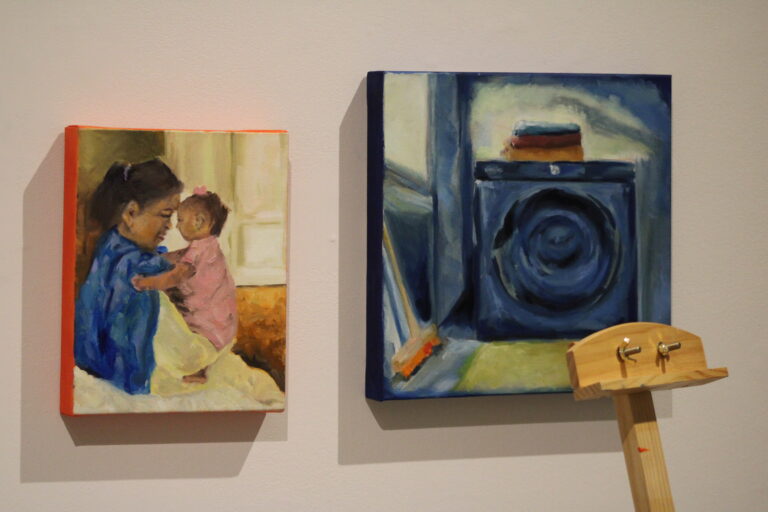
Oil-painting in an impressionist style, taking inspiration from Monet, Khan paints still lifes and interiors.
As a mother of three, it can be challenging for Khan to find time for herself and her art. Having children and less time has brought Khan to her impressionist style, as it’s a fast practice, built by quick and small strokes.
Each painting holds a personal story for Khan and an emotion that was deeply felt. Every seemingly mundane item she paints holds a deeply personal note. Throughout her residency, she continues to work on her interiors and still lifes. Khan’s artwork is inspiring as she continues to embody the spirit of an artist while simultaneously being a mother which is a demanding full-time job.
Her work is inspiring to mothers everywhere, showing anything is possible if you make it happen.
Alicia Udvari
Alicia Udvari, a Queen’s BFA ’23 graduate, mainly works with sculpture, animation, and printmaking. They draw constant inspiration from media, especially cartoons, and nature.
Throughout the residency, they’re working on a puppet and a stop motion piece that will be part of their ongoing series Little Guy, a stop motion animation which subtly depicts a chapter in their life.
Udavari’s personal philosophy with art combats the stigma that art requires expensive materials. Udavari uses their large imagination to create using various crafty materials, like wood and found object.
“I think it’s important to dismantle our idea of being an artist as spending a lot of money,” said Udavari in an interview with The Journal.
Shanique Peart
Shanique Peart is a multidisciplinary artist who works with choreography, dance, and photography. She explores movement through various styles of dance such as Hip-Hop, urban contemporary, and Afro-fusion.
Peart is working on two main projects throughout her residency. The first is a goal to create a collaborative dance film celebrating womanhood and body positivity. The second will be creating studio portraits depicting different people’s lives and their personal struggles such as mental health, dealing with neurodivergence, and more.
Dance has always resembled a second language for Peart, a translator to express feelings she could not convey using words. Dance and photography have offered Peart an opportunity to communicate what she needs to say without being ridiculed or belittled.
“Being a black woman, people are going to come to a conclusion [about me] before I even open my mouth, but you can’t deny my message when it’s portrayed through art,” Peart said in an interview with The Journal.
Shamara Peart
Shamara Peart, Queen’s English MA ’23, mainly focuses on creative writing, as well as sculptures and visual collages. She’s a scholar, currently working on publications for Acta Victoriana, Multilingual Matters, and the Edinburgh University Press.
Peart is using the residency to create her chapbook—a collection of her poetry with sculptures and visual collages that accompany the poems. Her writing represents facets of her identity as a Caribbean-Canadian woman, often toying with religious themes and symbolism.
Peart is currently exploring Afro-horror within her writing which examines the Black Canadian and minority experience using eerie stylistic choice. Peart describes suspense as that feeling as though someone is standing right behind you, watching you.
Horror literature and film revolves around the idea of what to do when you have an overwhelming force against you. That idea can speak to the minority experience in general because you’re dealing with an overwhelming societal force, said Peart.
The Twofold Residency has chosen four multifaceted and talented people who all share the goal of fostering human connection and being understood through art. Whether that be through animation, dance, painting, or writing, these four artists inspire us to think deeply about the art we’re interacting with—reflecting on how much care was placed into creating it by the artists, and how the work makes us feel.
Tags
All final editorial decisions are made by the Editor(s) in Chief and/or the Managing Editor. Authors should not be contacted, targeted, or harassed under any circumstances. If you have any grievances with this article, please direct your comments to eic@queensjournal.ca.