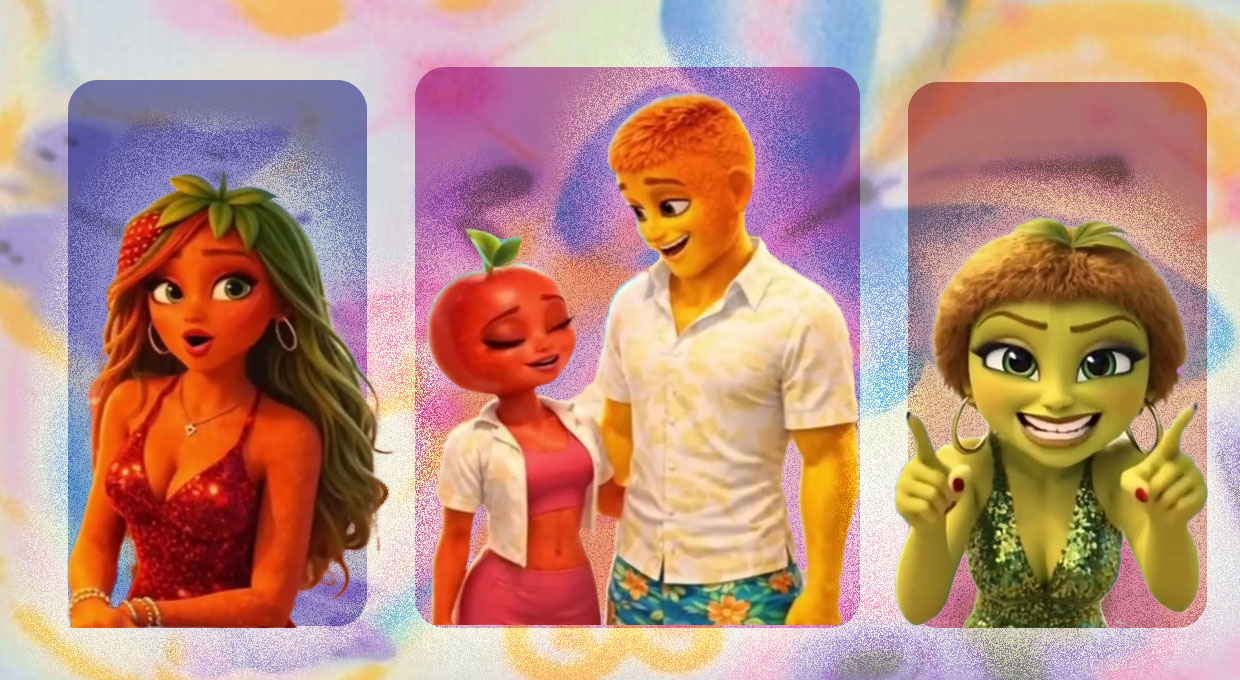
The hottest new reality series isn’t even real.
“Fruit Love Island” is a 19-episode TikTok series created by user ai.cinema021, modelled after the hit reality television series Love Island USA. While the animation style resembles Disney or Dreamworks, the plotlines follow adult relationship drama starring fruit-based characters in a “Love Island”-style reality dating scenario. As each video amasses millions of views, copycats like “Candy Love Island” by TikTok user candy.love.island began to crop up. While some denounce the content “AI slop” and point to potential social and environmental harms, social media users appear hungry for its eye-catching, juicy narratives.
With attention spans shorter than ever, social media users’ appetites for short-form content like Instagram Reels and TikToks continue to increase. A subgenre of short-form videos featuring cartoonish fruit-and-vegetable characters has emerged in recent months, often featuring absurd storylines like infidelity, loss (or gain) of wealth, secret pregnancies, and more.
The typically mature content of these videos contrasts wildly with their approachable, animated style, dangerous for children who stumble upon them unknowingly.
It’s no surprise, then, that “Fruit Love Island” videos are going viral. The real Love Island USA’s appeal is its constant churn of content; Season 7 had 36 hour-long episodes, a staggering amount of television for even the most tuned-in viewers. Love Island is also famous for filming its contestants around-the-clock from dozens of cameras, increasing the amount of juicy gossip, lovers’ quarrels, and dramatic showdowns viewers get to watch.
But the intensity of its production schedule and the novelty of its content mean Love Island USA only airs once a year. “Fruit Love Island” uses AI-generated videos to make up for Love Island’s lack; these videos are cheap, costing between USD $0.50 to $30 per minute according to one AI animation studio. They’re also constant, since their fruit-like stars don’t need the sleep, rest, and privacy human contestants (and film crews) require.
The concern of overly efficient AI entertainment replacing humans in the broader entertainment industry isn’t new. But through the “Fruit Love Island” saga, a new question emerges of how AI will shape social media going forward.
Influencer Zachary Willmore denounced the series for its environmental harms in an Instagram post from March 25. They also expressed concerns about the page’s rapid growth, comparing it to TikToker Charli D’Amelio’s seemingly overnight popularity in 2020. “The next round of influencers aren’t gonna be human,” Willmore said on Instagram.
AI content makes up 71 per cent of all social media, according to a report from March 2025. With the popularity of accounts like “Fruit Love Island,” it’s hard to see that changing. However, despite high follower counts for AI-based profiles, many social media users are speaking out against AI.
“These are not real people,” one X user wrote in response to other posts on X celebrating “Fruit Love Island.”
“If you actually like those fruit AI videos, your soul got stolen when you weren’t paying attention,” another X user wrote. Across X and Instagram, users are posting negatively in response to AI-generated content, and more pointedly, the humans who enjoy it.
And, after all, there are humans behind AI-generated content, too. Earlier this week, mass reporting on TikTok got some “Fruit Love Island” videos removed. The creator sprung to their Instagram story and posted expletive-laden tirades against their “haters,” claiming they were going to “use up all [their] water.” Seems the drama isn’t limited only to fruit-based videos.
Dozens of accounts have sprung up on Instagram since, posting their own AI-generated variations of “Fruit Love Island” and its characters, and reposting the original videos.
If there’s one thing to be said for the original Love Island USA, it’s that it couldn’t be replicated: there are no user-generated substitutes for watching your favourite couple break up after weeks of bickering. As the “Fruit Love Island” trend runs its course, one wonders what kind of content—real or AI-generated—will replace it.
Tags
AI, Fruit Love Island, Love Island, Love Island USA, reality television, Social media, TikTok
All final editorial decisions are made by the Editor(s) in Chief and/or the Managing Editor. Authors should not be contacted, targeted, or harassed under any circumstances. If you have any grievances with this article, please direct your comments to eic@queensjournal.ca.