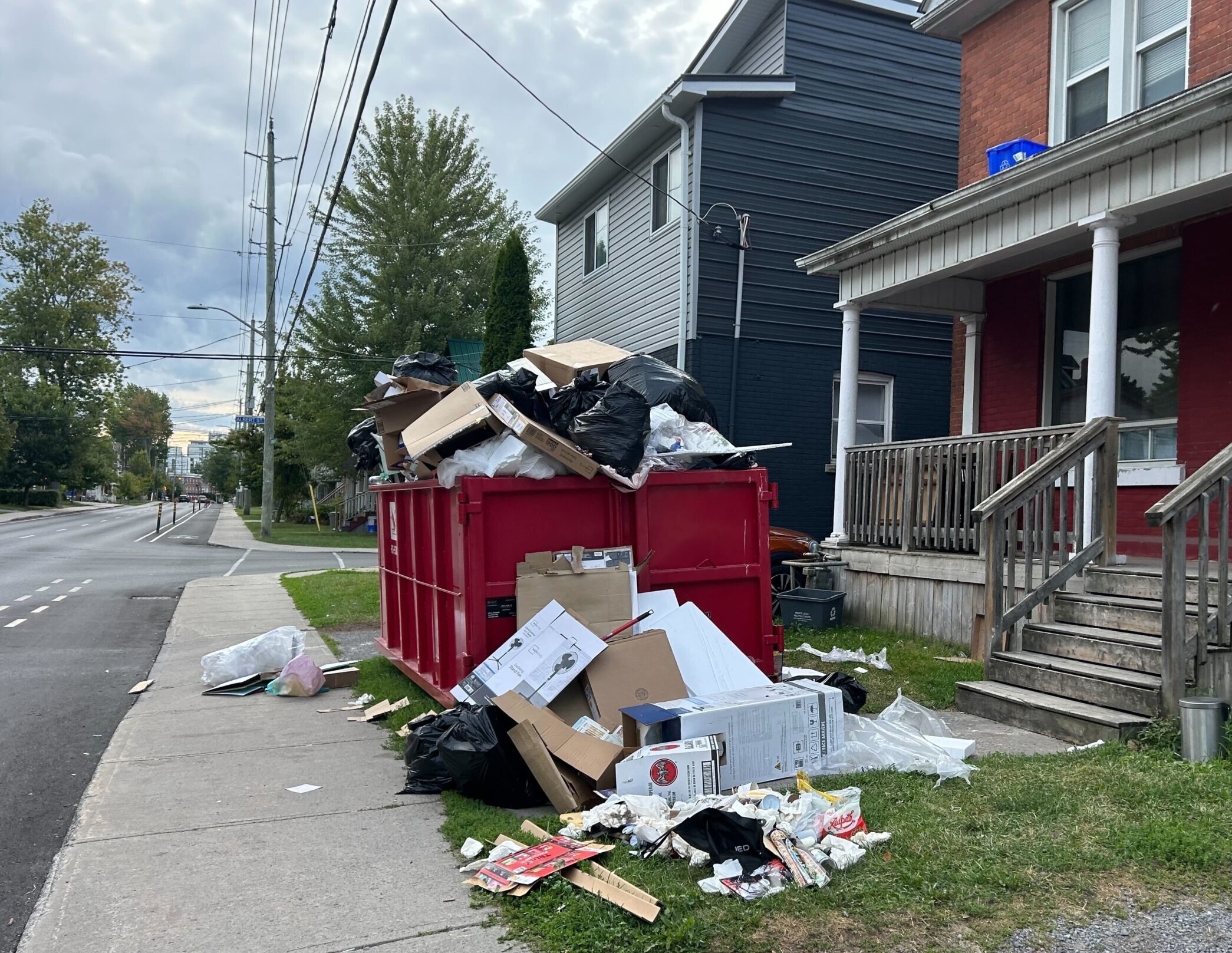
Move-in week at Queen’s brings cardboard, mini-fridge— and questions about where it all ends up.
Boxes tumbled from cars, bins overflowed, and signs for compost, recycling, and landfill dotted the parking lots during move-in weekend from August 28-30 at Queen’s.
For AMS Commissioner of Environmental Sustainability, Brooke Schmidt, the display raised a familiar concern that while visible, the University’s efforts still fall short of what’s needed.
In recent years, ‘sustainability’ has become a buzzword for institutions and corporations alike, including Queen’s, which often highlights its ‘first in Canada’ ranking on the United Nations Sustainable Development Goals (SDG).
READ MORE: Queen’s places first in Canada and sixth globally in Impact Rankings
For Queen’s, committing to sustainability means striking a balance between environmental responsibility and financial practicality. The UN World Commission on Environment and Development defines this as meeting the needs of today without compromising the ability of future generations to meet theirs—a standard that raises questions about how effectively Queen’s lives up to its own green promises. For Queen’s, committing to sustainability means striking a balance between environmental responsibility and financial practicality. The UN World Commission on Environment and Development defines this as meeting the needs of today without compromising the ability of future generations to meet theirs—a standard that raises questions about how effectively Queen’s lives up to its own green promises.
Properly managing and sorting the waste the University accumulates is one of the University’s undertakings to honour their commitment to sustainability. These initiatives are becoming increasingly relevant, as students move back into Kingston, bringing heaps of cardboard and trash along with them.
The Queen’s Waste and Recycling Services webpage states that, “minimizing landfill waste is a crucial aspect of maintaining a sustainable campus. To prioritize waste management, Facilities has made repurposing and recycling integral components of our operations here on campus.”
The task takes on particular urgency during move-in, when students arrive in Kingston with carloads of belongings that, more often than not, come wrapped within wasteful packaging.
In a statement to The Journal, The University pointed to committees and advisory groups as evidence of its planning around waste management. These initiatives include Wipe Out Waste, organized events on campus committed to raising awareness on food waste reduction and mindful consumption, and PEACH (Providing Equal Access, Changing Hunger) Market, a space on campus in the new Medical Building that distributes untouched food from Queen’s Hospitality Services to people in need.
“Sustainability is a topic of conversation as part of Residence move-in and move-out committees,” the University wrote in a statement to The Journal. “Additionally, Housing & Ancillary Services (H&A) has a Sustainability Advisory Committee with representation from different campus stakeholders to discuss efforts to mitigate waste during move-in and move-out, as well as throughout the year.”
In regard to how H&A handles the volume of waste generated, the University stated that they don’t have “specifically related” information, but that they encourage students to consider a wasteless move-in.
“Our Residence Facilities team works with the Energy and Waste Management Team in Central Facilities to manage the waste (mostly cardboard) that is disposed of during move-in weekend,” the University wrote. Lastly, the University noted how “H&A demonstrates their commitment to advancing the UN Sustainable Development Goals with the annual publication of the H&A Sustainability Framework.”
While the University highlights its waste management partnerships and sustainability frameworks, student leaders see gaps in how these efforts translate to move-in realities. Schmidt feels there should be increased discussion prior to move-in about what appliances will be supplied by the University in common areas so students don’t waste their money on appliances they will already have access to.
“I think a huge thing to improve in residences is just better facilitation of people contacting not just people that they’re sharing a room with, but their entire floor,” Schmidt said in an interview with The Journal. “How many people need to bring their own kettle? There’s a huge over consumption.”
Schmidt said she hopes to give students more guidance in making sustainable choices during move-in but lacks the necessary support from the University. “We need designated avenues of communication so that we can get support on these because as it is, [being the sustainability commissioner is] really kind of feels like a very isolating thing to do,” Schmidt explained.
In the meantime, she pointed to AMS programs like the Second-Hand Shuffle and the Collective Closet, which give students access to used clothing and appliances as alternatives to buying new.
Beyond move-in and student life programs, questions of sustainability extend into daily routines on campus—most visibly in the dining halls. “To mitigate waste, we practice small batch cooking that is informed by historical data for food production at each station and during every meal period,” the University wrote. “Reviewing historical participation, by meal period and station, from previous years (i.e., guest count, food volume consumed), allows for a projected an estimated of required number of food portions per station.”
The University explained that as the year progresses, current participation data continues to inform sustainable menu production.
“In the Fall of 2023, both main campus dining halls transitioned to a trayless dining model, following in the footsteps of Jean Royce dining hall, which had been trayless for years prior,” the University wrote. “Trayless dining was documented to show a reduction in food waste, based on changes to student behaviour, as well as a reduction in water and energy consumption.”
However, some first-years say the change hasn’t curbed waste as intended, noting that many students still pile their plates with more food than they finish.
“There is quite a bit of food waste [in dining halls], which is pretty bad, but I don’t know how you can fix that since people always take more than they can eat,” first-year student Jose Manuel Sanchez Szauer, Eng ’29, said in a statement to The Journal.
In 2023-24, in efforts to reduce food waste from dining halls, 29,089 lbs of food was donated to a local pig farmer and 42,068 pounds of food was donated to local food banks and community shelters.
“In the Fall of 2024, Sustainability Ambassadors directed their attention to support Wipe Out Waste events in the dining halls,” the University wrote. “12 of these events were held throughout the year, educating students on ways they can also reduce food waste when dining and measuring total and per-person food waste with each meal period.”
According to the University, data over the 12 events demonstrated a 10 per cent, 30 per cent, and 51 per cent reduction in post-consumer food waste at Leonard, Ban Righ, and Jean Royce dining halls, respectively.
“Lastly, leftover food suitable for donation from all campus locations is collected and distributed to the PEACH Market on campus, as well as many local community shelters and agencies across Kingston,” the University said. “Through these partnerships with Lionhearts and Queen’s Soul Food, 57,159 pounds of food was donated to these groups just last year.”
Food scraps from food preparation across kitchens that aren’t suitable for donation are distributed to a local pig farmer, according to the University, and the remainder of kitchen waste is collected through the campus Organics collection program.
Queen’s donates their organics to Tomlinson Organics in Joyceville, Ontario where it’s broken down into composting material and sold as compost for gardens and farms. Tomlinson Organics explained in an interview with The Journal, that they visit Queen’s to pick up the organic material once a week.
While Queen’s has systems in place for handling food and kitchen waste, the University’s broader waste footprint extends far beyond the dining halls—and off-campus living remains a notable gap in its sustainability planning.
Schmidt identified off-campus living as the biggest obstacle to sustainability in Kingston. “The biggest thing that’s not working is there’s a communication gap when students leave campus, where they’re just not understanding how waste works and the importance of it for the value of their community, for the value of the environment, and for the value of them not paying community fines,” Schmidt explained.
While Schmidt points to off-campus living and a lack of communication as major hurdles, the City of Kingston takes a different view. In a statement to The Journal, the City wrote they don’t track the environmental impact of the waste surge during move-in, making it difficult to measure Queen’s contribution. Instead, the City didn’t describe the week as a problem, but rather a predictable spike in cardboard and styrofoam.
Yet during move-in, a walk through the University District reveals streets lined with garbage, leading some students to describe the area online as ‘a mess’ during orientation week. The culprit of the exposed trash, Schmidt boils down to students’ lack of experience with independent waste management. The waste often becomes visible in the University District, where move-in and move-out periods leave sidewalks crowded with bags of garbage and misplaced recycling.
While off-campus streets show the challenges Schmidt highlights, on-campus waste management presents a very different picture. Szauer, for example, was impressed with what he observed: “I didn’t notice garbage accumulating, everybody threw it out. The waste disposal system is good.”
The City of Kingston doesn’t provide additional resources or operational adjustments to handle the surge in student-related waste at the start of the term. In most cases, Queen’s waste falls outside the municipal recycling system and isn’t directly the City’s responsibility. Despite this, students rarely hire private junk removal services. During the most recent move-in weekend, MJs Garbage & Junk Removal—one of the closest services to campus—wrote in an statement to The Journal that they served only four student clients over the most recent move-in weekend.
With limited external support for managing move-in waste, the University places responsibility on students to follow its recycling guidelines to prevent contamination and maintain effective waste sorting on campus.
According to their webpage, the University encourages all students, both on and off campus, to consult the waste management manual to ensure proper recycling. According to University guidelines, if a recycling container contains more than 10 per cent garbage, the entire container is considered contaminated and must be sent to waste, making careful sorting important for maintaining effective recycling on campus.
Schmidt is working to clarify these waste distinctions within AMS organizations. She told The Journal that Common Ground Coffeehouse (CoGro) is developing signs for its recycling and compost bins that feature images of the specific food and drinks sold there, and the café is also moving toward using more compostable packaging.
While initiatives like CoGro’s aim to make waste sorting clearer, the overall effect of such efforts on campus sustainability remains uncertain.
How these efforts translate into tangible impact on campus and beyond remains an ongoing question for students, administrators, and the wider Kingston community.
Tags
Environment, move-in, Sustainability
All final editorial decisions are made by the Editor(s) in Chief and/or the Managing Editor. Authors should not be contacted, targeted, or harassed under any circumstances. If you have any grievances with this article, please direct your comments to eic@queensjournal.ca.