In an article published Sept. 18, the Globe and Mail considered the status of Queen’s University’s reputation as an academic institution. The piece, titled “Crackdown on partying at Queen’s threatens university’s raucus reputation” focuses on the university’s negotiation of alcohol-related issues.
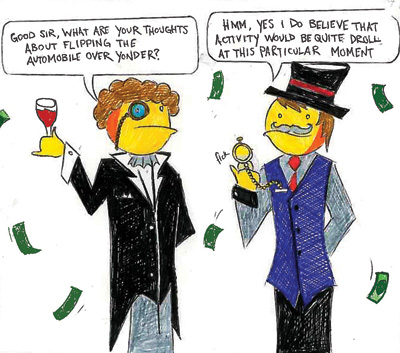
Opening on Aberdeen St.—calling it the “party nexus of Canada’s party university”—the article describes a local landlord eyeing a number of luxury cars parked curbside, and quotes him calling Queen’s students “a bunch of spoiled rich kids who don’t want to be seen with a garbage bag.” Car ownership is far from common among Queen’s students. Among those with said form of transportation, luxury cars are the exception—not the rule. This opening sets the tone which dominates the article—not a tone of hostility, but rather one in which the least-representative elements of the Queen’s community are implicitly set up to stand for the whole.
It isn’t that the Globe’s article makes baseless accusations. The real problem is that the piece fails to contextualize the facts.
It’s nearly impossible to argue that Aberdeen street is not the party nexus of Queen’s. Referring to Queen’s as the party university of Canada is a separate issue.
The article appears to be sensationalizing the party reputation it claims to be describing. Though the Globe firmly states that the 2005 Homecoming street party gave Queen’s students’ reputation a “tinge of recklessness,” little mention is made of any recent problems on a similar scale. The article even points to the docile atmosphere in the student neighbourhood, describing students drinking at “a swift but polite pace.”
In fact, the Globe article focuses largely on the unsanctioned 2005 Aberdeen Street party, and the recent two-year cancellation of Queen’s official Homecoming festivities—a far cry from the vague “crackdown” mentioned in the headline. While the article refers to the university’s cancellation of Homecoming festivities—which it later mistakenly lists as lasting indefinitely—it fails to distinguish between the university-sanctioned Homecoming weekend, and the street party unaffiliated with the university.
These distinctions seem like splitting hairs to a Queen’s student or Kingston resident, but for someone with no knowledge of the university’s stance on the Aberdeen Street party, it sounds as if Queen’s itself condoned an event that left its “reputation in tatters.”
An aside that “the tipsy crowds still come” to the party in September completely overlooks the effective steps that Queen’s and the city of Kingston took to combat the party last year, which saw a drastic reduction in attendees.
Reference to the familiar “Slosh the Frosh” style parties that occur following orientation week is equally vague. While mentioning that Queen’s senate officials plan to do away with these events—due to their promotion of binge-drinking—the article failed to indicate that these events are not university-sanctioned. For those who have no familiarity with Queen’s or the Kingston community, an article like this effectively dictates their perception of the university—a perception long on hype and short on facts. The Globe article sacrifices the best—and largest—parts of the Queen’s community for the sake of documenting the worst—and the smallest. A number of slovenly houses on Aberdeen St.—however offensive—do not represent the majority of student housing, nor is the average Queen’s student likely to glorify living in a pigsty.
As for the street party, Queen’s students aren’t the only ones in attendance. A large portion of those arrested have been from other schools in the area and across Ontario.
It’s odd that the Globe avoids directly acknowledging the reality that Queen’s Vice-Principal John Pierce indicates in the concluding paragraphs of the article—that alcohol-related issues are a problem that every university must deal with. While Queen’s may be a special case due to the density of its student housing—a vital part of what enables street partying in the first place—this is a unique symptom of a common problem.
One quoted student specifically disavows the raucous reputation suggested in the article. Another expresses the same practical view as Vice-Principal Pierce, stating, “Students will drink no matter what you do.” Individuals don’t represent the Queen’s community as a whole. But why couldn’t the Globe find one student willing to act as poster-child for the so-called “party university”?
It’s tempting to react to the Globe’s article with hostility simply because it depicts Queen’s students as luxury-car driving snobs—or, more poetically, as “the blondes of Canada’s university community.” In fact, the real issue is that the headline promises a crackdown at a party university, and delivers neither the former nor the latter.
The faculty, students and alumni of Queen’s University don’t want to be associated with binge-drinking and buffoonery. By re-hashing events from five years in the past, the Globe article has simply ensured that it will take as long as possible for the memories of that distasteful evening to fade.
All final editorial decisions are made by the Editor(s) in Chief and/or the Managing Editor. Authors should not be contacted, targeted, or harassed under any circumstances. If you have any grievances with this article, please direct your comments to eic@queensjournal.ca.