
Boxes, posters, and decades of memories filled The Journal house one last time this July, as Volume 153 staff packed up the red brick home that had long been the heartbeat of student journalism at Queen’s.
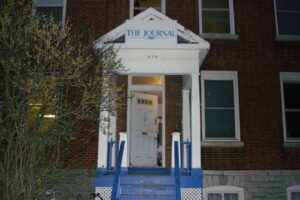
Given to The Journal as a temporary newsroom in 2006, the red brick house at 190 University Ave., quickly became the heartbeat of Canada’s oldest student newspaper. Nearly twenty years later, the paper is moving to a new office room A620 of the Queen’s Centre—a shift that, for alumni, feels like more than a change of address. To past Journal staff, leaving the house symbolizes not just the end of an era, but echoes the broader struggles facing student journalism nationwide.
Now, as the University cites accessibility needs and long-term planning, the house that once nurtured generations of student journalists is being repurposed for student housing.
According to the Director of Campus Planning and Real Estate, Tony Gkotsis, the University plans to convert 190 University Ave., into student housing as a part of a five-year strategy to return university-owned houses to residential use.
“Many older houses are not-barrier free and aren’t well-suited for office or program functions, so restoring them for residential purposes helps ensure campus spaces are inclusive and accessible,” Gktosis wrote in a statement to The Journal.
However, alongside inclusive and accessible initiatives pushing for the move, Queen’s is also facing backlash for its poor mismanagement of money, with specific underfunding towards various arts programs.
The University has faced criticism for limited support of arts programs, including journalism, at a time when print media is increasingly challenged by digital platforms. Volume 152 Editor in Chief Allie Moustakis, ArtSci ’25, noting in an interview with The Journal that “student journalism is a microcosm of the larger industry.”
While industry-wide pressures loom large, alumni are also focused on the immediate impact of the move—particularly the size and visibility of the new space compared to the distinctive house on University Ave.
Some alumni, including Volume 142 Editor in Chief Nick Faris, ArtSci ’15, have voiced concerns about the size and location of the new Queen’s Centre office, noting it lacks the visibility of the red-brick house with its unmistakable blue Journal sign.
In the initial 2005 Memorandum of Understanding (MOU) between The Journal, the Alma Mater Society (AMS), and Queen’s University, it was agreed that “the size of a permanent space in the Queen’s Centre The Journal may occupy in the future will be no less than the same amount of space that was agreed upon when The Journal consented to move to 190 University Ave approved in June 2005.”
Despite this formal MOU, Journal alumni wonder if this agreement will be recognized.
“Alumni will scrutinize what the AMS and University do next, expecting they’ll honour their written agreement—applicable once the house is vacated—to provide the newspaper with a sizeable, independent new working space,” Faris said in an interview with The Journal.
For generations of staff, the house was more than an office—it was where pages were laid out, stories were uploaded, and a newsroom buzz came to life. Today, much of that work could be done virtually, as many newsrooms have shifted online; The Kingston Whig-Standard, for instance, closed its Cataraqui St., office after Covid-19, while other student publications like HerCampus operate entirely in digital spaces.
However, Moustakis argues that a switch to a digital newsroom would negatively impact the human side of the paper. “Just because [online newsrooms] are a trend in the broader industry, you don’t want early career or student journalists starting on that,” Moustakis said. “The collaboration that in-person newsrooms inspire and the connections they foster go a long way in a lot of people’s careers and lives.” .
Queen’s relocation of The Journal to a much smaller space isn’t the first time this has happened to a Canadian student publication. In 2015, Waterloo’s student newspaper, The Imprint, was given four months to move from the space they’d occupied for 37 years. As a solution, the newspaper was offered a significantly smaller space—a story similar to The Journal’s.
READ MORE: The Imprint deserved better.
Just as space constraints reshaped Waterloo’s student paper, alumni fear The Journal’s move could also shrink its campus presence.
Moustakis worries losing the house will reduce The Journal’s visibility, noting its blue sign and newsbox drew student attention, where she explained how she first discovered the paper this way, but in the new office, students would need to seek it out rather than stumble upon it.
“Being unable to walk past the house with the blue Journal box outside, not being able to see that or have that kind of on-campus visibility or presence, I think that’s going to change how many students interact with The Journal on a daily basis,” said Moustakis.
However, administrators see the move as a potential benefit in visibility for The Journal, where Gkotsis emphasized that the relocation may attract more students. “The Queen’s Centre and JDUC together serve as hubs of student life, and The Journal’s new space offers barrier-free access and flexible design to support student engagement and evolving needs,” Gkotsis said.
Journal alumni, however, contend that maintaining distance from other AMS operations is essential to protecting the paper’s independence, and worry the new location could blur those boundaries.
“The house has been a safe space for us, for as long as it’s been there. I don’t know what’s to come next for QJ, but I truly believe the geography of the house, namely being separate from AMS and other Queen’s organizations, has helped us maintain journalistic integrity and a sense of objectivity away from the rest of the school,” Editor in Chief of Vol. 141, Janina Enrile, ArtSci ’13, said in an interview with The Journal.
Volume 140 Editor in Chief, Jake Edmiston, ArtSci ’12, echoes similar sentiments about the importance of physical distance expressed by Enrile. “There was something about being removed from campus, and the administration and the AMS, even if they were just across the street,” Edmiston said in an interview with The Journal. “Something about it made you feel marooned, in the best possible sense. We’re on our own and I think that really helped give everybody who worked there a sense of ownership over the whole enterprise.”
Alumni additionally worry that relocating into a busy student centre could discourage students from coming forward with stories, fearing their anonymity may be harder to protect in such a public setting.
“The proximity [to other student organizations] is concerning because when you’re in such a fully located spot on campus where people can see who comes in and out of the offices, how do you feel comfortable going to the campus newspaper and telling them your concerns, especially about a topic that’s relatively sensitive?” Moustakis said.
Edmiston said he makes a point of driving by 190 University Ave. whenever he comes into town. “I hope the students who come through in the coming years will feel the same way about the new space you’re moving into,” Edmiston said.
Despite their concerns, alumni express they ultimately want a space that respects the legacy of The Journal while supporting the work of current and future staff.
Given the demands of running The Journal, Faris hopes the University will provide a new space that meets the paper’s needs. While the move may feel daunting, it’s just the next chapter for a newspaper that has relocated many times throughout its history. Faris emphasized the house’s role in shaping student journalists, saying, “The Journal runs on camaraderie, commitment, and competence—qualities that were palpable during marathon press nights, launching careers and keeping students informed.”
Yet, The Journal’s history of relocations stretches back decades, each new house marking a chapter in the paper’s story.
In the fall of ’90, The Journal moved to 272 Earl St.,—a house a little less red found at at the intersection of Earl and Aberdeen.
 ‘The Journal’ house at 272 Earl in 2006. PHOTO SUPPLIED BY: Flickr Webpage
When examining Volume 117 archives of The Journal, 272 Earl St. was a building purposely constructed for the paper in the summer of ’90, funded by The Journal itself. Its location, however, put it directly in the path of the University’s expansion plans. In 2006, the paper was displaced when the building was demolished to make way for the Queen’s Centre—a combined athletics and recreation complex expected to take more than a decade to complete.
To honour the beloved Earl house, staff held a lively farewell party, showcasing The Journal’s enduring appreciation for community and shared space across generations.
 ‘Journal’ staff and alum at farewell house party. PHOTO BY: Volume 126 Photographer Tom Purves, Sci ’99.
Photos from a Flickr account captured the farewell party in 272 Earl that welcomed staff and alumni to say goodbye to the house prior to its demolition. Staff and alumni gathered in the press room and bars after saying goodbye to the house that hosted them for over 15 years.
Those farewell celebrations at 272 Earl echoed traditions carried on at later Journal homes, including the 190 University Ave., house. Edmiston remembers several similar parties being held at the 190 address at the end of the year.
“[My friends] were having a bonfire and looking for stuff to burn. So they asked to take stacks of The Journal,” Edmiston said. “To my friends, they were just old newspapers. But to everybody else at that party, they represented a year of hard labour. The whole staff suddenly turned vicious, myself included, and we chased the brutes out the front door.”
Bidding adieu to an important space has served as a reminder to members of The Journal, old and new, to appreciate the student newspaper’s rich and diverse history. “It feels really special to have so many generations of editors tied to the same location and the same experiences,” Enrile said.
A bountiful history surrounds the paper neither Journal staff nor Queen’s administration can ignore. “The University recognizes The Journal’s long legacy at Queen’s and the importance that The Journal house has played over the years,” Gkotsis said.
As The Journal moves onto a new chapter, saying goodbye to the old house on University Ave., has served as a reminder to Journalalumni of all the cherished shared memories that the space has been witness to. “I’m sure a lot has changed in the last 11 years, but it was a comfort to know that this falling-apart house was still there holding the next generation of Journal kids, who are somehow wrestling with the same version of InDesign as I did,” Enrile said. “I’m just glad that 190 University did the same for others as it did for me.”
The character and charm that the house exuded was a result of generations of creativity and passion that won’t be erased with a simple move. “When I think of The Journal, I think of The Journal house. But the same thing can be said about the people. When I think of The Journal, I think about the people. The people are what make The Journal—not the office, and not the walls,” Moustakis said.
As staff adjust to the new space, it’s worth noting that those who moved into 190 University Ave. in 2006 faced similar challenges, ultimately shaping a home for generations of student journalists. Now, The Journal begins its next chapter in the Queen’s Centre, ready for the work and stories ahead.
Corrections
A previous version of this story wrongfully stated that 272 Earl St. was a residential house converted into a student newsroom in the summer of 1990. In fact, it was a building purposely constructed for The Journal, funded by the paper itself.
Incorrect information appeared in the August 29 issue of The Queen’s Journal.
The Journal regrets the error
Tags
‘Journal’ alumni, AMS, The Journal
All final editorial decisions are made by the Editor(s) in Chief and/or the Managing Editor. Authors should not be contacted, targeted, or harassed under any circumstances. If you have any grievances with this article, please direct your comments to eic@queensjournal.ca.