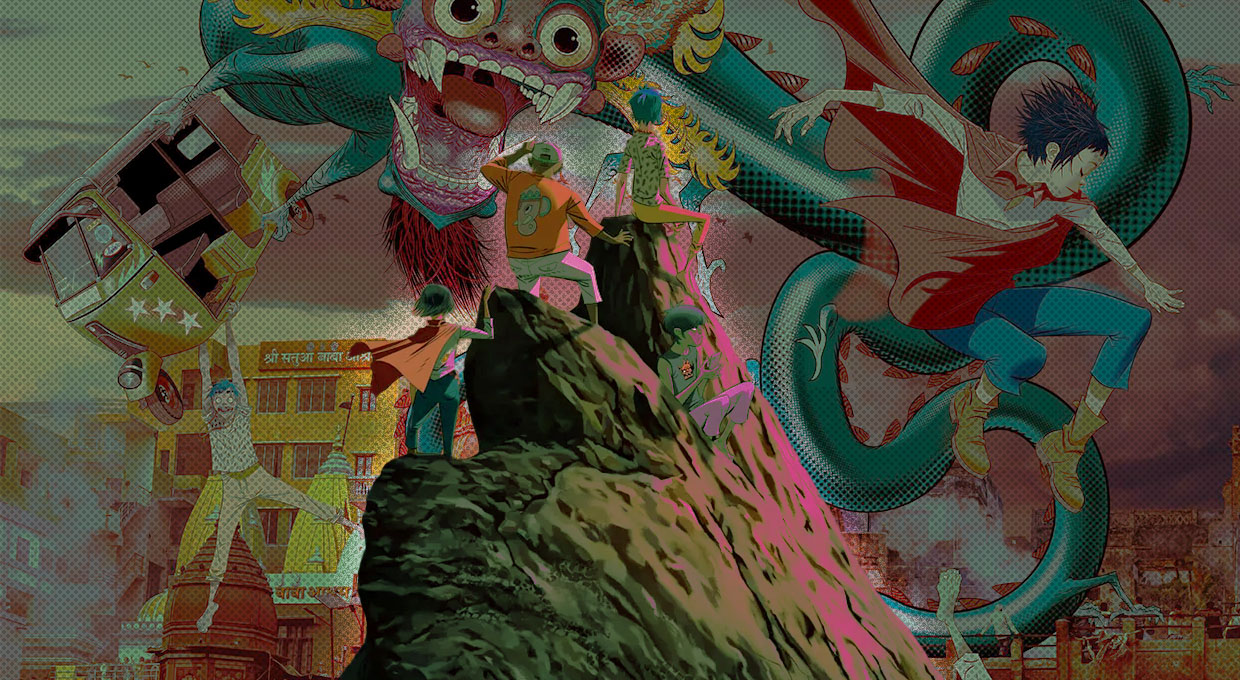
As artificial intelligence (AI) increasingly reshapes music and visual art, Gorillaz’s newest album The Mountain arrives as a reminder that even a “virtual band” can remain deeply human.
For more than two decades, Gorillaz have existed in a productive contradiction. The band itself is fictional, its four members consisting of animated characters created by artist Jamie Hewlett. Yet the music has always carried unmistakable emotional authenticity, brought to life by vocalist Damon Albarn. On The Mountain, the group’s latest album, that paradox becomes central to its artistic power.
Released earlier this year on Feb. 27, The Mountain marks a reflective turn for the virtual collective. Always known for genre-blurring experimentation, Gorillaz here lean into cohesion, crafting an album that feels like a spiritual journey. Drawing inspiration from Indian classical music alongside electronic and psychedelic sounds, the record meditates on grief, memory, and transcendence.
The opening title track immediately establishes the album’s tone. Instrumentation of bansuris and sitars builds slowly for four minutes before Albarn and posthumous-collaborator Dennis Hopper’s layered vocals close the track. Rather than chasing the radio-ready hooks of their most popular songs, like Feel Good Inc., the piece prioritizes atmosphere, bringing listeners into a contemplative space rarely occupied by mainstream pop releases.
“The Happy Dictator” emerges as an early highlight, pairing a haunting chorus from legendary new-wave duo Sparks with Albarn’s wry lyrics delivered in a monotone cadence. Set against an infectious electronic beat, the song creates a satirical juxtaposition between dark subject matter and bright sound, reminding listeners of Gorillaz’s long-standing political messaging.
Another standout is “Damascus,” which blends electronic beats with global musical influences. The track features Syrian pop singer Omar Souleyman alongside hip hop legend Yasiin Bey (formerly Mos Def) in one of the most expansive, hard-hitting highlights of the album.
Yet The Mountain is more than just an album release. Accompanying it is a companion short film, The Mountain, the Moon Cave and the Sad God, an eight-minute hand-drawn animated work developed over 18 months. The film stitches together songs from the album into a surreal narrative, continuing the band’s tradition of integrating music and visual storytelling into a single artistic environment.
The choice to rely on painstaking hand-drawn animation feels particularly significant. At a moment when AI-generated art is rapidly proliferating online, Gorillaz offer an alternative model of digital creativity rooted in human collaboration rather than automation.
Gorillaz have always been a “virtual band,” but their virtuality has never meant artificiality. Hewlett’s illustrated characters function as narrative vessels, while Albarn’s songwriting, singing, and musical production give the group’s projects emotion. The illusion enhances the art without replacing the artists behind it.
This distinction becomes increasingly relevant as AI-generated musicians and algorithmically composed songs enter the cultural mainstream. In contrast to these AI artists, Gorillaz remain committed to artistic labour with musicians performing together, artists drawing frame by frame, and the band’s creators shaping a fictional mythology through nearly 30 years of continuous storytelling.
In a pop culture era seemingly fascinated with machines making our art, Gorillaz demonstrates that virtual artistry can still centre human imagination, vulnerability, and collaboration. The band may not exist in the physical world, but the creativity behind it undeniably does, and on The Mountain, that humanity is louder than ever.
Tags
Album, Album review, Damon Albarn, Gorillaz, Music, The Mountain
All final editorial decisions are made by the Editor(s) in Chief and/or the Managing Editor. Authors should not be contacted, targeted, or harassed under any circumstances. If you have any grievances with this article, please direct your comments to eic@queensjournal.ca.